Tax revenue estimated at KRW 431 trillion, up 15.4% in a year
Booming stock market drives corporate and securities tax surge
Lee: “Funds should be used to develop new growth engines”
Investment via sovereign wealth fund to launch in the second half also under review
There is analysis that, boosted by the semiconductor super cycle (boom) and a buoyant stock market, this year’s national tax revenue could exceed the government’s projection made two months ago by more than KRW 16 trillion.
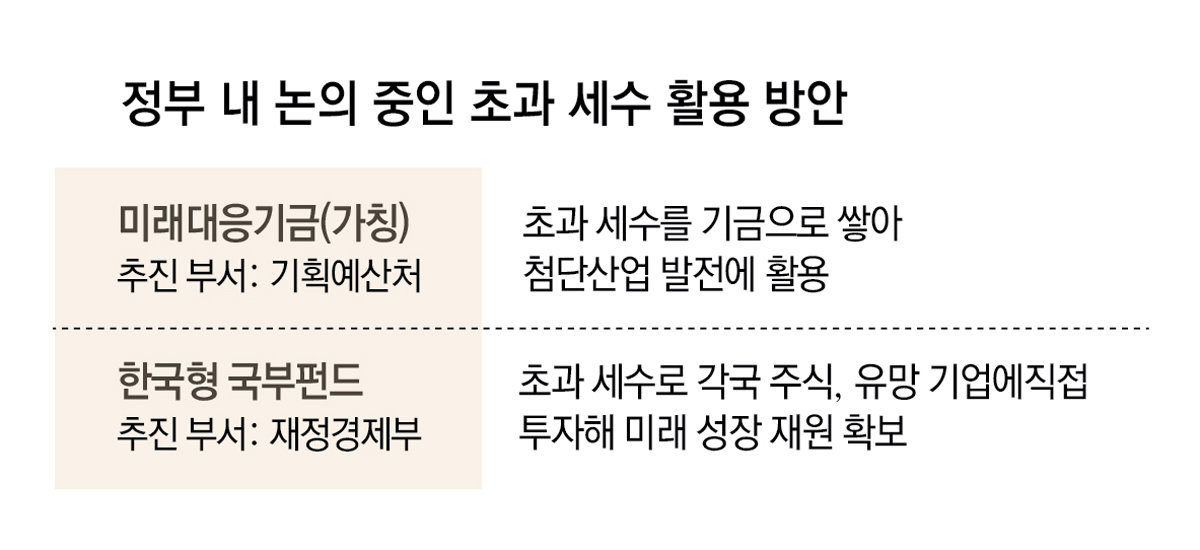
The government is reviewing ways to use the increasing excess tax revenue as funding for future industry investment, departing from the existing practice of allocating it to national debt repayment or supplementary budgets (extra budgets). Leading options under consideration include creating a new “Future Response Fund” (tentative name) to support artificial intelligence (AI) and high-tech industries, or making additional contributions to the Korean-style sovereign wealth fund that will be launched in the second half of the year (July–December).
● Securities transaction tax revenue quadruples
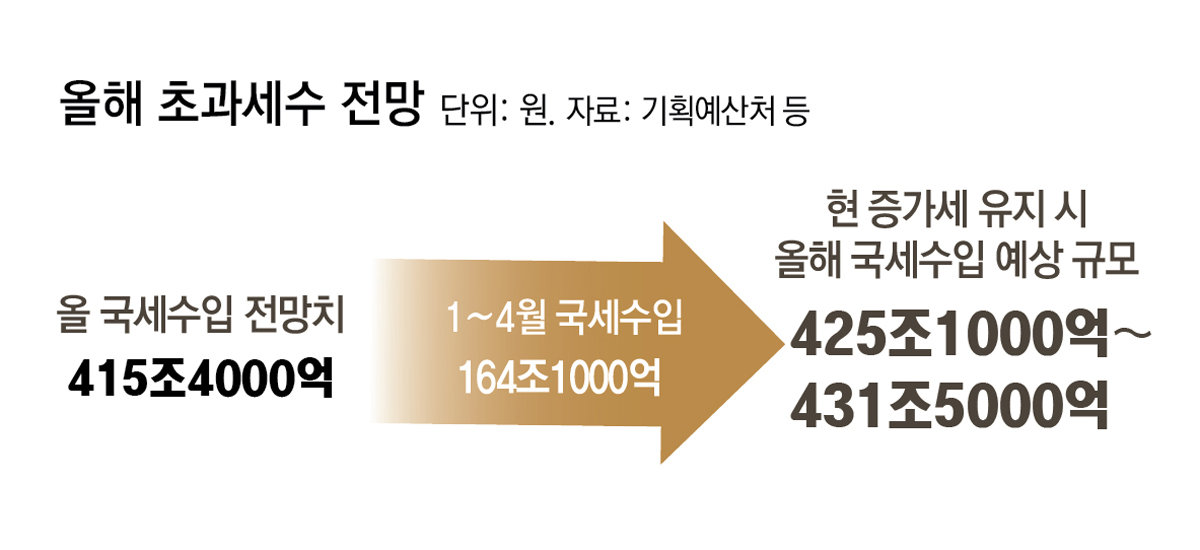
According to the Ministry of Planning and Budget on the 14th, cumulative national tax revenue for January–April this year was KRW 164.1 trillion, an increase of KRW 21.9 trillion (15.4%) from the same period a year earlier. If this pace continues through year-end, total national tax revenue for 2026 is estimated at about KRW 431.5 trillion, up KRW 57.6 trillion (15.4%) from last year’s actual revenue of KRW 373.9 trillion. This is KRW 16.1 trillion more than the government’s estimate of annual tax revenue (KRW 415.4 trillion) made at the time of the April supplementary budget this year.
Even under conservative assumptions, the scale of excess tax revenue is expected to be substantial. If it is assumed that tax revenue through April this year was collected at the same level as the average April collection progress rate (38.6%) over the past five years, national tax revenue for 2026 is projected at around KRW 425.1 trillion. This is still about KRW 9.7 trillion higher than the government’s projection.
The semiconductor boom and the strong stock market are driving the increase in tax revenue. Corporate tax collected between January and April this year amounted to KRW 39 trillion, up KRW 3.2 trillion (8.9%) from a year earlier. With semiconductor companies such as Samsung Electronics and SK hynix posting record earnings, and interim prepayment of corporate tax scheduled for August, there is a high likelihood that tax revenue will continue to rise in the second half as well.
The securities transaction tax has also emerged as a key item driving this year’s increase in tax revenue. Securities transaction tax revenue for January–April was KRW 4.1 trillion, four times the KRW 1 trillion collected in the same period last year. It showed the largest increase among all tax items. Over the same period, income tax revenue rose to KRW 44.7 trillion, up KRW 5.9 trillion (15.2%), supported by higher performance bonuses and increased real estate transactions.
● Future Response Fund and Korean-style sovereign wealth fund in the spotlight
Attention is now focused on how the excess tax revenue will be used. Under the current National Finance Act, excess tax revenue is first applied to settlements of local allocation tax and local education finance grants, and then used for contributions to the Public Fund Redemption Fund and repayment of national debt. From this year, however, full-scale discussions are under way on using excess tax revenue as funding for future industry investment, breaking away from the existing approach. The government is expected to consider amending the National Finance Act if necessary.
President Lee Jae-myung also expressed a similar view at a press conference on 8 June marking the first anniversary of his inauguration. President Lee said, “I believe excess tax revenue should be invested with the greatest priority in ways that benefit future generations and enhance the Republic of Korea’s growth potential,” adding, “To give a concrete example, it means discovering new growth engines such as semiconductors.”
He drew a line against the view that prioritizes repayment of national debt. President Lee stated, “Some people think that because national debt has increased a little, we should use the excess tax revenue to pay it back and that having no debt is best, but having no debt is not an absolute truth.”
The leading option being discussed inside and outside the government for using excess tax revenue is the creation of a Future Response Fund. The idea is to establish a separate fund and use it to secure future growth engines in areas such as AI, semiconductors, and energy transition. The Ministry of Planning and Budget is expected to flesh out related discussions around late August, when it submits next year’s budget proposal to the Cabinet meeting.
The Korean-style sovereign wealth fund, scheduled to be launched in the second half of the year, is also one of the leading destinations for excess tax revenue. The government had originally planned to create a sovereign wealth fund of about KRW 20 trillion by utilizing state-owned enterprise shareholdings and stocks paid in kind for inheritance tax, but it is now also discussing injecting excess tax revenue as additional funding. Deputy Prime Minister and Minister of Finance and Economy Koo Yun-cheol recently stated, “We will accumulate (excess tax revenue) as resources in the sovereign wealth fund and create a virtuous cycle in which investment returns are reinvested as growth capital.” However, it has not yet been decided whether all excess tax revenue will be allocated to the Future Response Fund or the sovereign wealth fund.
Kim Sang-bong, professor of economics at Hansung University, advised, “If funds are to be raised for future growth engines, a sovereign wealth fund, where a committee of private-sector experts can make investment decisions relatively freely, has far greater advantages than creating a new fund with rigid operating rules,” adding, “To secure fiscal space, a portion of the excess tax revenue should be used to repay national debt.”
ⓒ dongA.com. All rights reserved. Reproduction, redistribution, or use for AI training prohibited.
Popular News