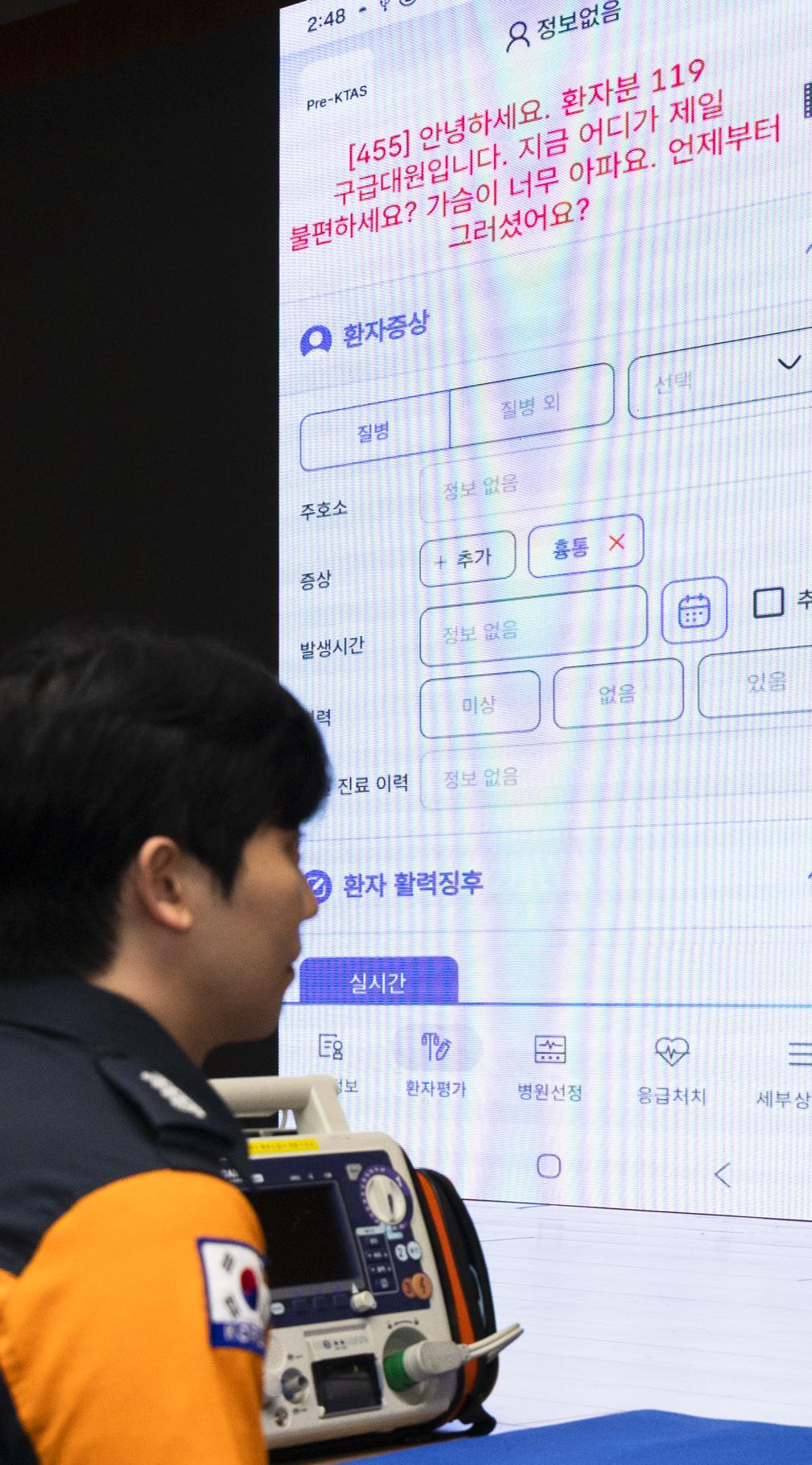
At the “Emergency Medical Artificial Intelligence Transformation (AX) Technology Demonstration” held at Kyungpook National University Hospital in Daegu on the 12th, when a virtual emergency patient told a paramedic “My chest hurts,” the AI automatically entered “chest pain” as the symptom and prepared the ambulance report. Provided by the Ministry of Health and Welfare.
On the 12th, at the auditorium of Kyungpook National University Hospital in Daegu. An emergency patient clutching his chest told the 119 paramedic, “I feel nauseous and short of breath. I am taking hypertension medication,” describing his symptoms and medical history. The paramedic immediately measured the patient’s blood pressure, pulse, and oxygen saturation. Artificial intelligence (AI) then automatically entered the patient information and conversation details, including “chest pain,” “arm numbness,” and “hypertension,” and categorized the patient’s severity level (1–5) as “Level 2, urgent.” When the paramedic subsequently measured the patient’s electrocardiogram, a message appeared on the monitor: “[Time-Sensitive Patient Alert] Patient suspected of myocardial infarction.”
AI’s role did not end there. When the paramedic searched for a hospital to which the patient could be transported, the system recommended Kyungpook National University Hospital, Daegu Catholic University Hospital, and Daegu Fatima Hospital in that order as the optimal destinations. AI analyzed each hospital’s emergency room crowding, transport distance, and availability of medical resources to identify the facilities best able to save the patient. When one of these hospitals pressed the “accept” button, the patient data were transmitted to that hospital, which immediately began preparing for surgery.
This was not an actual situation but a scene from the “Emergency Medical AI Transformation (AX) Technology Demonstration.” The Daegu–Gyeongbuk smart transport system introduced that day is the “SAVE-R” platform, developed by Kyungpook National University Hospital since 2024 through the Ministry of Health and Welfare’s research and development project “Korean-style ARPA-H.” It is a system that supports decision-making by paramedics and medical staff by introducing AI throughout the entire process, from severity assessment and hospital selection to emergency room treatment.
Experts expect SAVE-R to reduce emergency patient transport times by an average of about 20 minutes. This is because it can minimize confusion in triage and reduce the time wasted calling multiple hospitals. Ryu Hyun-uk, professor of emergency medicine at Kyungpook National University Hospital, said, “If incomplete information about a patient is conveyed, it is difficult for the emergency room to decide whether to accept that patient,” adding, “This platform identifies the hospital that can provide the best treatment to the patient in the shortest time, thereby improving survival chances.”
Unlike the existing system, each hospital can check other hospitals’ emergency room resources in real time. This means medical staff decide whether to accept a patient while understanding the overall emergency room capacity across the region. Park Jung-hwan, director of the Health and Medical Data Promotion Division at the Ministry of Health and Welfare, explained, “If another hospital is in a more difficult situation, a facility can make an altruistic decision such as ‘We should take this patient.’” SAVE-R will be installed as early as next month in six regional and local emergency medical centers in the Daegu area and in 30 ambulances for pilot operation.
After arrival at the hospital, the AI-based “AEGIS” system is used. It analyzes ambulance reports, initial examination information, and past medical usage records to assist emergency room staff with diagnosis and treatment. Cha Won-chul, head of the Data Innovation Center at Samsung Medical Center, said, “AI replaces what was previously confirmed over the phone, allowing staff to focus more on the patient.”
However, improving AI accuracy in processes such as voice recognition and diagnosis remains a challenge. The current AI diagnostic accuracy rate exceeds 90%. Minister of Health and Welfare Chung Eun-kyung, who attended the demonstration, stated, “We hope AX will contribute to resolving issues in emergency medical care,” and added, “We will work to expand it nationwide.”
ⓒ dongA.com. All rights reserved. Reproduction, redistribution, or use for AI training prohibited.
Popular News