Localization pioneer in cardiovascular and neurovascular devices, Enventric
Siblings from Johnson & Johnson and LG launch startup backed by decades of field experience
Building high barriers with technology and patents, flying under the radar of global giants
Innovating PFA-based stroke treatment devices… “Taking Korean technology to the global market”
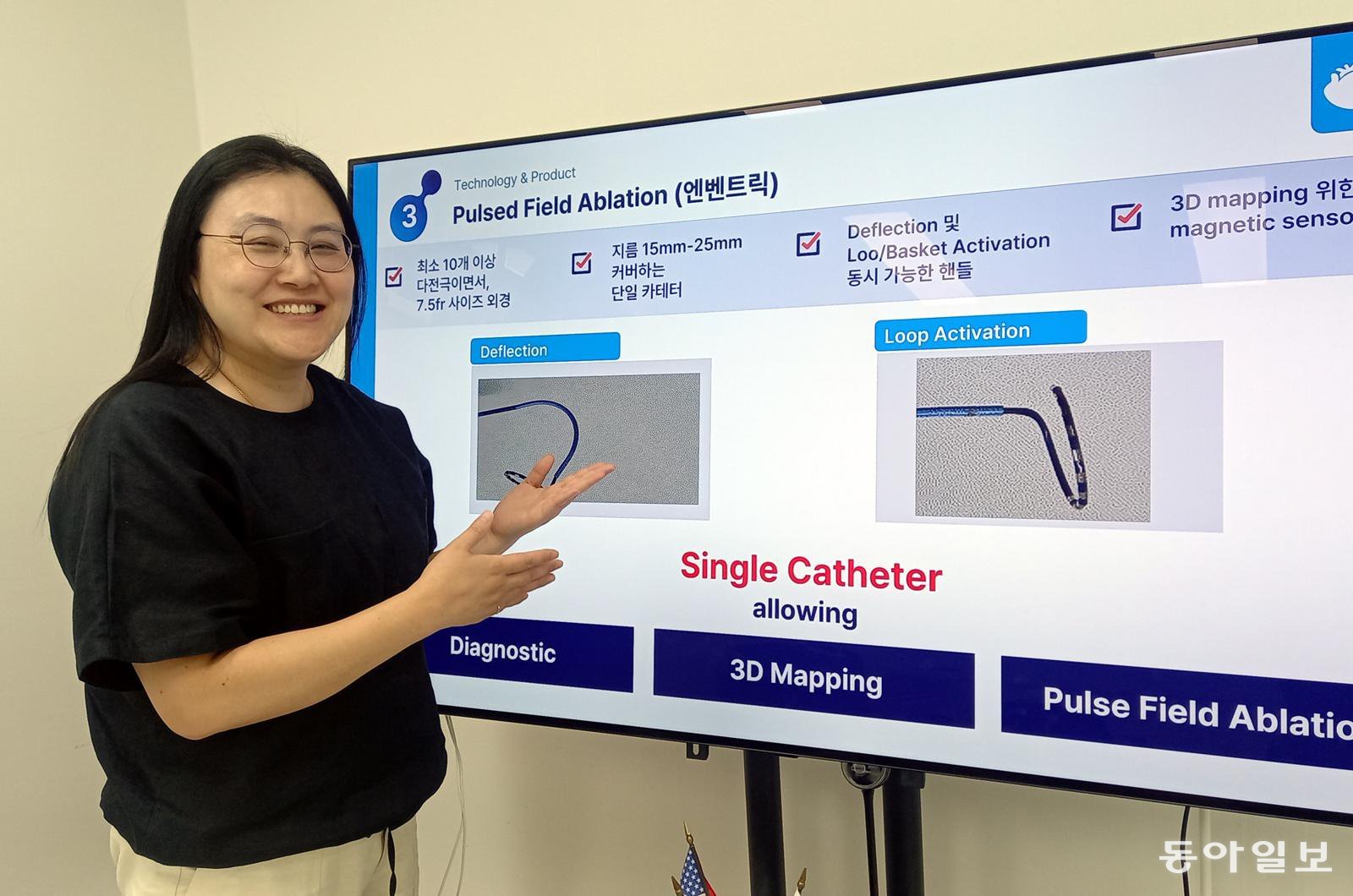
On 8 June, Enventric Co-CEO Min Ji-young explains how the company’s pulsed field ablation catheter works at its office in Guro District, Seoul. Photo by reporter Heo Jin-seok, jameshur@donga.com
The most critical devices that enter the inside of the heart and cerebral blood vessels in domestic operating rooms have long been dominated by foreign manufacturers. Catheters (slender tube-shaped medical devices inserted into the body) that emit radiofrequency inside the hearts of arrhythmia patients to restore normal rhythm, and stent retrievers (wire-mesh devices used to remove thrombi) that extract clots in acute cerebral infarction patients, have all entered the market bearing the names of large US and European medical device companies.
Enventric is a company that aims to revolutionize the performance of such devices used in life-threatening situations and to capture the global market with Korean technology. “The best scenario is that patients never in their entire lives have to encounter the devices we make. But if they must encounter them once, in that moment the devices absolutely must work properly,” said CEO Min (51), whom this newspaper met at the company’s office in Guro District, Seoul, on 8 June. The awareness that it is manufacturing medical devices used at the threshold between life and death was both the company’s motivation and its starting point.
● A brother-sister founding team in their mid-40s
Enventric Co-CEO Min Sung-woo participates in a German medical trade fair. Based mainly in the United States, he leads the research and development division. Photo provided by Enventric
The foundation for the start-up lay not in a laboratory but in the industrial field. CEO Min worked at LG CNS for nearly 20 years, handling process innovation and management. Her co-founder and younger brother, CEO Min Sung-woo (50), majored in mechanical engineering and bio-microelectromechanical systems (MEMS) at Stanford University. He then worked as an engineer for 15 years at global medical device companies Johnson & Johnson and Abbott, developing catheters and stents.
The two, who run Enventric as co-CEOs, saw similar limitations during their careers at large corporations. Even with good technology, products ultimately moved only within the brands and distribution networks of global conglomerates, while Korean hospitals remained dependent on foreign-made devices. “We brought together experts with 15, 20, even 30 years of experience in the medical device industry, and launched the company with full knowledge of the market, regulatory approvals, and sales,” he said. Thus, in July 2019, Enventric was established with its headquarters in Korea and an R&D base in Arcadia, California, in the United States.
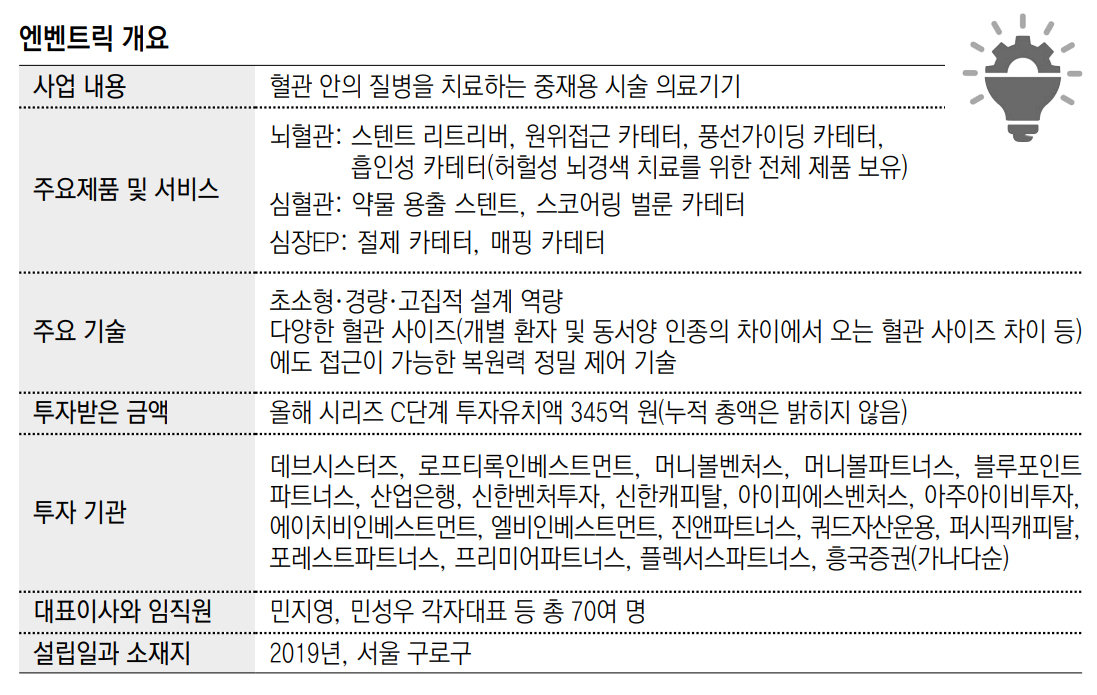
● “Focusing on the vascular field we know best”The company set out from the beginning with two clear principles. First: “We will only develop interventional vascular devices, the field we know best.” Second: “We will commercialize technologies that can actually sell in the market.” Based on these principles, it selected three focus areas: cerebrovascular, cardiac electrophysiology (EP), and cardiovascular. It has been growing both its own branded products and its contract research, development, and manufacturing business in parallel. In the medical device industry, revenue does not arise immediately just by making a good product. Design and verification can take four to five years, followed by another one to three years for regulatory approvals. To endure this long gap, Enventric has pursued a business-to-business (B2B) model, undertaking development and production on behalf of global companies. Over the past three to four years, it has generated cumulative revenue of around KRW 6 billion in this segment first.
For several years, the company did not promote its activities externally and instead focused on perfecting its technology. “The vascular device market is led by global companies such as Johnson & Johnson, Medtronic, Stryker, and Abbott, so revealing our technological direction too early could have put us at a disadvantage,” CEO Min said. Enventric adopted a low-profile strategy until it had accumulated sufficient progress in development completion, clinical data, regulatory approvals, and patents.
● Innovation in devices treating arrhythmia and cerebral infarctionThe field in which Enventric first drew technological attention was EP catheters for treating arrhythmia. Arrhythmias occur when electrical signals in specific areas inside the heart flow abnormally; the representative treatment is to locate these areas with a catheter and apply energy to eliminate them. In the past, radiofrequency and cryoablation were mainstream, but in recent years pulsed field ablation (PFA) has attracted attention. It is evaluated as causing less thermal damage and offering higher procedural efficiency, because it applies very short, high-intensity electrical pulses to selectively ablate specific myocardial cells. According to Enventric, the global EP device market is about USD 25 billion (approximately KRW 38 trillion), and PFA within that is expected to grow into a USD 10 billion (approximately KRW 15 trillion) market by 2030.
Reading this next-generation technological trend, Enventric moved early into developing PFA catheters. “Three years ago, through our CDRMO business, we developed catheters for PFA, and the clinical results were extremely positive,” CEO Min said. As single-use products, PFA catheters are slightly over 1 meter in length and priced at more than KRW 10 million each.
In the cerebrovascular business, stent retrievers and access catheters for removing thrombi in cerebral infarction patients constitute the core axis. In the cerebrovascular treatment market as well, mechanical thrombectomy has been the most rapidly growing area in recent years. When a thrombus occludes a cerebral artery, blood flow must be restored within a few hours, and the stent retriever is the key device that directly grasps and removes the clot. “In the past it was a market where only drugs were used, but now we are in an era where devices are actually inserted to mechanically remove thrombi,” CEO Min said. In January this year, Enventric obtained product approval from the Ministry of Food and Drug Safety (MFDS) for ‘EVOGLIDE’, an access catheter that reaches deep into cerebral vessels, and in June it secured approval for the stent retriever ‘ULTRIVA’. The company assesses that with these two products it has almost completed the core device line-up for treating cerebral infarction. The unit price of these products ranges from several hundred thousand to several million KRW.
● “Technology is harmonizing contradictory properties to raise completeness”
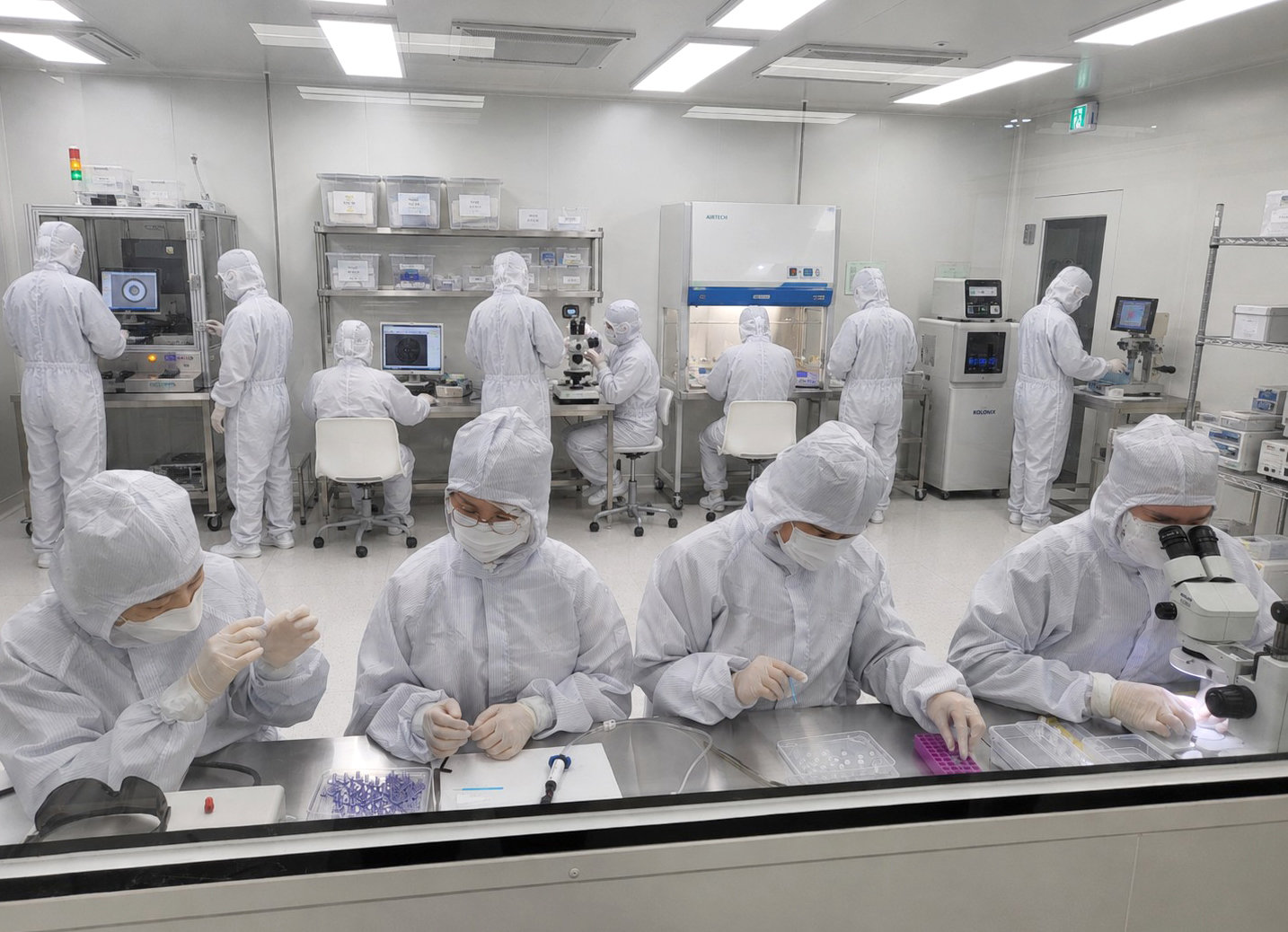
Inside Enventric’s production plant for catheters and stent retrievers in Guro District, Seoul. Photo provided by Enventric
The catheters Enventric manufactures are akin to ultra-precise structures. Catheters that enter the brain and heart are assembled and joined under a microscope, as hair-thin components, alloys, and polymers are combined by hand. They must not break while advancing along a path of nearly 2 meters, and at the same time must be extraordinarily flexible. “They have to be flexible yet strong, small yet highly controllable. It is a struggle to satisfy conditions that are inherently contradictory, all at once,” CEO Min said.
For this reason, Enventric is obsessive about process technology and structural design. The company’s PFA catheter is thinner than existing products while, unlike most others, having a structure that allows diagnosis and treatment in a single procedure. “By enabling single-step diagnosis and treatment and allowing the device to move freely exactly as the physician intends, we believe we have increased procedure success rates,” CEO Min said.
The technology applied to ULTRIVA is Enventric’s proprietary ‘Arch-1’. This technology finely processes ultra-small single tubes to secure both flexibility and support strength. Enventric has realized a structure that can capture various types of thrombi, a packaging method that further reduces size, and marker structures that are more clearly visible under X-ray. The company highlights as its differentiating point the improved readability, during the procedure, of the device’s position inside the cerebral vessels, the length of the thrombus, and the deployment status.
● “Naturally, the target is the global market”CEO Min explained that in the cerebrovascular segment Enventric is focusing on its own brand, in the cardiovascular segment it is centering on B2B business supplying technology to major corporations, and in cardiac EP it is expanding from B2B into its own branded products. The company first persuades distributors and agents that have long sold large corporations’ products, and then supplies its devices through their networks to physicians who perform high volumes of procedures.
The United States is the largest medical device market, followed by Europe. “Starting in Korea, we will enter the United States, the world’s largest market, and then present our technology to the global market as a whole,” CEO Min said. “We aim to become the company that offers physicians the best possible options for treatments inside cerebral vessels and the heart.”
ⓒ dongA.com. All rights reserved. Reproduction, redistribution, or use for AI training prohibited.
Popular News