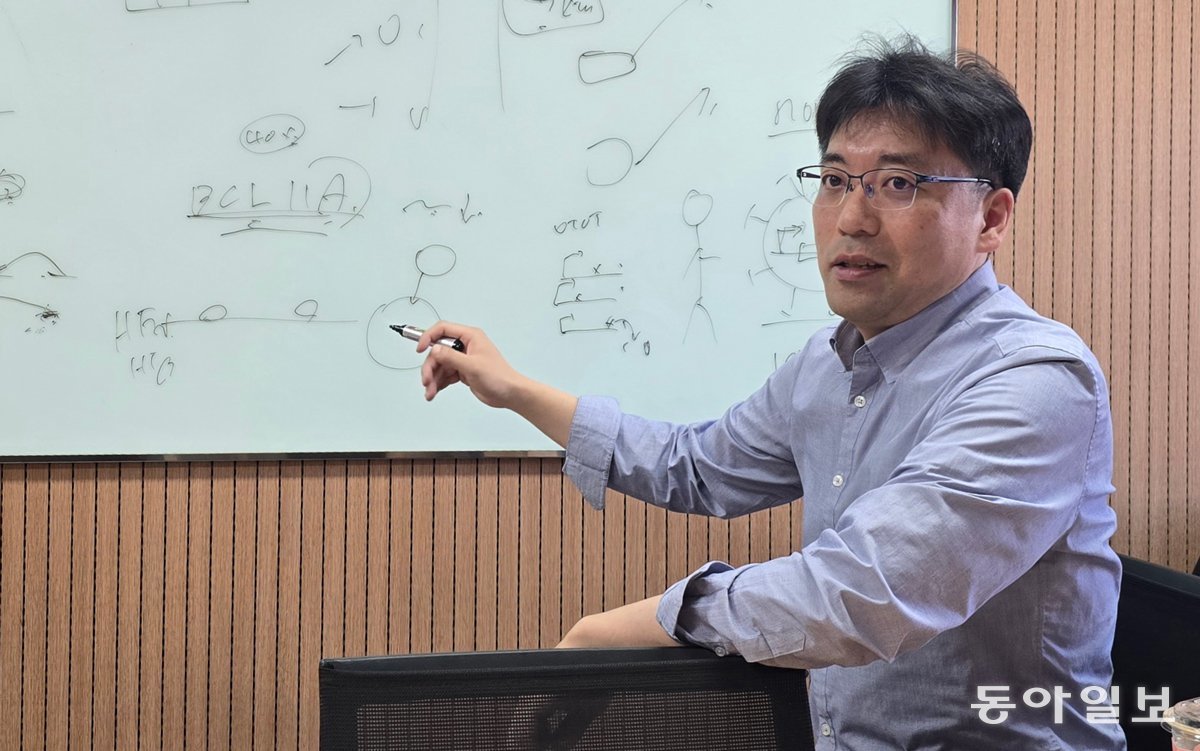
Interview with Bae Sang-soo, Professor at Seoul National University College of Medicine
Sustained therapeutic effect without lifelong medication
Lack of industrial foundation to realize core technologies
In an interview conducted on the 6th of last month, Bae Sang-soo, professor at Seoul National University College of Medicine, cited the development of delivery systems and the maturation of the industrial ecosystem as key tasks for the advancement of gene-editing technology in Korea. Professor Bae stated that his goal is to cure patients with gene-editing therapies based on Korea’s original technologies. Moon Hye-won, Dong-A Science reporter moony@donga.com
The research team at Columbia University in the United States has succeeded in correcting genes in human embryos that cause heart disease and anemia, and disclosed the results on the preprint server “bioRxiv” on the 1st of this month. The study demonstrated that heart disease of genetic origin that may arise at the human embryonic stage can be treated with a single gene edit. Despite ethical concerns about research on embryos and debates over so-called “designer babies,” there is broad agreement that this is the most innovative technology available for overcoming genetic diseases.
Professor Bae Sang-soo, who took part in the study, said in a recent interview, “Directly correcting human genes (deoxyribonucleic acid, DNA), which are called the blueprint of life, was once regarded as the ‘domain of God,’ but it is now becoming reality,” adding, “The goal is to treat patients using gene-editing technologies developed in Korea.” To achieve this, Professor Bae believes that the industrial ecosystem led by gene therapy must grow in tandem.
Professor Bae said, “Gene editing using genome scissors has the advantage of maintaining a therapeutic effect for life with a single treatment, without the need for repeated drug administration.” In particular, human embryo gene editing is regarded as a technological leap forward because it allows the removal of disease-causing factors before birth.
Last year, Professor Bae also succeeded in correcting, with genome scissors, mutations in the congenital hearing loss gene “MPZL2,” which primarily appears in East Asians, in “humanized mice” that incorporate human cells or tissues and better reflect human diseases. He explained, “Gene editing corrects the problematic nucleotide sequence itself using genome scissors,” adding, “It has the advantage that normal gene expression levels are naturally maintained and the correction effect persists even after cell division, but the technical difficulty is high.”
Although there are many eminent experts in genome scissors technologies in Korea, including Professor Jin-Soo Kim of KAIST, the slow progress in research using human embryos or in the development of gene therapies is often attributed to domestic research ethics standards or regulations. Professor Bae takes a slightly different view. He diagnosed that researchers alone cannot solve the problem and that there is a lack of industrial infrastructure to realize original technologies.
He said, “Korea also has outstanding researchers, but the industrial base to realize original technologies is still insufficient,” and added, “The fact that the most excellent researchers in the bio field are still in academia means that the industrial base has not yet become active.” His view is that researchers, companies, and regulatory agencies must grow together.
He also saw the slow pace of approval for gene therapies in Korea in the same light. Professor Bae said he could understand the cautious stance of the Ministry of Food and Drug Safety. “There is not a single case of domestically developed gene therapy, so the question remains of who will take responsibility for the first approval,” he said. “Because there are no precedents, approvals are not granted, and because approvals are not granted, precedents do not emerge.”
Professor Bae cited a lack of industrial experience as a reason why the growth of Korea’s bio industry has been relatively slow compared with other industries. In the case of semiconductors, which are currently “booming,” Samsung Electronics and SK hynix have already reached world-class levels, so when new technologies emerge, their value and risks can be assessed independently within Korea. By contrast, he pointed out that the history of independently developing new drugs in Korea’s bio industry is less than 20 years.
He said, “Korea has produced generic drugs and undertaken contract manufacturing, but the history of developing drugs independently is short,” explaining, “So when new technologies emerge, both industry and regulators are still not sure how to handle them.” He added, “Korea’s strength is that once it decides to try something, it pushes ahead aggressively,” and predicted that once industry and regulation mature together, the country could catch up rapidly.
For the field of gene therapy using genome scissors, he cited delivery systems as the main technical challenge to be resolved. Technologies to efficiently deliver genome scissors to the desired target sites are still lacking. “The viral vectors that are mainly used can leave genome scissors in the body for a long time, which may increase the risk of side effects,” he explained.
Professor Bae viewed the recent approval of domestically developed CAR-T therapies as a positive signal. Once a single success case is achieved in the field of gene therapy, it can spread across the broader advanced bio sector, including stem cells and organoids, he said. “I believe that within five years it will be possible to commercialize gene therapies in Korea,” he added. “The ultimate goal is to actually cure patients with technologies developed by our own hands.”
ⓒ dongA.com. All rights reserved. Reproduction, redistribution, or use for AI training prohibited.
Popular News