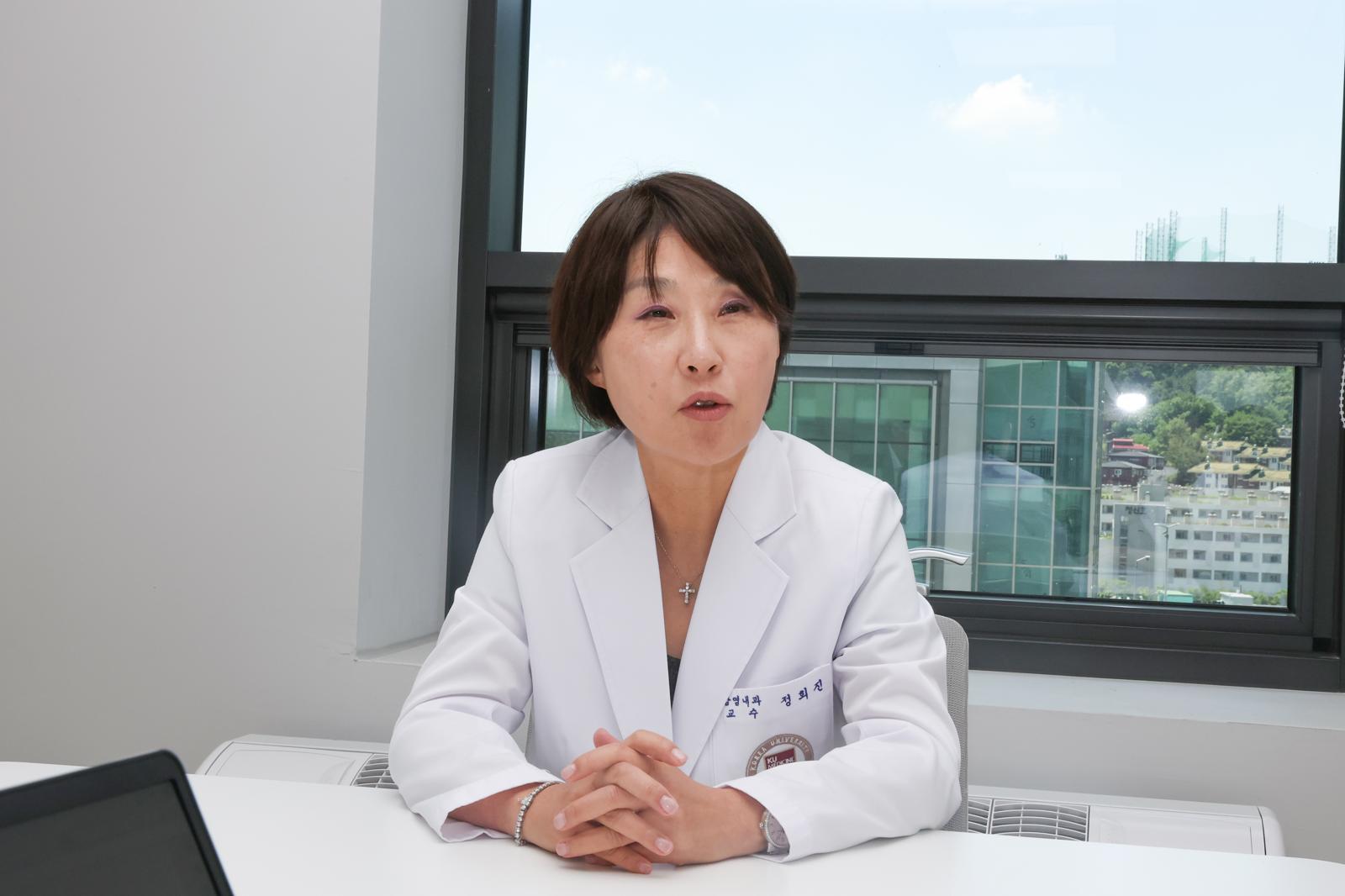
Interview with Jung Hee-jin, Head of the Vaccine Innovation Center, Korea University College of Medicine
Jeong Hee-jin, Head of the Vaccine Innovation Center
Jeong Hee-jin, head of the Vaccine Innovation Center at Korea University College of Medicine (professor of infectious diseases at Korea University Guro Hospital), said, “Through cooperation with the government, research institutes, and industry, I will contribute to enabling Korea to move from a vaccine-importing country to a vaccine-exporting country, and further to a nation with bio-sovereignty.”
The following is an interview with Jeong on the role of the Vaccine Innovation Center and methods for preventing infectious diseases.
―What are the role and objectives of the Vaccine Innovation Center?“The Vaccine Innovation Center at Korea University College of Medicine is the only private vaccine research and development institution in the country, established to resolve ‘vaccine inequity,’ which emerged as a global issue in the wake of the novel coronavirus infection (COVID-19). The core objective is to secure original technologies in vaccine antigen design and platform development so that domestically produced vaccines can be manufactured using independent technology without infringing patents. Ultimately, the mission is to develop safe and effective vaccines to protect the health of the population during the next infectious disease outbreak and to assist underdeveloped countries that are even more vulnerable to vaccine inequity.”
―Why is it necessary at this point in time to concentrate on investment in infectious disease research and vaccine development?“As society has regained normal daily life after passing through a long tunnel, it is natural that public interest in infectious diseases may decline due to fatigue from the pandemic. However, the next infectious disease outbreak will not wait for our state of preparedness. Climate change, increased contact with wild animals caused by indiscriminate development, and the expansion of global exchanges are shortening the emergence cycle of novel infectious diseases to an unprecedented degree. The harsh price paid during COVID-19 was because technology development began only after the crisis had already struck. Only by accumulating next-generation vaccine platforms and original technologies in advance, during this time of relative peace, can we respond swiftly to the next infectious disease outbreak.”
―Compared with the COVID-19 period, to what extent do you think Korea’s infectious disease response capabilities have advanced?“During COVID-19, Korea received global acclaim for so-called ‘K-quarantine,’ which included systematic epidemiological investigations and contact management. In particular, the country secured unrivaled international competitiveness in diagnostic kits, and the international community began to evaluate Korea as a nation leading global health security. However, it is true that there was a lack of concrete achievements in the independent localization of vaccines and therapeutics. That said, over the past few years, the fundamental bio-technologies and platform capabilities accumulated jointly by the public sector, private sector, academia, and research institutes have matured to a level incomparable with the past. Korea now stands at a critical leap-forward stage of moving beyond the success of the ‘software’ of the quarantine system to completing the ‘hardware’ of its own proprietary vaccine technologies.”
―In April, BL3 and ABL3 special laboratories were expanded, relocated, and opened. What significance does this have for vaccine research?“High-risk emerging infectious diseases must be studied in the absence of available therapeutics or vaccines, so ensuring the complete safety of researchers is of paramount importance. It is akin to the basic foundation work of a building. The newly opened BL3 and ABL3 special laboratories fundamentally block the external leakage of high-risk pathogens and the risk of exposure to researchers. They are equipped with a negative pressure system in which air flows only from the outside into the laboratory. The internal air is discharged only after pathogens are filtered out through HEPA filters. The greatest significance of this opening is that it has established an international-level infrastructure that enables the entire vaccine development process—from high-risk pathogen analysis to animal efficacy evaluation—to be carried out safely in a one-stop manner.”
―What is the top priority that must be addressed for Korea to move from being a vaccine-importing country to a vaccine-exporting country?“Korean society has a strong culture of valuing rapid results, and there is a tendency to cut research support if outcomes are not produced in the short term. However, vaccine development is an area in which years, sometimes more than a decade, and countless trials and errors are essential. If support is halted simply because there are no concrete short-term results, Korea will be forced to remain forever merely as a ‘contract manufacturing base’ importing overseas technologies. To truly become a vaccine-sovereign country, a long-term investment environment that patiently waits and a research culture that accepts failure as an asset in the research process must be firmly established at the national system level.”
―As an expert, are there any infectious disease prevention guidelines you would like to request of the public?“The most basic and reliable method of responding to infectious diseases is to secure individual immunity in advance. There is no one who does not know that quitting smoking is good for health. In the same way, it is widely known that vaccination is the most effective means of building immunity. As the necessary vaccinations differ depending on age and health status, it is advisable to consult a physician and receive the vaccines appropriate for oneself in advance. Our research team will not cease efforts to supply safer and more effective vaccines so that the public can be reassured when receiving vaccinations.”
ⓒ dongA.com. All rights reserved. Reproduction, redistribution, or use for AI training prohibited.
Popular News