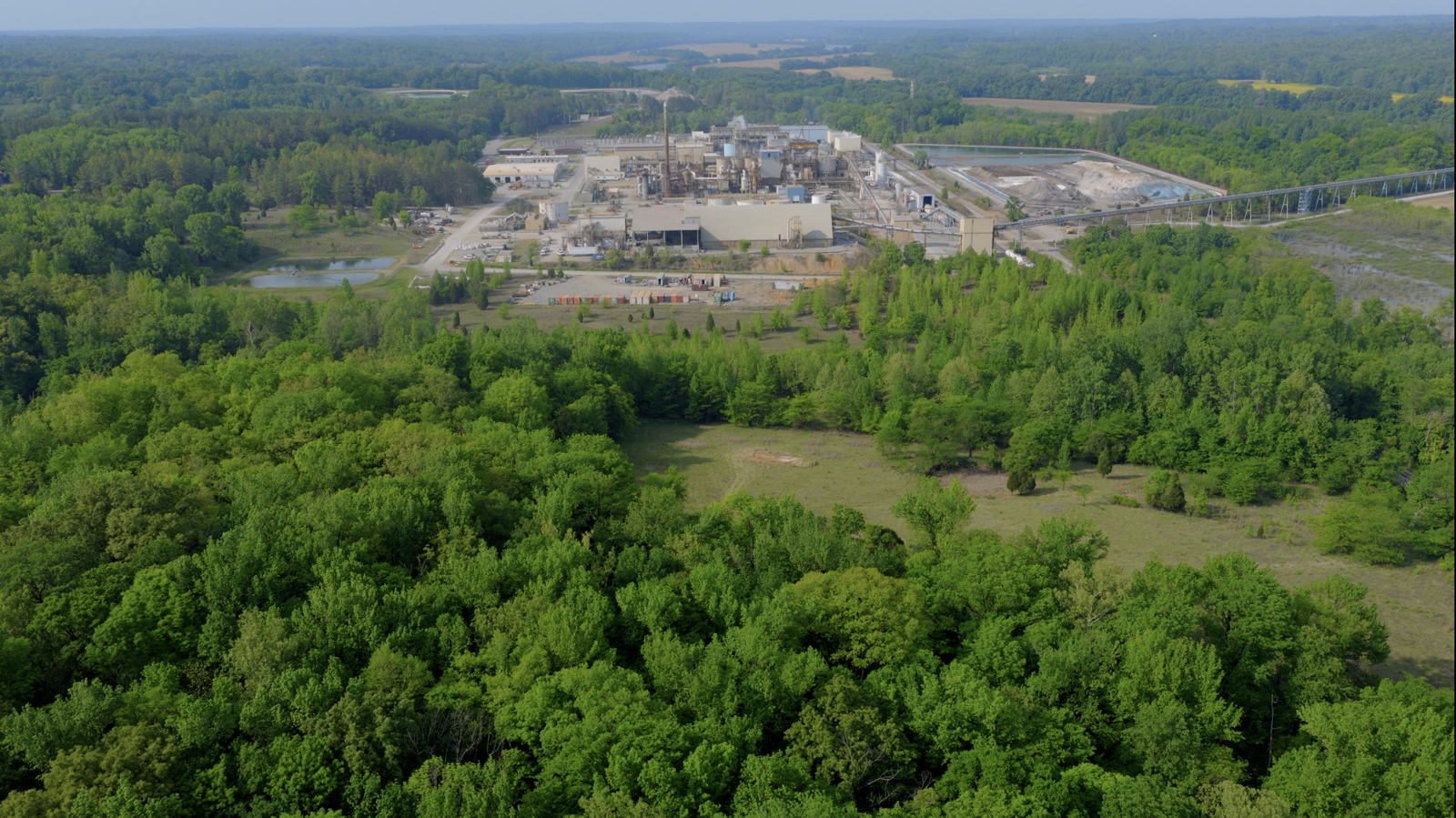
Panoramic view of the site for the integrated smelter in Clarksville, Tennessee, which Korea Zinc is building together with the U.S. government. Provided by Korea Zinc
Choi Yoon-bum, Chairman of Korea Zinc, met with officials from the Canadian government and the mining industry to discuss ways to expand cooperation on the critical minerals supply chain. The plan is to link the integrated smelter being promoted in the U.S. state of Tennessee with Canada’s mining and smelting industries to secure a raw material procurement network in North America.
Korea Zinc announced on the 9th that Chairman Choi participated as a speaker at the “Korea–Canada Energy and Resources Supply Chain Cooperation Forum” held in Ottawa, Canada, on the 2nd.
Chairman Choi visited Canada as a member of a public–private economic delegation led by Senior Presidential Secretary for Political Affairs Kang Hoon-sik, who was serving as the President’s Special Envoy for Strategic Economic Cooperation. The governments of Korea and Canada used this visit to discuss joint stockpiling of critical minerals, investment in strategic resource development projects, and measures to stabilize energy supply. The two countries also agreed to draw up a joint stockpiling plan for critical minerals by the end of this year.
At the forum, Chairman Choi introduced “Project Crucible,” an integrated smelter that Korea Zinc is working to build in Clarksville, Tennessee.
Project Crucible is an integrated non-ferrous metal smelter construction project in which Korea Zinc and the U.S. government are investing around KRW 11 trillion. It is scheduled to produce 11 types of critical minerals—such as copper, silver, antimony, and germanium—that are strategically managed by the U.S. government, as well as sulfuric acid for semiconductors.
Once commercial production begins in 2030, the facility is expected to serve as a hub for smelting and processing ore mined not only in the United States but also across North America, including Canada.
Chairman Choi said, “Project Crucible is North America’s largest integrated non-ferrous metal smelting hub, built on the operational experience and technological capabilities of Korea Zinc’s Onsan Smelter,” adding, “We will broaden cooperation opportunities with Canada’s critical minerals industry and contribute to strengthening the competitiveness of North America’s supply chains.”
Korea Zinc also plans to pursue a business to import residues generated at Canadian smelters and recover valuable metals from them. Smelting residues contain valuable metals such as copper, silver, antimony, and indium that were not recovered in existing processes.
The company explained that it intends to apply the residue reprocessing technology currently in operation at the Onsan Smelter to use smelting by-products generated in Canada as raw materials.
At present, the Onsan Smelter uses smelting residues and waste electronic products as recycled raw materials together with concentrates mined from ore. Copper is produced entirely using recycled raw materials, and silver is also produced from secondary raw materials rather than concentrates.
Twenty-two percent of zinc production and 26% of lead production are based on recycled raw materials. Metals used in advanced and defense industries, such as antimony and indium, are likewise recovered from smelting residues.
Chairman Choi said, “If high-grade smelting residues generated in Canada are processed to recover additional valuable metals, resource utilization can be enhanced,” adding, “This can become a form of cooperation between the two countries that both secures additional critical minerals and advances a circular economy.”
Korea Zinc will also expand cooperation with Canadian mining companies on raw material procurement and mine development.
Once Project Crucible is in operation, additional zinc concentrates and recycled raw materials will be required for the U.S. smelter, on top of existing demand at the Onsan Smelter. Accordingly, the company is reviewing plans to increase import volumes of zinc concentrates and other materials from Canada.
Currently, the company is conducting a zinc exploration project in British Columbia with Canadian mining company Teck Resources. Korea Zinc expects that if exploration and development proceed as planned, annual zinc production of around 100,000 tons will be possible.
Chairman Choi said he plans to consult with the Canadian government on support for infrastructure such as roads and power needed for mine development.
The company has also signed an offtake agreement to purchase zinc concentrates produced at the “Kudz Ze Kayah” mine in Canada’s Yukon Territory. The mine is expected to enter full-scale operations around 2030.
A Korea Zinc official said, “We plan to secure the raw materials needed to produce critical minerals by expanding cooperation with Canadian resource companies and mining projects,” adding, “As Korea and Canada share an understanding of the need for supply chain stability, cooperation is expected to increase in mine development, raw material procurement, and smelting residue recycling.”
ⓒ dongA.com. All rights reserved. Reproduction, redistribution, or use for AI training prohibited.
Popular News