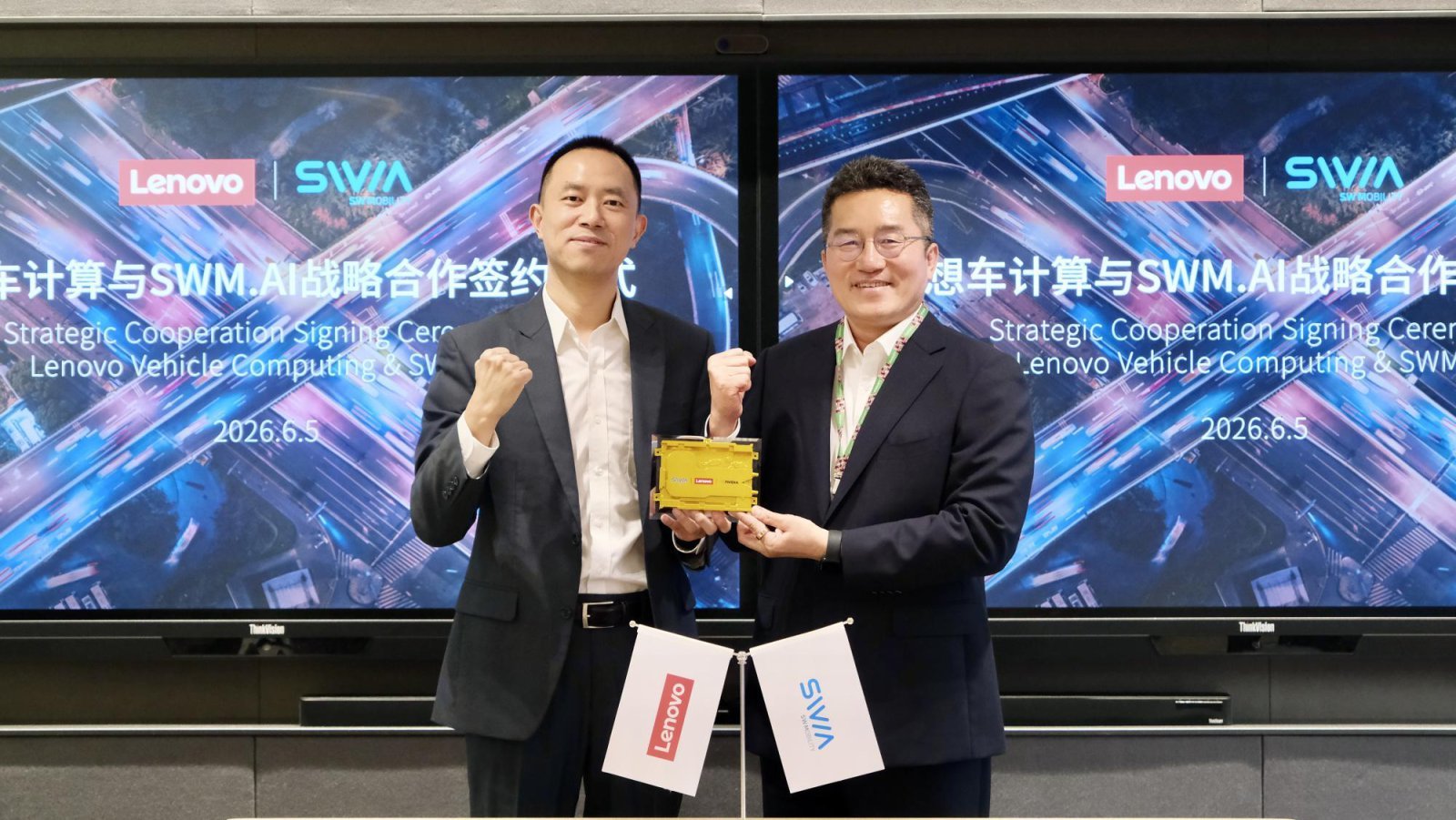
SWM.AI and Lenovo have signed a joint development agreement for the next-generation autonomous driving controller “AP-700.” Photo courtesy of SWM.AI
SWM.AI announced on the 8th that it has signed a joint development agreement with global ICT company Lenovo for the next-generation autonomous driving controller “AP-700.”
The agreement was concluded to combine real-world driving data accumulated in downtown Seoul with global computing technologies in order to realize fully driverless autonomous vehicles as a complete physical AI operating in the real world. Through this collaboration, SWM.AI is assessed to have completed its Seoul-based robotaxi as a Physical AI and secured the elements required for the commercialization of fully driverless autonomous driving.
Physical AI, which perceives, reasons, and acts directly in the real world beyond virtual environments, is cited as a key field in the technology industry. Interest in this area has risen as NVIDIA CEO Jensen Huang visited Korea to discuss physical AI cooperation with major domestic companies. Huang previously cited self-driving cars as intelligent robots that people will encounter in daily life. Autonomous vehicles driving on public roads are analyzed as a form of physical AI that has already entered everyday life.
SWM.AI’s robotaxi recognizes its 360-degree surroundings using cameras, LiDAR, and radar, understands and assesses situations with a Vision-Language-Action (VLA)-based AI model, and autonomously determines acceleration, deceleration, and steering to navigate urban streets.
Since September 2024, SWM.AI has been operating a robotaxi service in Seoul’s Gangnam area, accumulating real-world driving data. Gangnam, with its intersections, high traffic density, and frequent unexpected situations, is regarded as an environment suitable for validating physical AI. The accumulated real driving data in turn becomes training data that further advances the AI model, creating a structure in which the advanced model generates new data.
The industry cites several core elements for realizing fully driverless autonomous driving: autonomous driving software validated in real urban environments; large-scale real-world driving data; next-generation AI models capable of situational reasoning; and ultra-high-performance computing platforms that process computations on board the vehicle in real time. SWM.AI, having secured Gangnam real-world driving data and a VLA model, is now assessed to have obtained an in-vehicle AI computing platform through this collaboration with Lenovo.
The “AP-700,” jointly developed by SWM.AI and Lenovo, is an in-vehicle computing platform designed for autonomous driving. It is equipped with dual NVIDIA Drive Thor-X SoCs to process large volumes of sensor data and AI computations in real time, and applies Infineon TC397 MCUs in duplicate to enhance safety and reliability. It adopts a liquid cooling system designed to maintain stable performance even in a high-performance computing environment of approximately 580W. This design aims to secure the reliability required for unmanned robotaxi services.
Kim Ki-hyuk, CEO of SWM.AI, stated, “Robotaxis that drive on the same roads as citizens every day are the first physical AI to enter everyday life,” adding, “Combining real-world driving data accumulated in downtown Gangnam with an in-vehicle AI computing platform can accelerate the commercialization of fully driverless autonomous driving.” He continued, “This collaboration is not merely about developing a controller, but about building a complete physical AI that operates in the real world,” and added, “Based on technologies verified in actual urban environments, we will continue to respond to the global physical AI and autonomous driving markets.”
ⓒ dongA.com. All rights reserved. Reproduction, redistribution, or use for AI training prohibited.
Popular News