A new device emerges to succeed the smartphone… AI recognizes what users see
Hands-free and “able to ask questions the moment you look” but hard to detect recording, raising privacy concerns
“Hey Meta, which bag goes better with what I’m wearing now?”
Standing in front of a mirror holding a brown leather bag in one hand and a white handbag in the other, the question was posed. Almost immediately, a voice came through the temple of the glasses: “The brown bag is more suitable for commuting to the office.” It continued with the advice: “The white bag might stand out too much, whereas the brown bag gives a more professional impression.”
Provided by Meta
●
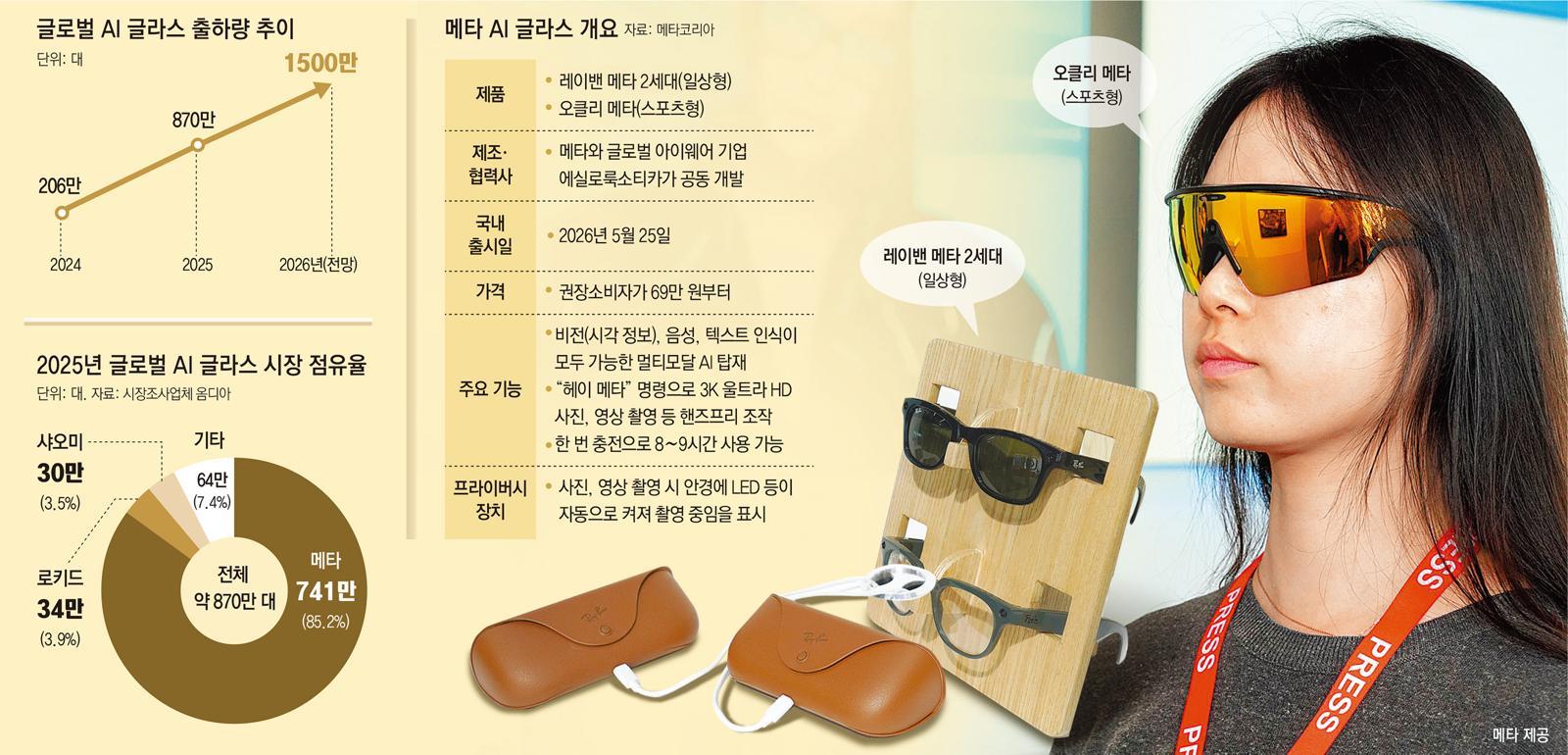
Glasses that have become an ‘AI assistant’ With the official domestic launch on the 25th of last month of Meta’s artificial intelligence (AI) glasses “Ray-Ban Meta 2nd Generation” and “Oakley Meta,” developed together with global eyewear company EssilorLuxottica, the AI smart glasses (AI glasses) market is drawing renewed attention. Whereas past AI glasses were closer to “cameras worn on the face” or augmented reality (AR) experience devices, recent products have shifted their focus toward “everyday AI assistants.” On the outside they look like stylish, ordinary glasses, but the AI recognizes the objects, text, and scenes that the user is viewing and responds by voice.
On the morning of the 4th, Meta’s AI glasses were tested first-hand at the Meta Korea office in Gangnam District, Seoul. When the user looked at the painting “The Starry Night” by Vincent van Gogh hanging on the wall and said, “Explain this painting,” an explanation of the work flowed out from the speakers built into both temples. Even at maximum volume, the sound did not significantly disturb those nearby, and the volume could be adjusted by swiping down the right temple. The device seemed well suited for use in art galleries and museums.
This time, standing in front of a sign written in a foreign language and saying “Translate this,” the response came back: “It says ‘Welcome’ in French.” When asked in front of a plate with croissants, salad, bacon, milk, and other items, “How many calories if I eat all this?” the AI analyzed the food information and replied, “If you consume everything, it is 580–630 calories.” The weight did not differ significantly from ordinary glasses, and it soon became easy to forget that they were being worn. Although the answers were sometimes a beat or two late or slightly off, asking again was not difficult.
The Ray-Ban Meta tested that day features a 12-megapixel ultra-wide-angle camera, 3K Ultra HD recording, and open-ear speakers, and can be used for 8–9 hours on a single charge. The Oakley Meta Vanguard, which focuses on outdoor and sports activities, highlights its 122-degree ultra-wide-angle camera and water- and dust-resistant design. Both products are linked to a smartphone application (app), and their AI functions are identical. Both the menu and voice commands support Korean, and prices start at KRW 690,000.
●
‘Ask the moment you see it’The biggest advantage felt while using the device was that the hands remained free. The entire process of taking out a smartphone, turning on the camera, launching an app, and entering a question disappeared. It became possible to immediately ask for information about a store spotted while walking down the street with both hands full of bags. If search in the smartphone era was “taking it out to ask,” search with AI glasses is closer to “asking the moment you see it.”
This is why the information technology (IT) industry is focusing on AI glasses as the next-generation form factor (device type) to succeed the smartphone. There is an expectation that controlling a device with only speech and gaze could become established as a new form of search. The market is in fact gradually expanding. According to market research firm Omdia, global AI glasses shipments surged more than fourfold from about 2.06 million units in 2024 to about 8.7 million units last year.
However, concerns about privacy invasion remain an unresolved issue. Meta explained that when photos or videos are taken, a light-emitting diode (LED) above the right lens of the glasses blinks, but people nearby may not even know they are being filmed. Choi Kyung-jin, a professor in the Department of Law at Gachon University, pointed out: “The camera on glasses is less noticeable than on smartphones, so it may be difficult for people nearby to know whether they are being recorded based only on an LED light,” adding, “There is a need to establish a legal framework that encompasses notification of filming, consent from surrounding individuals, and rights to request deletion.”
ⓒ dongA.com. All rights reserved. Reproduction, redistribution, or use for AI training prohibited.
Popular News