Participation in the 2026 American Diabetes Association (ADA) Scientific Sessions
Debut of Next-Generation Muscle-Enhancing Obesity Treatment
Peptide-Based Myostatin Inhibition Mechanism
Overcoming Limitations of GLP-1/Fc Fusion Protein Class
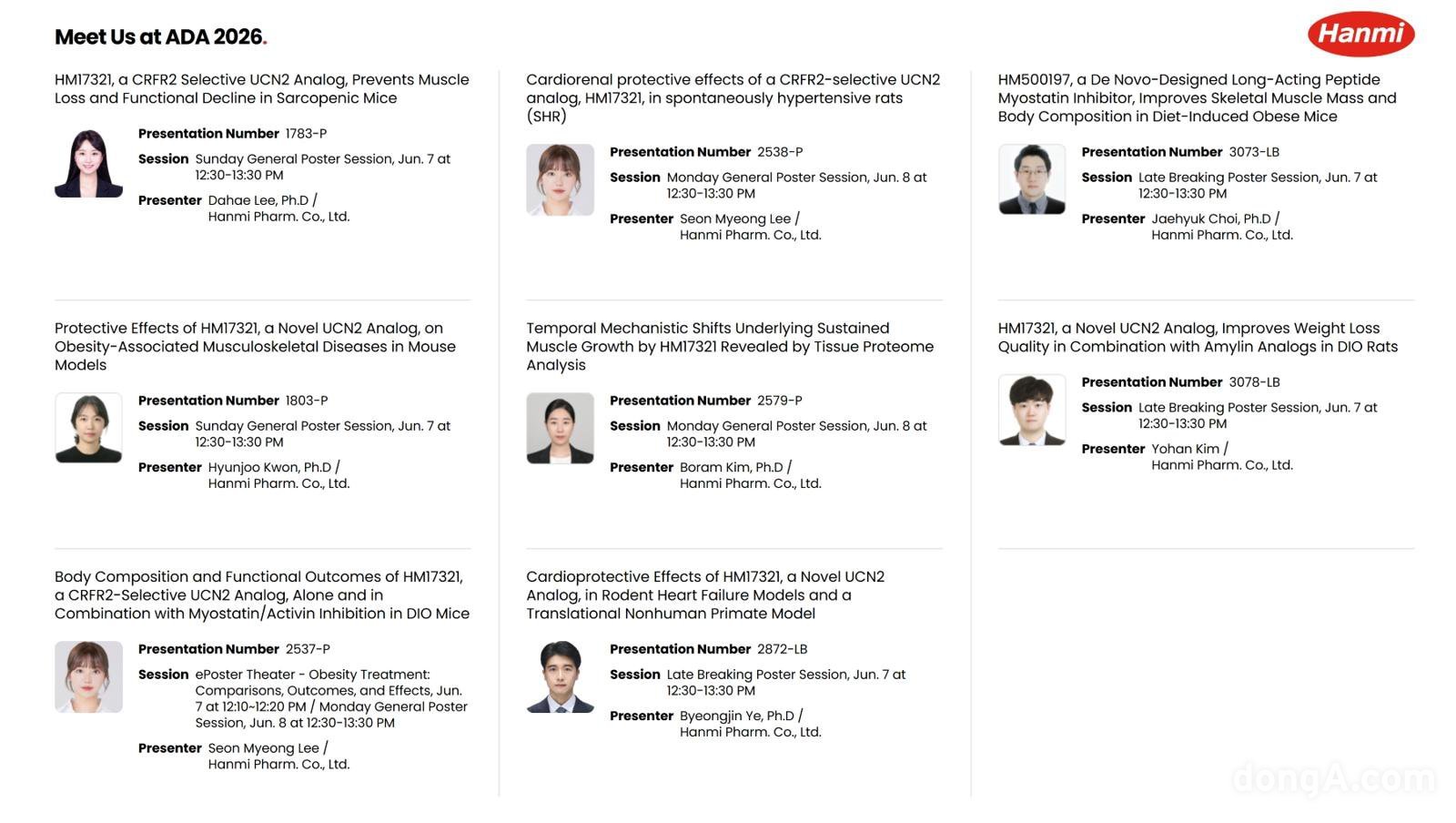
Overview of key research poster abstracts to be presented by Hanmi Pharmaceutical at the American Diabetes Association Scientific Sessions (ADA 2026). Provided by Hanmi Pharmaceutical
Hanmi Pharmaceutical is unveiling an innovative obesity drug that is expected to increase muscle mass while also improving muscular function.
Hanmi announced on the 27th that it will participate in the American Diabetes Association Scientific Sessions (ADA 2026), to be held in New Orleans, United States, from July 5 to 8 (local time), and will present eight research results on two novel obesity drug candidates: the “next-generation obesity treatment (LA-UCN2, HM17321)” and the “next-generation muscle-enhancing therapy (LA-MSTN, HM500197).”
The next-generation muscle-enhancing therapy being unveiled for the first time is a new pipeline distinct from Hanmi’s existing innovative obesity drug, “LA-UCN2.” The company has thus established a next-generation drug pipeline comprising two pillars in the muscle-strengthening-based obesity treatment segment.
Current glucagon-like peptide-1 (GLP-1) class obesity treatments have demonstrated excellent weight-loss effects, but it continues to be reported that approximately 20–40% of the reduced weight consists of lean mass loss. Lean body mass refers collectively to muscles, organs, body fluids, blood, and bones, excluding fat. In general, the weight of bones and organs does not change significantly, so this indicator mainly reflects changes in muscle mass. In summary, a key drawback of the current GLP-1 class of obesity treatments is muscle loss.
Excessive loss of skeletal muscle can lead to decreased basal metabolic rate and weakened muscle strength and physical function. Muscle is regarded as an important factor for long-term weight maintenance and for the health of older patients.
To address these limitations of GLP-1 therapies, the pharmaceutical and biotech industry is focusing on combination treatment research that modulates pathways involving myostatin and activin, which are associated with muscle growth.
All candidate substances currently under development in the industry are trending toward antibody and Fc fusion protein–based approaches (Fc fusion proteins are engineered fusion proteins designed to have prolonged in vivo survival). However, due to their relatively large molecular weight, these approaches face limitations in developing combination formulations with incretin-based agents (gastrointestinal hormones secreted from the intestine). Moreover, because of their mechanism of simultaneously inhibiting various ligands (substances that bind specifically to certain receptors), there is potential to affect off-target physiological pathways, raising safety concerns.
Hanmi stated that it designed HM500197 as a peptide-based substance (with a myostatin-inhibition mechanism), thereby overcoming the limitations of antibody-based approaches. It is also the fourth core pipeline of Hanmi’s obesity drug project “H.O.P (Hanmi Obesity Pipeline).” The company explained that this innovative drug candidate was derived using “HARP (Hanmi AI-driven Research Platform),” an advanced artificial intelligence and structural modeling technology platform independently developed on the basis of Hanmi’s proprietary new drug design capabilities.
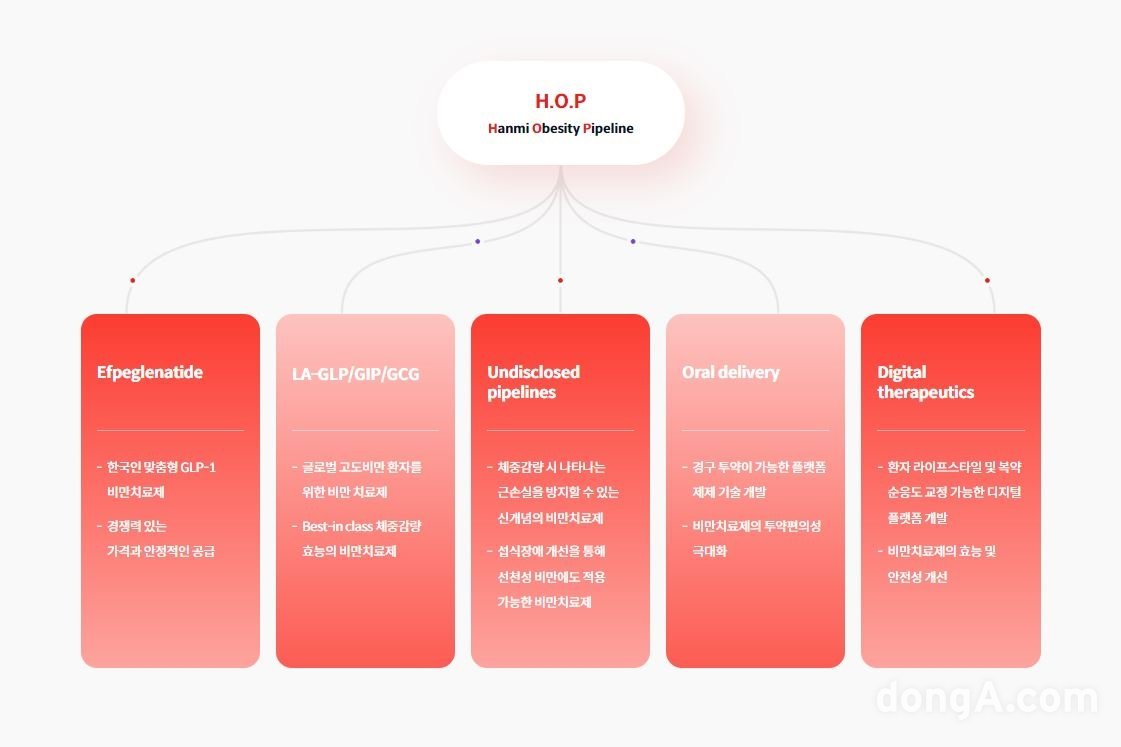
Overview of Hanmi Pharmaceutical’s H.O.P project for obesity drug development. Provided by Hanmi Pharmaceutical
Hanmi Pharmaceutical’s obesity new drug ‘H.O.P’ project on track… “Most advanced toward commercialization”
Through the H.O.P project, Hanmi Pharmaceutical is pursuing the development of segmented obesity therapies tailored to weight levels, metabolic characteristics, and other factors. The goal is to build a full-cycle portfolio capable of providing patient-specific obesity treatment solutions.
According to the company, “efpeglenatide,” the flagship candidate of Hanmi’s H.O.P project, is in systematic preparation of all necessary conditions for commercialization within the year. Following this, the triple-agonist obesity treatment (LA-GLP/GIP/GCG, HM15275) and the world’s first muscle-increasing obesity treatment (LA-UCN2) have entered Phase 2 and Phase 1 clinical trials in the United States, respectively.
Choi In-young, Head of Future Growth at Hanmi Pharmaceutical, said, “Building on Hanmi’s unrivaled research and development capabilities accumulated over many years in the field of metabolic diseases, the company is creating next-generation obesity drugs,” adding, “Hanmi will successfully complete the development of globally innovative new drugs so that obesity patients worldwide can achieve ‘healthy weight loss,’ effectively reducing body fat while strengthening muscle.” Hanmi Pharmaceutical is regarded as being the most advanced among domestic pharmaceutical and biotech companies in terms of the timing for commercialization of independently developed obesity drugs.
ⓒ dongA.com. All rights reserved. Reproduction, redistribution, or use for AI training prohibited.
Popular News