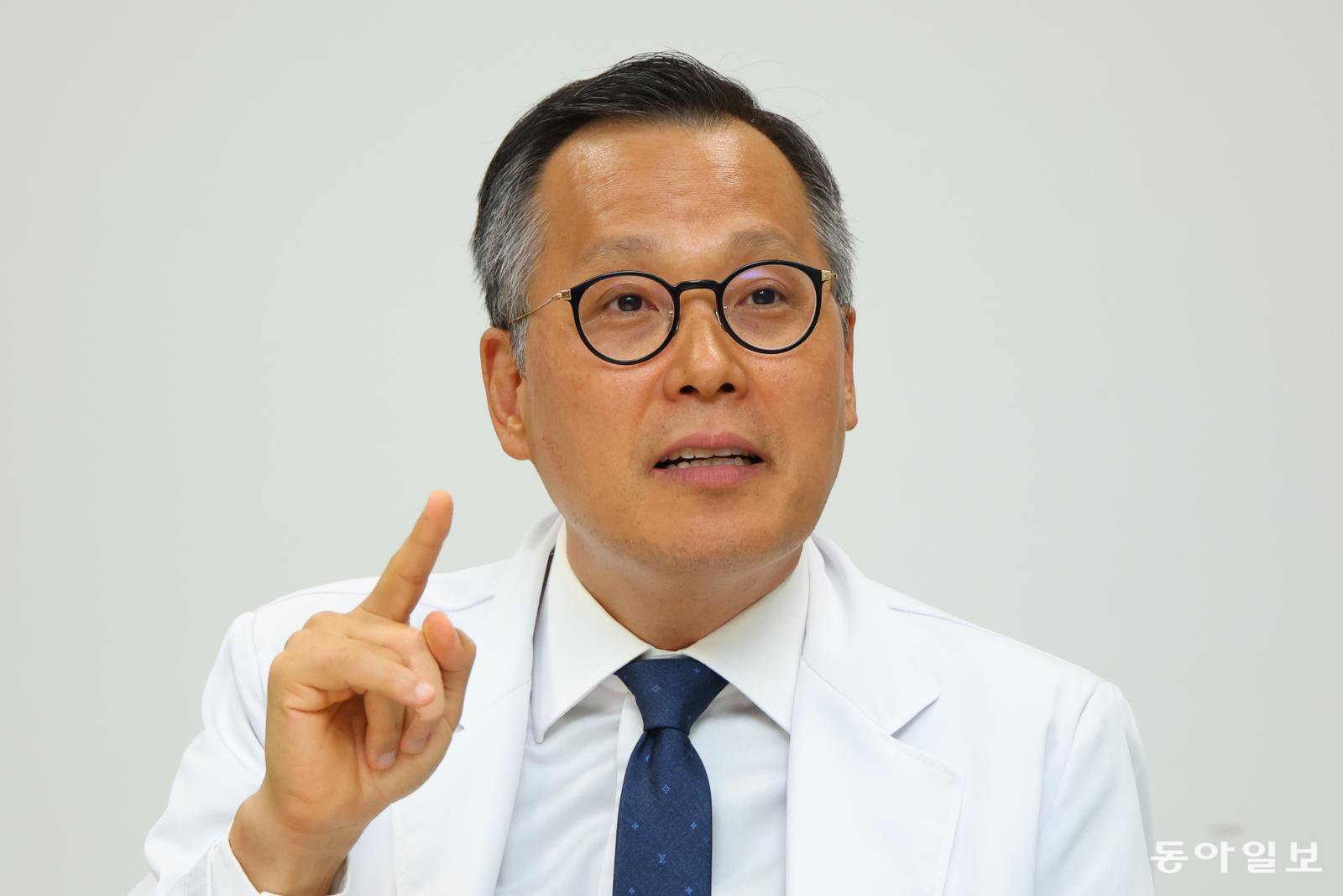
Professor Byoung Chul Cho, Division of Medical Oncology, Severance Hospital
Overcoming treatment resistance: the biggest challenge in lung cancer care
Hope in fourth-generation EGFR targeted therapies
Leads clinical development of domestic new drug “JIN-A02”
Professor Cho Byoung-cheol of the Division of Medical Oncology at Severance Hospital said, “The biggest challenge in current lung cancer treatment is to delay resistance and to enable subsequent treatment to continue even after resistance occurs,” adding, “Recently, development of fourth-generation EGFR targeted therapies has also been actively under way.” Reporter Song Eun-seok silverstone@donga.com
“Lung cancer remains one of the most difficult cancers to treat. At the same time, it is also one of the cancers for which therapeutic research is most actively being conducted.”
Professor Cho Byoung-cheol of the Division of Medical Oncology at Severance Hospital (Lung Cancer Center, Yonsei Cancer Center) recently described the current trend in lung cancer treatment in these terms. In the past, a diagnosis of terminal lung cancer effectively meant a limit to survival, but recently, with the emergence of various new drugs such as targeted therapies based on gene mutations, immuno-oncology agents, antibody-drug conjugates (ADCs), and bispecific antibodies, the treatment paradigm has been changing rapidly. In particular, in non-small cell lung cancer, precision medicine focused on “epidermal growth factor receptor (EGFR)” mutations has become full-fledged, and some patients are now reaching a stage where they can continue long-term treatment and manage the disease.
However, there are still barriers to overcome. Cancer cells that initially respond to anticancer drugs develop new mutations over time, and eventually drug resistance occurs. Recently, not only single resistance mechanisms but also “compound resistance,” in which multiple resistance mechanisms appear simultaneously, has been increasing, making lung cancer treatment even more challenging. Accordingly, global pharmaceutical companies and researchers are accelerating the development of fourth-generation EGFR targeted therapies to overcome resistance that emerges after existing third-generation EGFR targeted agents.
Professor Cho is serving as overall clinical trial advisor for “JIN-A02,” a fourth-generation EGFR targeted therapy under development by the Korean biotech company J INTS BIO. The following is a detailed discussion with Professor Cho on lung cancer resistance and the latest treatments.
―What is the most significant change recently perceived in lung cancer care in Korea?“Compared with the past, lung cancer treatment is shifting toward precision medicine. Previously, treatment strategies were determined mainly by histologic type, but now it has become routine clinical practice to identify various gene mutations immediately after diagnosis and establish patient-specific treatment strategies. In particular, as next-generation sequencing (NGS)-based genomic testing rapidly expands, treatment is evolving in a direction that considers the overall molecular biological characteristics of the tumor, rather than looking at only a single specific mutation. Another notable change is the increasing number of lung cancer patients who are non-smokers. EGFR mutations are especially common in East Asian female patients with lung adenocarcinoma. The patient population is also relatively younger than in the past.”
―What factors make lung cancer treatment particularly difficult?“Lung cancer still ranks first in global cancer mortality. The main reason is that a significant number of patients are already at an advanced or metastatic stage at diagnosis. Lung cancer often has almost no symptoms in the early stages, making early detection itself difficult. Another major issue is that cancer cells change very rapidly. Even if they initially respond well to targeted therapies, over time cancer cells acquire new mutations, and resistance eventually develops. Recently, a serious problem has emerged where not just a single resistance mechanism but multiple resistance mechanisms coexist as compound resistance. Brain metastases are also common in lung cancer. Therefore, whether a drug can adequately penetrate the central nervous system has a major impact on treatment outcomes. Ultimately, the key issues in lung cancer treatment are how much resistance can be delayed and how to continue subsequent treatment strategies once resistance occurs.”
―Why is EGFR-mutant lung cancer regarded as such an important treatment area?“EGFR mutation is a genetic alteration that plays a critical role in the growth and proliferation of lung cancer cells. It is particularly common in East Asian non-smoking female patients with lung adenocarcinoma. The ‘Exon 19 deletion’ and ‘L858R’ mutations are representative and well known. These patients often show a very good initial response to EGFR targeted therapies. In fact, compared with the era when only cytotoxic chemotherapy was available, treatment outcomes have improved dramatically. The problem is that resistance develops in most cases over time. Recently, cases in which multiple resistance mechanisms coexist have also not been uncommon. Ultimately, treatment of EGFR-mutant lung cancer is not simply about using the first-line agent well; it also includes the process of predicting what type of resistance will emerge and preparing for subsequent treatment.”
―What treatment strategies are currently receiving the most attention in the lung cancer field?“At present, the most important task in lung cancer treatment is ultimately overcoming resistance. There is active research on strategies to delay the onset of resistance from the early stages of treatment. Representative approaches attracting attention include combination with MET inhibitors, combination with ADCs, and EGFR-MET bispecific antibodies. Going forward, it is highly likely that treatment will evolve around various combination strategies rather than monotherapy. How to combine targeted therapies with ADCs, bispecific antibodies, and immuno-oncology agents is becoming extremely important. In addition, as artificial intelligence (AI)-based biomarker analysis and liquid biopsy technologies advance, active efforts are being made to track resistance mutations via blood and more precisely predict individual patients’ resistance patterns and treatment responses.”
―What are the goals of the fourth-generation EGFR targeted therapies currently in development?“The core objective of fourth-generation EGFR targeted therapies is to overcome resistance that develops after existing third-generation EGFR-TKIs. Development is focusing particularly on selectively inhibiting C797S, a representative resistance mutation, while reducing toxicity to normal cells and effectively controlling brain metastases. In the past, the prevailing concept was simply to develop a more potent drug, but recently it has become important to more precisely target only mutant EGFR while reducing skin toxicity and gastrointestinal adverse events.”
―What is the significance of the clinical trial of JIN-A02, for which you are serving as overall advisor?“JIN-A02 is a fourth-generation EGFR-TKI developed to target C797S, a representative resistance mutation that occurs after treatment with third-generation EGFR-TKIs. The clinical trial is currently being conducted in patients with advanced non-small cell lung cancer harboring EGFR mutations whose disease has progressed after prior EGFR-TKI therapy. The aim is to assess whether it can offer a new treatment option for a patient group with virtually no remaining choices after existing therapies. To date, early clinical results have shown meaningful tumor shrinkage even at low doses, and in some patients, reduction of brain lesions has also been observed. The fact that no severe cardiac toxicity or hematologic toxicity has been observed so far is another positive point. Efficacy has also been confirmed in rare EGFR mutations. However, it will be important in future phase 2 studies to objectively validate reproducibility and clinical significance.”
―In what direction is lung cancer treatment likely to evolve?“Lung cancer treatment will increasingly move toward more precise and personalized approaches. Even with the same lung cancer, each patient has different gene mutations and resistance architectures. Ultimately, it will become an era in which treatment strategies are designed based on each patient’s molecular biological characteristics and resistance profile. Above all, it is important to recognize that the lung cancer treatment environment is now completely different from the past. Patients who previously had almost no options can now, based on genetic testing, access a variety of treatment opportunities, and the number of patients receiving long-term treatment is actually increasing.”
―Finally, is there any message you would like to convey to lung cancer patients and their families?“Becoming a cancer patient can be an experience that shakes one’s entire life, going beyond a simple disease treatment issue. In particular, lung cancer involves a long treatment process and repeated confrontation with recurrence and resistance, so both patients and caregivers experience a significant mental and physical burden. Lung cancer remains a difficult cancer, but it is also the field in which treatment is advancing most rapidly. Even now, researchers, healthcare professionals, and pharmaceutical companies around the world are constantly striving to develop better therapies. Above all, it is hoped that patients will not view treatment only with fear. Clinical trials are also an important part of the treatment process that can provide an opportunity to access new therapeutic possibilities and should be actively considered. It is important to work closely with medical staff to find treatment opportunities that are appropriate for each individual.”
ⓒ dongA.com. All rights reserved. Reproduction, redistribution, or use for AI training prohibited.
Popular News