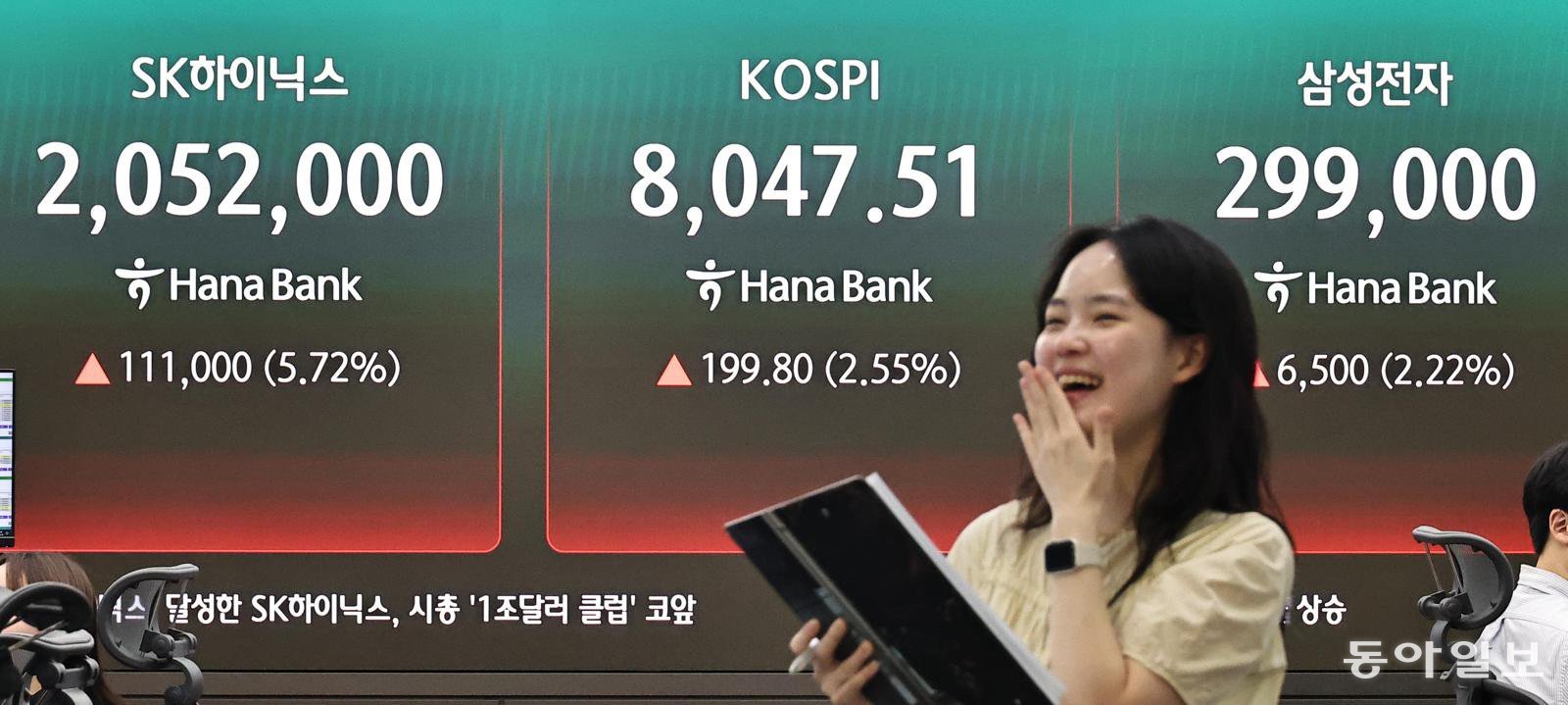
The closing level of the KOSPI is displayed on an electronic board in the dealing room at Hana Bank’s headquarters in Jung District, Seoul, on the afternoon of the 26th. The KOSPI, which during intraday trading had exceeded 8,100, closed above the 8,000 mark for the first time ever. Photo by Yang Hoe-sung yohan@donga.com
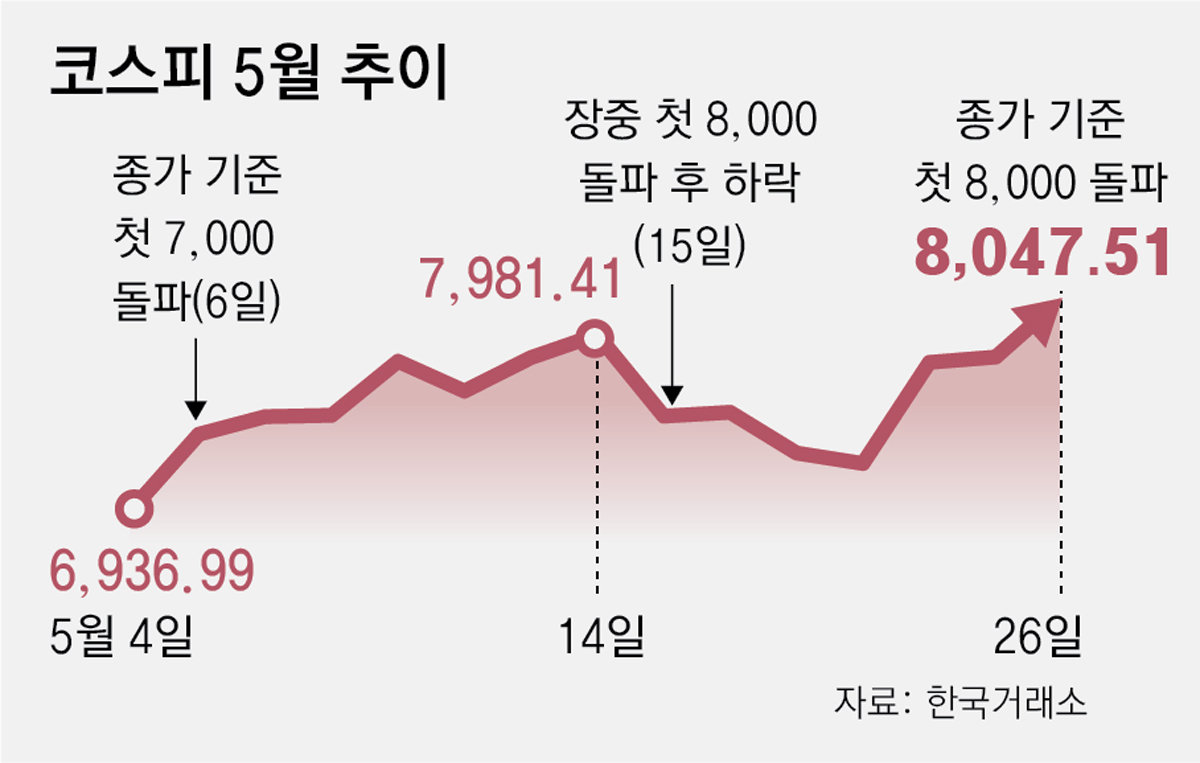
The KOSPI closed above 8,000 points, dubbed “Palcheonpi,” for the first time ever on a closing basis, only 13 trading days after it surpassed 7,000. The rise was driven by continued gains in artificial intelligence (AI) infrastructure-related stocks, on top of expectations for talks on reopening the Strait of Hormuz. Investor sentiment also appeared to be boosted ahead of the listing on the 27th of single-stock leveraged products that track the share prices of Samsung Electronics and SK hynix at ±2 times.
More securities firms are presenting KOSPI forecasts of “Manpi” (10,000) for this year. However, market participants are advised to note that factors remain which could increase KOSPI volatility.
● Intraday milestones: “KRW 300,000 Samsung,” “KRW 2.08 million Hynix”
On the day, the KOSPI closed at 8,047.51, up 199.80 points (2.55%) from the previous session. During intraday trading, it climbed as high as 8,131.15. Institutional investors led the index higher with net purchases of KRW 817.0 billion. This contrasted with foreigners, who recorded net sales of KRW 132.0 billion, and retail investors, who posted net sales of KRW 575.0 billion. Institutions attracted attention by logging net purchases of KRW 171.0 billion in the financial investment segment, where the impact of retail ETF buying is reflected. As expectations mounted for a rally ahead of the listing of single-stock leveraged products tracking Samsung Electronics and SK hynix, ETF inflows also increased.
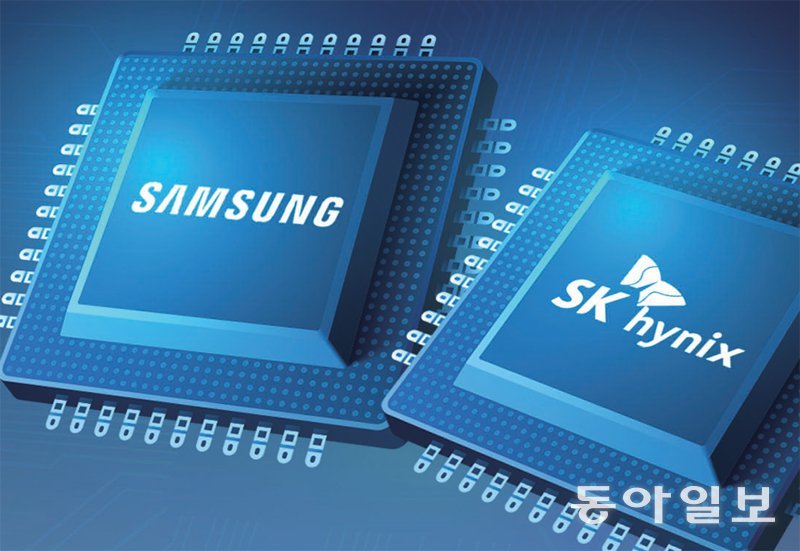
In fact, buying interest flowed into these two stocks. Samsung Electronics rose above KRW 300,000 intraday, while SK hynix jumped 5.72%, reaching KRW 2.08 million. According to financial information website CompaniesMarketCap, SK hynix’s global market capitalization ranking moved up two notches in one go, from 15th to 13th, overtaking U.S. firms Eli Lilly and Walmart on the day. Its market capitalization in dollar terms also moved closer to USD 1 trillion.
News that the United States and Iran had in principle agreed on conditions for ending hostilities, including the resumption of navigation through the Strait of Hormuz, also had an impact. In addition, Nvidia reported another record-breaking result on 20 May (local time), easing concerns about earnings deterioration stemming from large-scale AI infrastructure investments by U.S. big tech companies and helping drive semiconductor stocks higher.
The number of securities firms that are officially predicting a KOSPI breakthrough of 10,000 has increased. Nomura Securities set the KOSPI’s peak forecast for this year at 11,000. Domestic brokerages such as KB Securities (10,500), Eugene Investment & Securities (10,400), Hana Securities (10,380), and LS Securities (10,000) have also raised their year-end peak forecasts for the KOSPI.
● “Foreigners net sellers for 13 sessions… short-term risks warrant caution”
In the short term, some analysts warn that the KOSPI may enter a further correction phase. This is because foreigners have been net sellers for 13 consecutive trading days from the 7th through this session. During this period, foreigners logged net sales worth KRW 4.67060 trillion in the KOSPI market. As of this day, the won–dollar exchange rate in the Seoul foreign exchange market has remained above KRW 1,500 for seven consecutive trading days on a weekly closing basis.
Lee Hyo-seop, head of the Financial Industry Division at the Korea Capital Market Institute, said, “If foreigners’ net selling continues, the exchange rate will not fall below KRW 1,500, and downward pressure on the stock market will inevitably increase.”
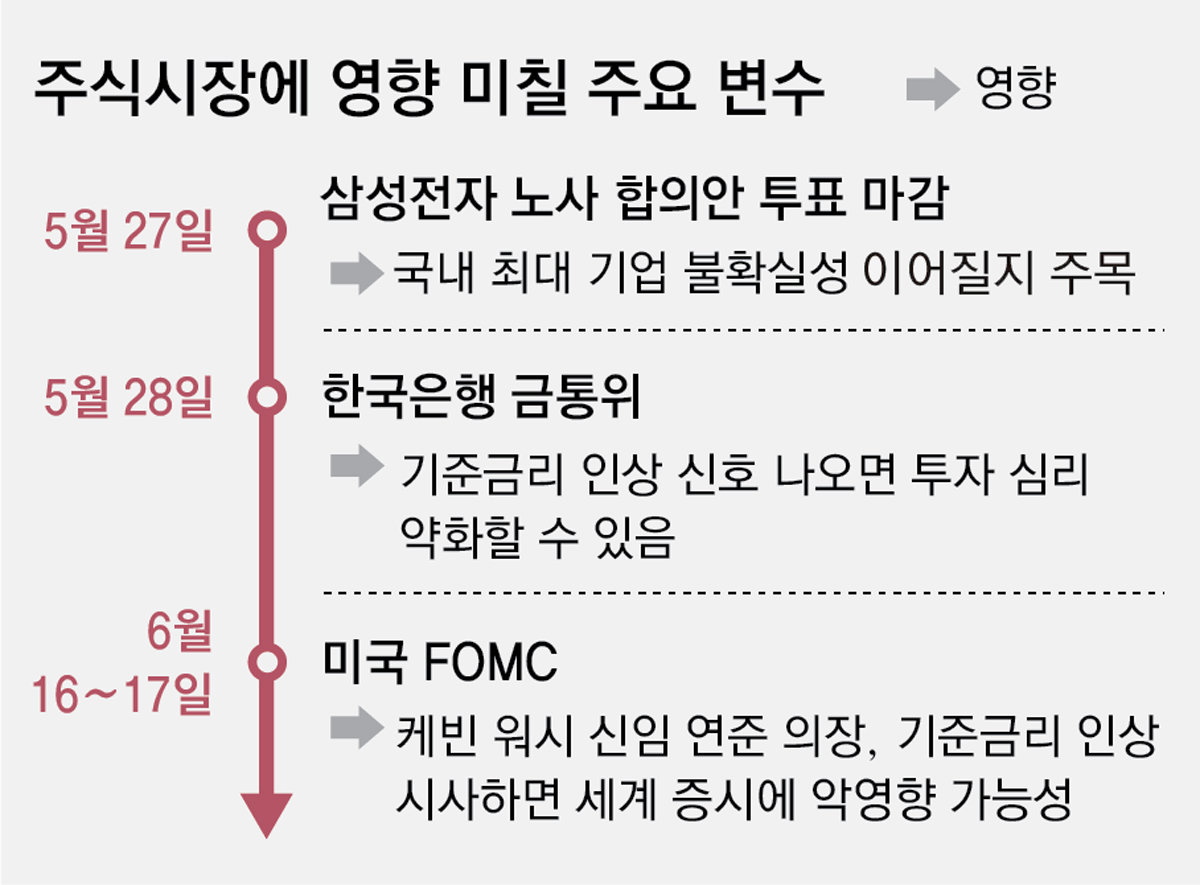
Short-term external factors could also amplify KOSPI volatility. Financial authorities are closely monitoring the possibility that the launch on the 27th of single-stock leveraged products, amid large price swings in Samsung Electronics and SK hynix, could lead to an excessive concentration of funds and heightened stock market volatility.
Another potential factor is whether the Bank of Korea’s Monetary Policy Board will send any signals regarding a base rate hike at its meeting on the 28th. Concerns are also emerging that, if new Federal Reserve Chair Kevin Warsh hints at a rate increase at next month’s Federal Open Market Committee (FOMC) meeting, global government bond yields could surge and investor sentiment could tighten. Jung Yong-taek, a researcher at IBK Investment & Securities, forecast, “Concerns over rate hikes could begin to grow in earnest after the Bank of Korea’s Monetary Policy Board meeting and next month’s U.S. FOMC,” adding, “This will act as a burden on the domestic stock market.”
ⓒ dongA.com. All rights reserved. Reproduction, redistribution, or use for AI training prohibited.
Popular News