ⓒNewsis
It has been discovered that when proteins in the body become deficient, the intestine regulates neurons in the brain to induce behavior that prioritizes the intake of essential amino acids, which are nutrients the body cannot synthesize on its own. The findings are drawing attention as a potential basis for research into treatments for obesity and eating disorders.
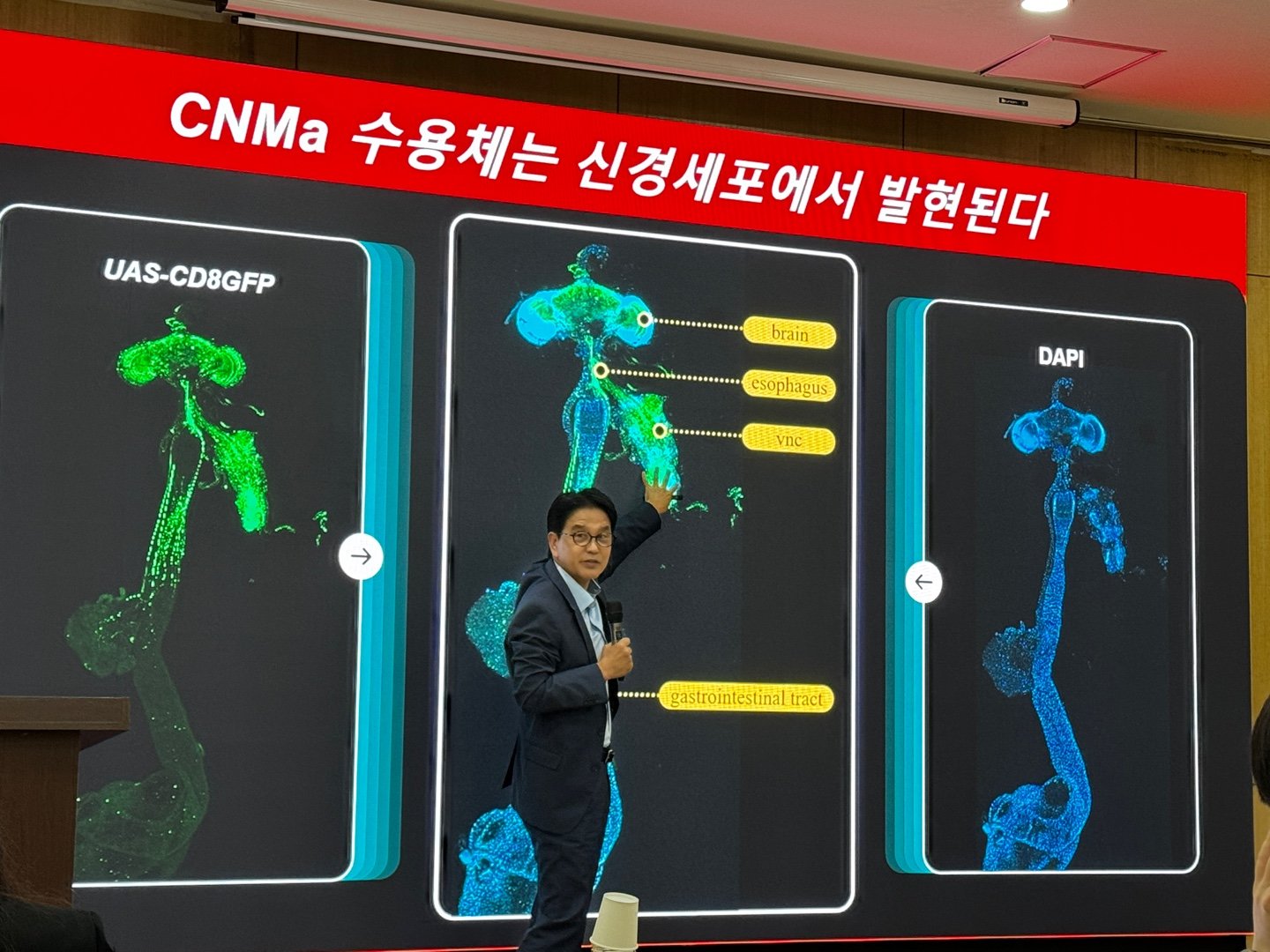
The Ministry of Science and ICT announced on the 22nd that the research team led by Seokhyeon Bae Seo, director of the Center for Microbiome and Aging Research at the Institute for Basic Science (IBS), together with a joint team from Seoul National University and Ewha Womans University, has identified the operating principle of the “gut-brain axis,” the connection system through which the gut and brain exchange signals. The results were published in the international journal Science on the 21st (local time).
The research team had previously revealed that when fruit flies are placed in a state of protein deficiency, a peptide hormone called “CNMa” is secreted from the gut, causing them to favor protein foods, and published these results in the international journal Nature in 2021. Peptide hormones are signaling substances formed by several amino acids linked together in a chain.
In this study, the team clarified the pathway by which CNMa signals are delivered to the brain and the behavioral principle behind the selection of specific nutrients. The key finding is that the gut-brain axis simultaneously activates a “fast neural pathway” and a “slow hormonal pathway.”
When intestinal epithelial cells detect protein deficiency, enteric neurons use the neurotransmitter acetylcholine to rapidly transmit signals directly to the brain, which then activates specific neurons called “R3m neurons” to induce the intake of essential amino acids. In the slower hormonal pathway, CNMa hormones reach the brain via the circulatory system and sustain protein-preferring behavior over a longer period.
CNMa signaling increases the intake of essential amino acids while suppressing the activity of “DH44 neurons,” which are responsible for carbohydrate intake. Rather than simply increasing meal size, it alters eating behavior so that essential amino acids are sought out before carbohydrates.
In mouse experiments, protein deficiency also led to behavior favoring essential amino acids. This was observed even in mice lacking FGF21, a key hormone in the protein deficiency response.
In a commentary in the same issue, Professors Stephen Simpson and David Raubenheimer of the University of Sydney in Australia assessed that “the gut serves as a key control hub for regulating protein appetite” and that the findings “will provide important clues for understanding human obesity.”
Seo stated that “most obesity treatments and appetite-regulating drugs make use of gut hormone signaling, but the effects and pathways by which naturally secreted gut hormones influence the brain and behavior have not been sufficiently studied.”
He added, “This study, which reveals the principle of nutrient selection by the gut-brain axis, is expected to become an important basis for research into treatments for obesity, metabolic diseases, and eating behavior disorders.”
ⓒ dongA.com. All rights reserved. Reproduction, redistribution, or use for AI training prohibited.
Popular News