Medidata has released its report “The State of AI in Clinical Trials 2026.” Source: Medidata
Analysis indicates that the use of AI (artificial intelligence) in clinical trials can enhance operational efficiency. Clinical trial solutions company Medidata announced on the 20th, through its report “The State of AI in Clinical Trials 2026,” that the use of AI in clinical trials is expanding and delivering results.
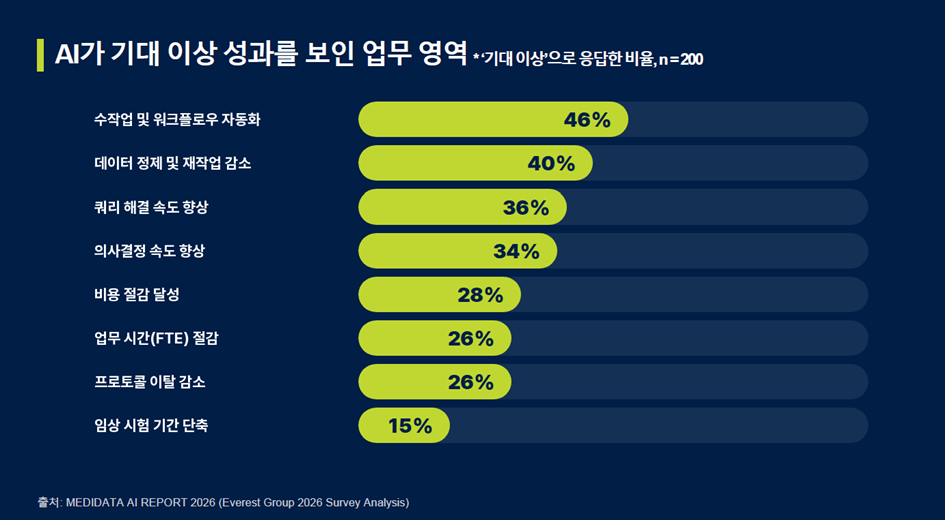
The report was prepared based on a survey conducted by Medidata and market research firm Everest Group of 200 clinical research experts worldwide. According to the report, 46.5% of respondents said they had adopted AI for task automation, data cleaning, and query resolution and experienced improvements that exceeded expectations.
Companies that adopted AI early were also able to shorten clinical trial timelines. Among companies that had used AI for more than 18 months, 29.7% reported feeling the effect of shorter clinical trial durations. The shares that reported improvements in workflow automation and data cleaning efficiency reached 62.2% and 48.6%, respectively. Medidata stated that the earlier companies adopted AI, the faster they achieved results across overall clinical operations, and projected that the performance gap depending on early AI adoption would widen further over the next two to three years.
Protocol and operational simulation were cited as areas where AI will be used in the future. This involves adopting AI to predict and analyze in advance, during the clinical trial design process, factors such as the likelihood of patient recruitment, operational efficiency of trial sites, and probability of protocol changes. In addition, 26.5% of respondents expected that digital twin technology—which digitally models patients, trial sites, and clinical trial environments to run simulations in virtual settings—would become a core technology within the next two to three years.
The report forecast that the use of AI in clinical trials will accelerate through 2030. Companies currently in the early stages of AI adoption are expected to complete their first full implementation cycle within 18–24 months. A full implementation cycle refers to the initial deployment phase during which companies expand AI from pilot and experimental stages into actual clinical operational environments. Furthermore, 92% of respondents said they plan to increase AI investment within the next one to two years, and 82% expected a 2–3 times return on investment (ROI) from AI adoption.
Medidata is incorporating AI functions into its platform in line with the broader trend of AI adoption across clinical trials. Drawing on data from more than 38,000 clinical trials and over 12 million patients, it supports insights required for clinical trials and automation of work processes. In the clinical trial design and planning stages, it uses database-driven AI and machine learning solutions. Based on historical clinical trial big data, the system identifies suitable patients to construct virtual control arms, thereby reducing the size of traditional control groups that receive existing treatments and enabling the study to proceed with fewer such patients. Medidata explained that, using this approach, it reduced the number of control group patients by about two-thirds in MediceLna’s clinical trial for a recurrent glioblastoma treatment.
The company also supports data management required for clinical trials. It operates an AI-based solution called “Clinical Data Studio” that integrates and analyzes data from various sources for rapid management. AI automatically detects data inconsistencies and anomalies across multiple sources, accelerating the pace of source data review.
A Medidata representative said, “Now is the time to consider how to leverage AI in clinical trials. Companies need to identify tasks where AI can be applied and redesign clinical operations workflows to maintain human oversight mechanisms.”
ⓒ dongA.com. All rights reserved. Reproduction, redistribution, or use for AI training prohibited.
Popular News