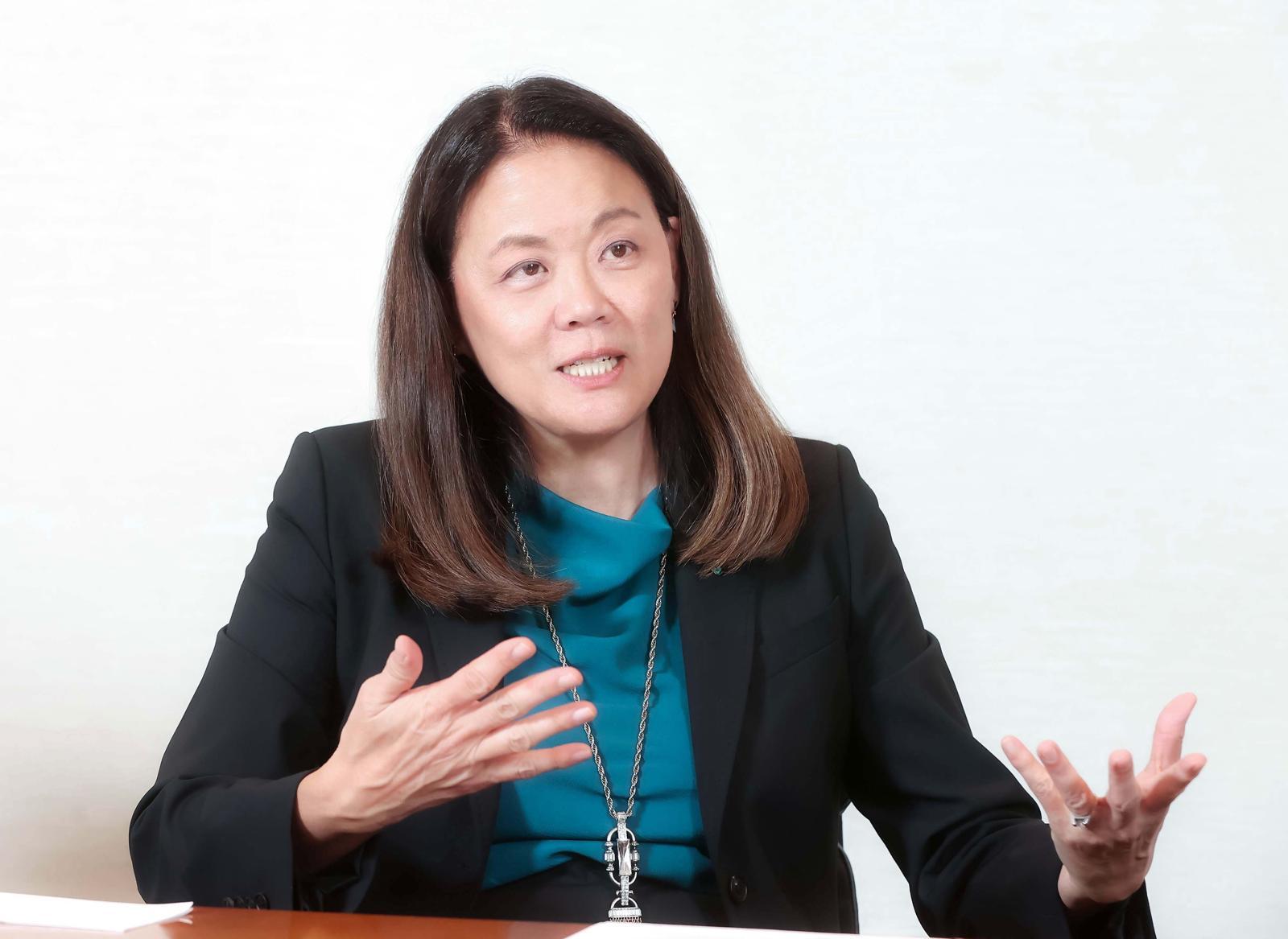
[Young-Old&] Grace Han, Head of Business Development, MSD Pacific Clinical research contracts signed with 12 companies including Alteogen Differentiation is key to licensing technology to Big Pharma
“The greatest strength of the Korean bio ecosystem is that it combines both the scale and quality of innovation. It was impressive to see the exploration of new biological mechanisms or approaches and the active willingness to take on more complex challenges.”
At MSD’s “Partnering Day,” held at COEX in Gangnam-gu, Seoul on the 27th of last month, Grace Han McMahon, Head of BD&L (Business Development & Licensing) for MSD Pacific (photo), shared these impressions after meeting with Korean biotech companies. Partnering Day is an event co-hosted by MSD Korea and the Korea Health Industry Development Institute (KHIDI), and on this day as well, business meetings between MSD and Korean companies took place one after another. Han stated, “Korea is counted among the top countries, alongside the United States, in the number of pembrolizumab (brand name Keytruda) combination study agreements,” adding, “This is an indicator that demonstrates the competitiveness and potential of the Korean bio ecosystem.”
MSD’s flagship “cash cow” at present is the immuno-oncology drug Keytruda. Keytruda generated sales of USD 31.6 billion (approximately KRW 46,556.3 billion) last year, accounting for 48.6% of MSD’s total revenue. From 2023 through last year, Keytruda has ranked first in global sales among single prescription drugs worldwide for three consecutive years. However, its patent will expire in 2028, and MSD is now actively seeking new growth engines to succeed Keytruda. Han said, “We are currently conducting 15 clinical trial collaboration and supply agreements (CTCSA) related to Keytruda with 12 Korean companies.”
A representative partner is Alteogen. The original Keytruda is administered as an intravenous injection that requires more than an hour of dosing time in hospital. Using Alteogen’s technology, MSD launched “Keytruda Qurex,” a subcutaneous formulation that can be injected in under one minute, in the U.S. market last year.
To strengthen cooperation with Korean companies, MSD also recently opened its BD&L (Business Development & Licensing) office within the Korea Health Industry Startup Innovation Center (K-BIC) of KHIDI in Jung-gu, Seoul. Han explained, “We have established a base that Korean companies can naturally turn to when they wish to discuss collaboration with MSD,” adding, “This opening is a move that demonstrates MSD’s continued commitment to investing in the Korean market.”
She emphasized that for companies seeking to out-license (LO) their technology to a global big pharma such as MSD, “clearly defining the problem the company aims to solve” is more important than anything else. After fully understanding the competitive landscape, it is necessary to persuasively explain in what respects the company’s technology is differentiated.
She also cited the need to share all data transparently with a partner as a key factor in concluding an agreement. Han said, “Even results that differ from expectations or data that are difficult to interpret must be shared without concealment,” adding, “This is because both parties must work together to reduce risk and derive clear conclusions through rigorous experiments and repeated verification.”
Choi Ji-won
AI-translated with ChatGPT. Provided as is; original Korean text prevails.
ⓒ dongA.com. All rights reserved. Reproduction, redistribution, or use for AI training prohibited.