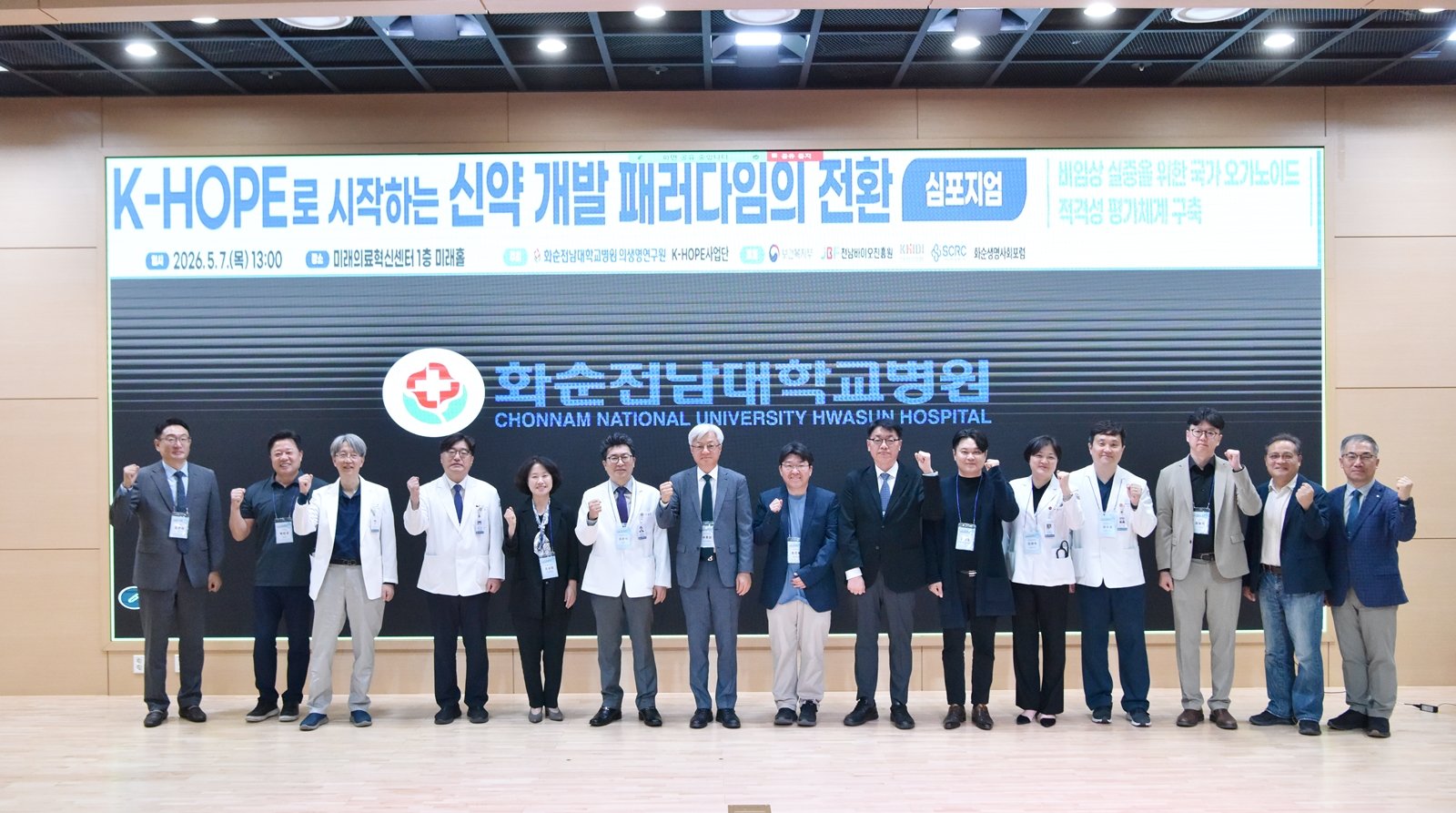
■ Hwasun Chonnam National University Hospital promotes new drug development through K-HOPE
Hwasun Chonnam National University Hospital has begun full-fledged discussions on building an organoid-based non-clinical evaluation system centered on the next-generation new drug development platform “K-HOPE (Korea-Hwasun Oncology Precision Biomedicine & Experimental Trials).”
The hospital recently announced that it held a symposium at the Mirae Hall of the Future Medical Innovation Center under the theme “Paradigm Shift in New Drug Development Starting with K-HOPE.”
The symposium was co-organized by the Biomedical Research Institute of Hwasun Chonnam National University Hospital and the K-HOPE project group, and was supported by the Jeonnam Bioindustry Foundation, the Korea Health Industry Development Institute, and the Hwasun Life Social Forum.
Researchers in the organoid field and industry stakeholders attended the event and shared regulatory trends and industrialization strategies.
K-HOPE is a project to establish a Korea-style, cancer-specialized digital smart clinical trial platform. The symposium was held under the subtitle “Establishment of a National Organoid Qualification Evaluation System for Non-clinical Validation.”
The hospital explained that it is pushing for a transition from conventional animal experiment-centered non-clinical research to a precision evaluation system utilizing patient-derived organoids.
Through this, it expects to more accurately predict drug responses and toxicity under conditions similar to the actual human environment, and to contribute to shortening new drug development timelines and improving success rates.
In addition, it plans to build a research platform integrating clinically linked data and develop it into a full-cycle model that connects basic and non-clinical research outcomes to actual clinical practice and industrialization.
■ “BRCA breast cancer patients do not need preventive contralateral mastectomy in advance”
Professor Cha Chi-hwan
A research team led by Professor Cha Chi-hwan of the Department of Surgery at Hanyang University Hospital reported study results showing that, in breast cancer patients with BRCA gene mutations, the risk of developing contralateral breast cancer varies not only by gene type but also according to the tumor’s biological characteristics.
The team conducted a multicenter cohort study involving 14 medical institutions in Korea and followed 4,009 breast cancer patients who underwent BRCA gene testing between 2008 and 2018 for approximately eight years.
As a result, patients with BRCA mutations had a significantly higher risk of developing contralateral breast cancer than non-carriers, and the 10-year cumulative incidence was about 7.8%. For patients with BRCA1 mutations, the rate was 9.1%, and for those with BRCA2 mutations, 5.8%, but the difference between the two groups was not statistically significant.
The research team applied matched analysis to finely stratify the patient groups. Among patients under 50 years of age with BRCA1 mutations, triple-negative breast cancer and high-grade tumors were associated with the occurrence of contralateral breast cancer, and among BRCA2 mutation carriers, a higher Ki-67 index tended to be associated with increased risk.
Professor Cha stated, “It is important to develop personalized treatment strategies that comprehensively take into account not only genetic factors but also tumor characteristics and the patient’s overall condition.” The study was published in the international journal “Breast Cancer Research.”
■ Concurrent dual gene mutations linked to autism spectrum disorder
A joint research team led by Professor Yoo Hee-jung of the Department of Psychiatry at Seoul National University Bundang Hospital and Professor Ahn Jun-yong of the Department of Biomedical Systems and Informatics at Korea University has identified a new genetic mechanism involved in the onset of autism spectrum disorder.
The team reported that it confirmed that even rare genetic variants with limited impact on their own show a clear association with autism when specific variants in two genes are present together.
The researchers analyzed a total of 59,168 genomic datasets from East Asian and European populations, including Korean families with autism, and identified gene pairs associated with autism. In East Asians, six gene pairs were identified, and in Europeans, 156 gene combinations were found; when both genes in each pair were mutated, the association with autism increased significantly. These gene pairs were found to be closely related to cytoskeletal functions involved in maintaining neuronal morphology and intercellular connections.
Through cell experiments, the team found no change when only one gene was suppressed, but when both genes were simultaneously suppressed, the formation of cilia on the cell surface decreased. Cilia are structures critical for normal brain development. The study also identified sex-based differences, such as the same genetic variants being associated with more severe symptoms in male patients with autism. The findings were published in the international journal “Genome Biology.”
ⓒ dongA.com. All rights reserved. Reproduction, redistribution, or use for AI training prohibited.
Popular News