Korea University Anam Hospital launches ‘Advanced Critical Care Medicine Project’
Equipped with cutting-edge devices for simultaneous surgery and procedures
New hybrid operating rooms to be established
Intensive care unit to expand to 135 beds
Bird’s-eye view of Korea University Anam Hospital. Korea University Anam Hospital has announced its “Advanced Critical Care Project.” The hospital plans to strengthen its role as a final treatment institution focusing on severe, emergency, trauma, and cardio-cerebrovascular diseases. Provided by Korea University Anam Hospital
《As population aging and the increase in critically ill patients fuel calls to redefine the role of tertiary general hospitals, Korea University Anam Hospital is moving to significantly expand its critical care infrastructure. By comprehensively increasing intensive care units, operating rooms, and emergency beds, the hospital plans to reinforce an acute and severe disease-centered care system and further enhance the final treatment capabilities that are the core function of tertiary general hospitals.》
Significant expansion of emergency and critical care capacity
Korea University Anam Hospital announced that on the 19th it will hold a groundbreaking ceremony for the main building remodeling and surgical department expansion, and will fully launch the “Advanced Critical Care Project,” worth approximately KRW 120 billion. The project will be carried out in stages over about 36 months, focusing on remodeling the 1st and 2nd wards of the main building and expanding the surgical department. The remodeling area will be 3,402 pyeong (approximately 11,246㎡), and the expansion area will be 2,077 pyeong (approximately 6,866㎡).
This project goes beyond simple facility expansion and focuses on redesigning the entire patient care flow. It is designed so that emergency response, testing and diagnosis, surgery, intensive care, and recovery stages are organically connected from the time patients arrive at the hospital, with the aim of reducing waiting times in the treatment process for critically ill patients and improving treatment efficiency.
The first area Anam Hospital will strengthen is its intensive care capacity. To respond to the increase in elderly patients and the expansion of cardio-cerebrovascular diseases, the hospital will significantly increase intensive care units, emergency beds, and infection-control beds. Through ward remodeling, it will add 32 intensive care unit beds, 14 beds in a high-risk maternal intensive care unit, 5 emergency beds, and 19 isolation beds for infectious diseases. After completion, the hospital will operate 22 high-risk maternal intensive care unit beds, 34 isolation beds, and 35 emergency beds, and the intensive care unit will be expanded to a total of 135 beds.
In particular, the expanded intensive care unit will be configured mainly with single rooms to strengthen infection control functions. Since infection response capabilities have attracted attention as a core function of tertiary general hospitals after the coronavirus disease (COVID-19) pandemic, this reflects an intention to establish a structure that can respond to infectious disease crises even in normal times. Anam Hospital also plans to upgrade its stroke intensive care unit, sterile ward, and psychiatric ward to enhance its capacity to treat patients requiring intensive care.
Operating rooms to increase by 30%… strengthening capabilities for high-risk surgery Reinforcement of surgical functions is also a key pillar of this project. The operating room area will be expanded by about 30% compared to the current size, adding eight operating rooms. In particular, a new hybrid operating room will be built, enabling surgery and procedures to be performed simultaneously using advanced imaging equipment.
Hybrid operating rooms offer advantages in treating patients who require rapid decision-making and complex interventions, such as those with severe trauma or cardio-cerebrovascular diseases. As surgery and endovascular interventions can be performed immediately in parallel according to changes in the patient’s condition, emergency response can be accelerated. Anam Hospital plans to use this to strengthen its capabilities in treating regional trauma patients and patients with complex cardio-cerebrovascular diseases. The central supply department and the radiology department will also be expanded to improve the operational efficiency of the operating rooms.
The establishment of a smart hospital system will proceed in parallel. Existing multi-bed rooms will be converted into smart wards, and a monitoring system will be introduced in the wards to centrally manage patient safety data. This system will be linked with the nation’s first cloud-based “Next-Generation Hospital Information System (PHIS).” Medical staff will be able to check key safety information, such as patient status and fall risk, in real time via electronic dashboards at the ward stations, and each patient room will be able to display safety information for individual patients immediately.
Korea University Anam Hospital explained that the construction of the smart system is not merely a digital transformation, but a move toward improving patient safety and medical efficiency. Once patient data can be managed in real time through linkage with the hospital information system, it will be possible to respond more swiftly to changes in the condition of critically ill patients.
Through this project, Anam Hospital has set a goal of strengthening its role as a final treatment institution focusing on severe, emergency, trauma, and cardio-cerebrovascular diseases. In particular, it maintains the position that the healthcare delivery system should be reorganized so that tertiary general hospitals focus on high-risk, complex treatments rather than providing comprehensive care for all diseases.
Han Seung-beom, President of Korea University Anam Hospital, said, “This project is an important turning point for Anam Hospital, as it simultaneously advances its critical care and surgical functions as a final treatment institution,” adding, “By upgrading our care system based on advanced technologies, we will build a patient-centered, high-complexity treatment system and evolve into a future-oriented hospital.”
“Tertiary hospitals must focus on high-complexity treatments that are difficult for other hospitals to perform”
Interview with Han Seung-beom, President of Korea University Anam Hospital
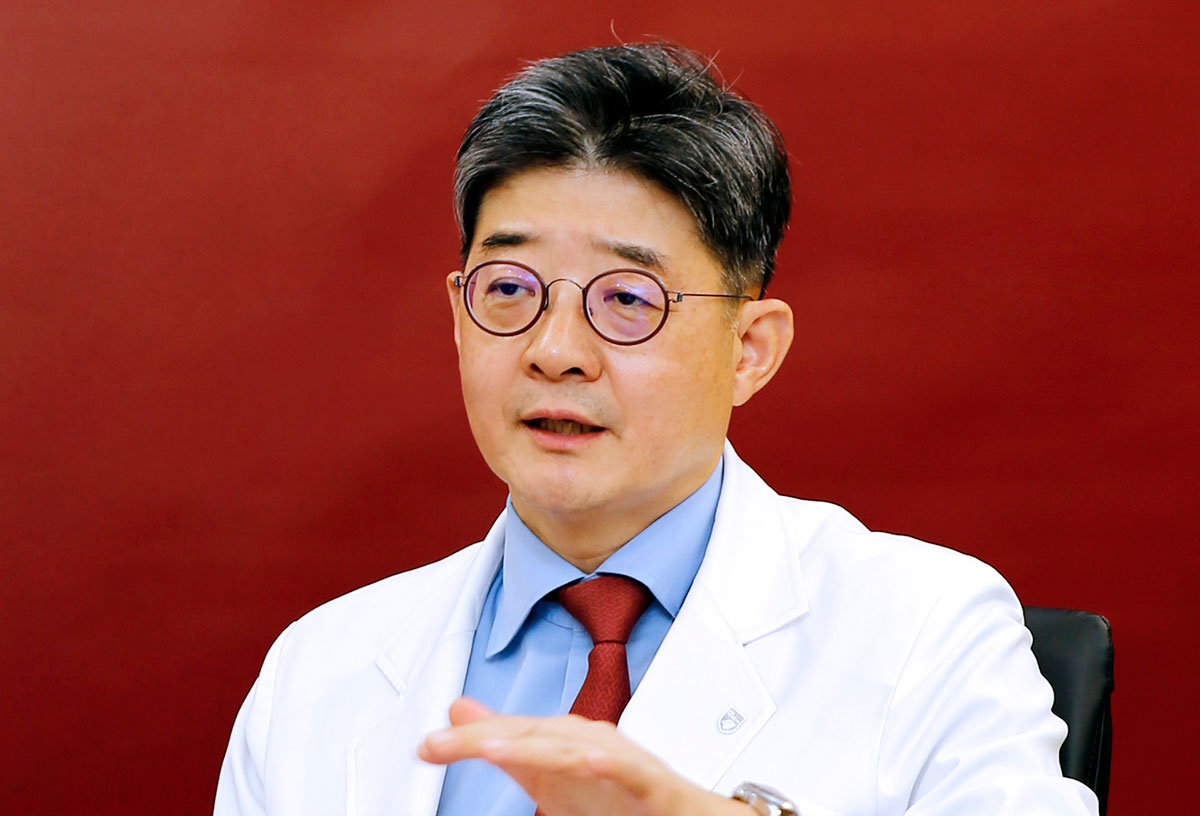
Han Seung-beom, President of Korea University Anam Hospital.
Korea University Anam Hospital has launched its “Advanced Critical Care Project,” which will invest about KRW 120 billion to significantly expand intensive care units, operating rooms, and emergency beds. Han Seung-beom, President of Korea University Anam Hospital, described this initiative not as a simple facility expansion but as a “redesign of the critical care system.” He stressed that, given the rapid increase in cardio-cerebrovascular diseases and critically ill emergency patients due to population aging, the role of tertiary general hospitals must also change. Han said, “Going forward, tertiary general hospitals should focus on their role as final treatment institutions responsible for high-complexity treatments and surgeries that are difficult for other hospitals to perform.” The following is a Q&A with President Han.
―Why do you describe this project as a ‘redesign of the critical care system’? “As population aging accelerates, cardio-cerebrovascular diseases and critically ill emergency patients are rapidly increasing. The role of tertiary general hospitals must now become more clearly centered on acute and severe diseases. It is important not merely to increase the number of beds, but to create a structure in which emergency response, testing and diagnosis, surgery, and intensive care are organically connected within a single flow.”
―What are the key areas of focus in this project?
“Through this project, we sought to secure as many beds as possible for critically ill patients. Due to the ward bed quota system, it is impossible to increase the number of beds indefinitely, but we aimed to increase emergency beds so that patients who visit the emergency room can receive timely treatment and then proceed smoothly to admission and surgery.”
―The expansion of the high-risk maternal intensive care unit is also included. “I believe that treatment of high-risk mothers and newborns is a social responsibility that tertiary general hospitals must assume. In reality, there are not many hospitals capable of providing such care. University hospitals should take on that role.”
―Is there a gap between how the government and the front line of care define ‘critical’? “There is indeed a difference between what is perceived as critical in the field and what is defined by policy standards. For example, hip fracture surgery in elderly patients is extremely high-risk. It is so closely related to survival that surgery within 48 hours is considered crucial. Yet, from a policy perspective, such cases may sometimes be classified as non-vital areas. In the field, we focus on the patient’s condition and risk level, whereas policy tends to view severity by disease category.”
―There is criticism that the current critical care system is designed mainly around cancer. “In Korea, there is a strong tendency to view critical illness mainly through the lens of cancer. If this structure persists, all hospitals will inevitably move in the direction of becoming cancer specialty hospitals. The roles of hospitals need to be further subdivided so that there are hospitals that excel in cancer, hospitals that specialize in cardiovascular diseases, and hospitals that focus on neurosurgery, and so on.”
―How should the recurring problems of the “emergency patient transfer system” be addressed? “The issue of the emergency patient transfer system is sometimes handled too superficially. What is important is a system that ensures patients receive appropriate treatment in the right place. Hospitals capable of performing the same type of surgery should be grouped at the regional level, and an on-call system should be managed and coordinated at the national level.”
―What is the significance of establishing a hybrid operating room?
“A hybrid operating room is not simply about bringing in one more piece of equipment. The structure itself must be newly designed. Since it enables surgery and procedures to be performed simultaneously based on advanced imaging equipment, it can enhance treatment capabilities for patients such as regional trauma cases or those with cardio-cerebrovascular diseases, where time and speed are critical.”
―Building a smart hospital is also a key component. “If patient status, blood pressure, and other vital signs can be monitored in real time in the ward and linked with the hospital information system, patient safety can be significantly improved. Ultimately, future hospitals will operate based on data. The direction should not be simple digitalization, but enhancing patient safety and treatment efficiency.”
―What is your vision of a future-oriented hospital? “Our goal is to become a leading, top-tier tertiary general hospital in Korea. However, I believe it must be a hospital with a human touch, not just a large-scale institution. I want to build a future-oriented hospital that not only excels in surgery, but also seriously considers its social role and responsibilities.”
ⓒ dongA.com. All rights reserved. Reproduction, redistribution, or use for AI training prohibited.
Popular News