Rental of “wearable robots” for Jeju farmers Engineered to cut work fatigue by 85%
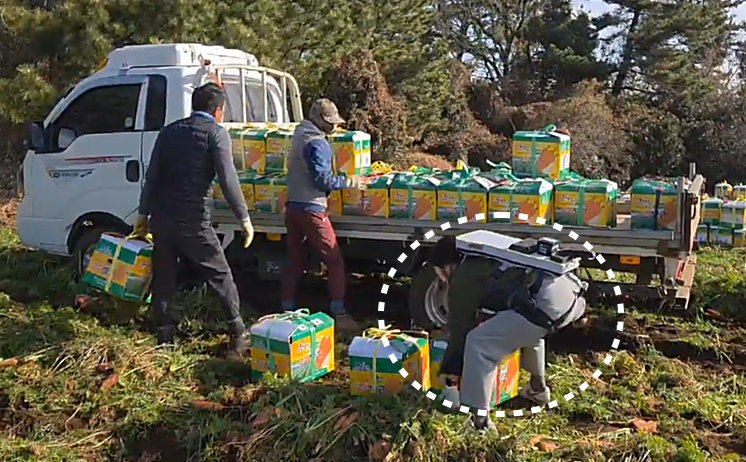
A worker (white circle) wearing a wearable robot is lifting a carrot box in a carrot field in Jeju. Provided by Jeju Province.
As the aging of farming households in Jeju intensifies, “wearable robots” that reduce the burden of heavy loads are being deployed in the field. The Jeju Special Self-Governing Province announced on the 27th that it will operate a wearable robot rental service for farmers and farming organizations in the province.
A wearable robot is a device worn on the body to assist muscular strength. It has been developed in a vest type tailored to Jeju’s agricultural environment, such as for tangerine harvesting. It provides up to 25 kgf (kilogram-force) of assistance to the waist and is designed to reduce work fatigue by about 35% during repetitive bending tasks or when handling heavy objects. It is also equipped with functions that measure biometric signals and send emergency alerts by linking with a mobile app. This makes it possible to manage workers’ health conditions and respond to emergencies such as falls.
Jeju Province produced 42 robots last year through the “Advanced ICT Wearable Robot Development Project for Farmers.” From October of the same year, it distributed the robots on a trial basis to 35 farms in the province (32 individual farms and 3 organizations) to check performance and improve the equipment. Rental applications can be submitted year-round through a dedicated system operated by the implementing agency, Jeju Technopark. Kim Nam-jin, Director General of the Innovation Industry Bureau of Jeju Province, said, “The wearable robot rental service is a case of actually applying advanced technology in line with the needs of the agricultural field and farmers,” adding that “it will serve as a catalyst for the spread of AI and digital transformation.” The aging of farming households is also pronounced. As of 2024, among Jeju’s farming population of 68,696, those aged 70 or older numbered 19,532, the largest group. They were followed by 15,303 people in their 60s and 14,042 in their 50s. Those under 30 numbered only 11,687. The figures for those in their 40s and 30s were 5,443 and 2,689, respectively.
Song Eun-beom
AI-translated with ChatGPT. Provided as is; original Korean text prevails.
ⓒ dongA.com. All rights reserved. Reproduction, redistribution, or use for AI training prohibited.