Preventing a repeat of the ‘Wando firefighter line-of-duty death’ “In the long term, expand and deploy up to 100 units”
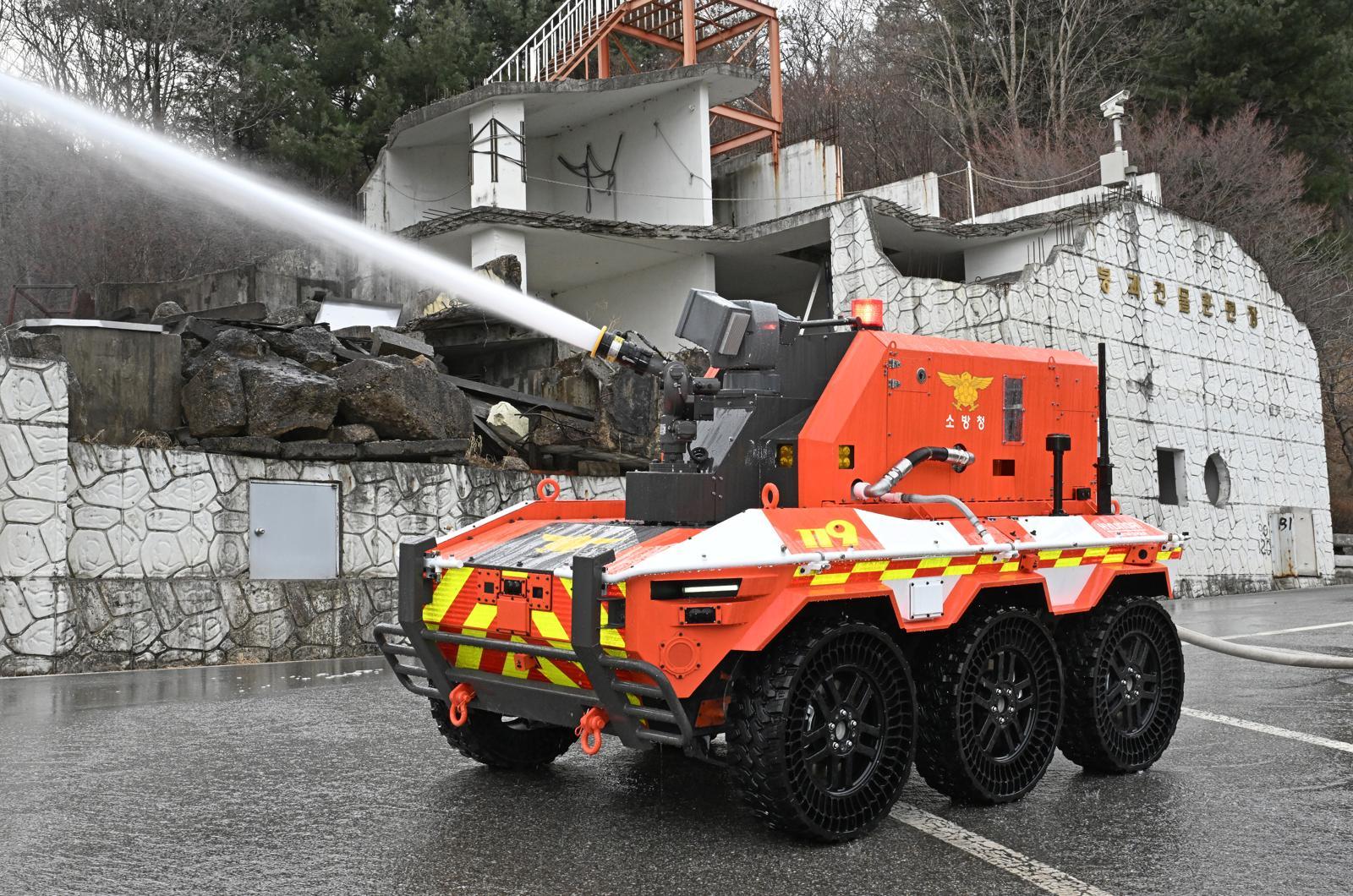
The National Fire Agency has decided to significantly expand the introduction of unmanned firefighting robots (photo). The measure follows a series of fatalities at large fire scenes, including the death in the line of duty of two firefighters last month during efforts to extinguish a fire at a seafood processing factory in Wando, South Jeolla Province.
Commissioner General Kim Seung-ryong of the National Fire Agency held a meeting in Sejong Special Self-Governing City on the 27th and stated, “There has been a sharp increase in ‘hard-to-access disasters,’ where the approach of firefighters is difficult due to toxic gases and explosion risks,” adding, “We plan to introduce 18 unmanned firefighting robots over the next two years and, in the longer term, expand the fleet to 100 units for deployment across fire headquarters in cities and provinces nationwide.”
The National Fire Agency is currently conducting pilot operations with four unmanned firefighting robots jointly developed with Hyundai Motor Group that were donated this year. Based on tracked mobility equipment and capable of remote control, the unmanned firefighting robots are deployed on a priority basis at sites where firefighters cannot immediately enter, such as buildings at risk of collapse, high-temperature environments, and areas with potential for explosions or toxic gases. With heat-resistant design, they can operate in high-temperature environments of 500–800 degrees Celsius and can transmit real-time video information via infrared cameras even in smoke-filled spaces. However, an official at the National Fire Agency noted that “securing a budget is the key challenge for further expansion.” The current price per unit is approximately KRW 2.4 billion.
Preventive measures to reduce the occurrence of large-scale fires themselves will also be strengthened. The National Fire Agency has decided to pursue a shift away from the existing fire station-led inspection system to a pan-government joint inspection framework in which relevant agencies such as those overseeing construction, electricity, and gas participate together. In addition, it plans to upgrade the fire incident database (DB), designate workplaces with repeated fire incidents as “priority fire safety management targets,” and focus on conducting joint firefighting drills and fire safety inspections at those sites.
Han Jae-hee
AI-translated with ChatGPT. Provided as is; original Korean text prevails.
ⓒ dongA.com. All rights reserved. Reproduction, redistribution, or use for AI training prohibited.