LG Group is transforming into a future-oriented tech company centered on services and solutions. Building on the robust technological capabilities accumulated in traditional manufacturing sectors such as home appliances and chemicals, the group is now accelerating a major transition from simple product sales to becoming a “platform” company that solves customer problems and delivers new experiences. Chairman Koo Kwang-mo has emphasized a management philosophy focused on “speed,” stating that swift execution takes priority over perfect planning. This “speed of execution” is manifesting as powerful structural reforms across LG’s core businesses. In particular, in the field of artificial intelligence (AI), the group is accelerating AI Transformation (AX) across all areas from manufacturing processes to customer services by leveraging its proprietary model “EXAONE.” Growth in next-generation mobility–centered vehicle components and battery businesses is also noteworthy. Based on its battery technologies, LG is presenting solutions across most mobility domains, from in-vehicle infotainment to lamps and powertrains, thereby solidifying its position as an integrated core partner. This article looks into the story of LG Group, which is changing quietly but rapidly.
In 1848, the discovery of a gold mine in California, United States, ushered in the era of the so-called Gold Rush. However, not everyone made a fortune. Those who ultimately profited were not the miners who flocked to dig for gold, but the merchants who sold them supplies such as jeans. This gave rise to the saying, “The one who sells the jeans laughs, not the one who mines the gold.”
Today, the world is entering the era of artificial intelligence (AI). As leading companies worldwide prepare for the AI age, the ones already reaping gains are semiconductor companies, because semiconductors are an essential component for AI development. It is effectively an AI-era Gold Rush.
By contrast, LG Group has quietly been building a different playing field. Historically, the miners who failed to profit from the Gold Rush were those who headed to the mines late and without technology. Early entrants with technological capabilities could share in the gains together with the Levi Strauss brothers, who sold jeans.
LG Chairman Koo Kwang-mo emphasizes swift AX implementation during an executives’ meeting held on the 25th of last month at Namsan Leadership Center in Jung-gu, Seoul. Provided by LG
For LG Group, which does not have a semiconductor business division, the recent semiconductor boom has effectively been “someone else’s party.” However, LG Group Chairman Koo Kwang-mo has treated this not as a crisis but as an opportunity for restructuring. The group aims to position itself as an early entrant into the AI era within its own business domains.
LG Group’s AI strategy consists of two major pillars: hardware and software. The hardware pillar is LG Electronics’ “AI home appliance ecosystem,” while the software pillar is the “EXAONE” model developed by LG AI Research Institute.
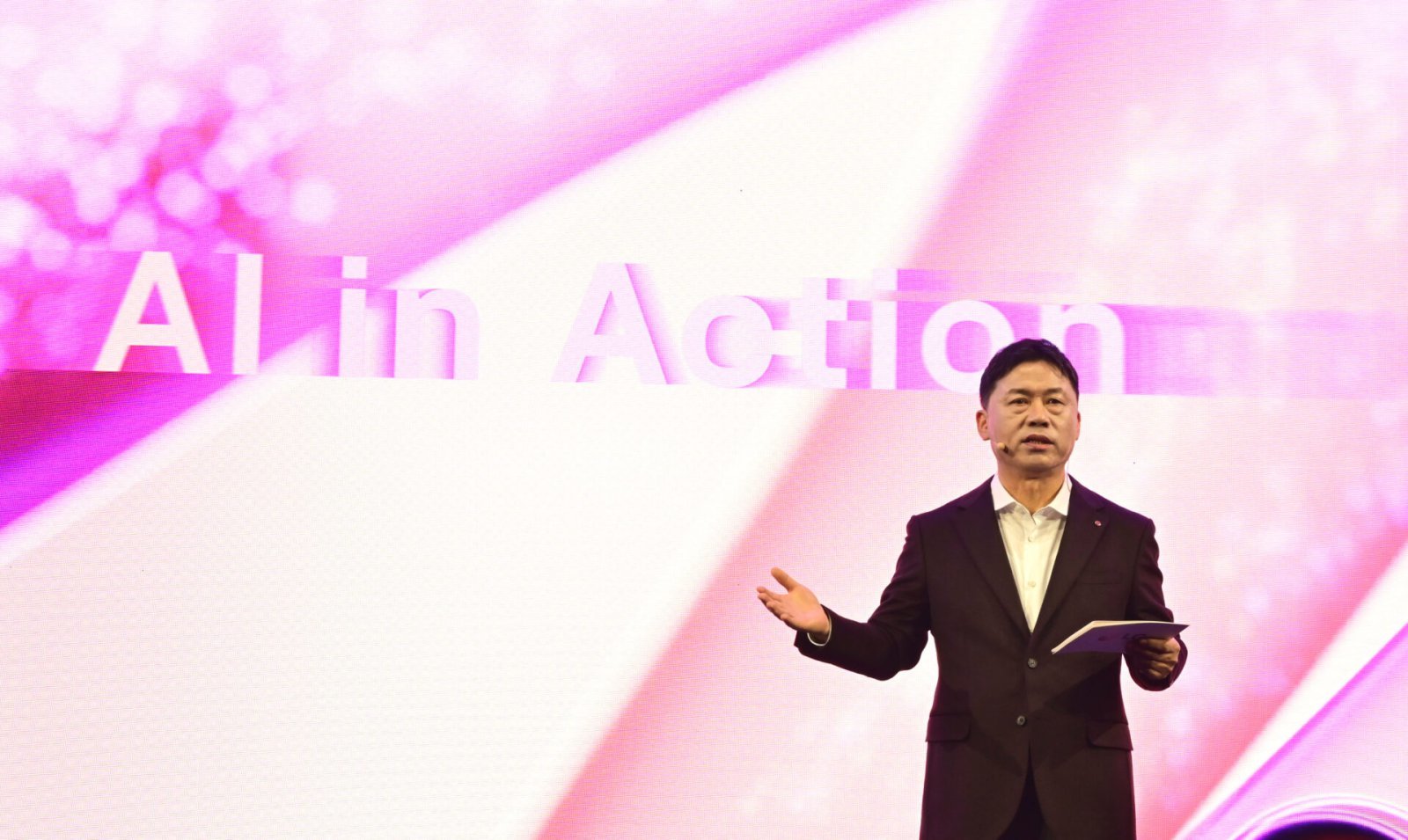
LG Electronics CEO Ryu Jae-cheol presents an “AI experience” that connects customers’ everyday spaces with a variety of solutions based on Affectionate Intelligence at CES 2026, emphasizing that the company is ready to lead the era of “AI in Action.” Provided by LG Electronics
From empathy to action… LG Electronics’ AI home appliance ecosystem
LG Electronics’ AI strategy has become increasingly concrete over the years. At last year’s CES, the world’s largest home appliance and IT exhibition, the company put forward the concept of “Affectionate Intelligence.” It pledged to shape customers’ changing lives through Affectionate Intelligence embedded in a range of spaces—from homes and offices to hobby spaces and vehicles—from morning until night.
At this year’s CES, the company advanced its vision one step further with “AI in Action.” CEO Ryu Jae-cheol raised the question, “What if Affectionate Intelligence started acting directly for customers?” He stressed that LG Electronics is ready to lead the era of AI in Action based on ▲ outstanding products ▲ Affectionate Intelligence ▲ a connected ecosystem. The core vision is the “Zero Labor Home,” in which devices in the home perceive situations and act autonomously, moving beyond appliances that simply have AI functions embedded.
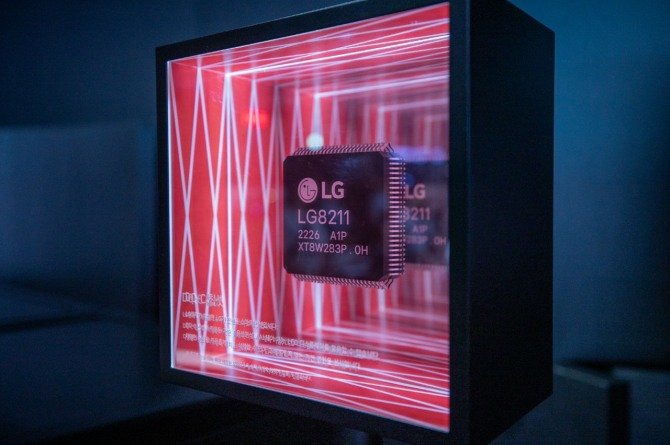
LG Electronics’ on-device AI chip for home use, “DQ-C.” Provided by LG Electronics
Underpinning this vision is “DQ-C,” an on-device AI chip for home use that LG Electronics unveiled in 2023 after more than three years of research and development. This chip performs AI computation directly on the device without relying on the cloud, and its application is being expanded to major appliances such as washing machines, dryers and air conditioners, forming the foundation of LG’s hardware competitiveness.
LG Group also plans to move aggressively into the robotics business based on AI technologies. At a regular shareholders’ meeting last month, CEO Ryu said, “Among the various business opportunities emerging with the spread of AI, we will focus on four key areas where LG Electronics’ capabilities can generate synergies,” adding, “We will make this year the first year of full-scale expansion of the robotics business.”
In particular, the company is expanding its business-to-business (B2B) operations by directly designing and manufacturing actuators, a core component that accounts for a large portion of robot costs, and supplying them to global robot manufacturers. It aims to establish itself as a key supplier based on a mass-production infrastructure capable of producing about 45 million units annually. In addition, as new businesses such as data center (AIDC) cooling solutions enter full swing, expectations for a “value re-rating” are also emerging.
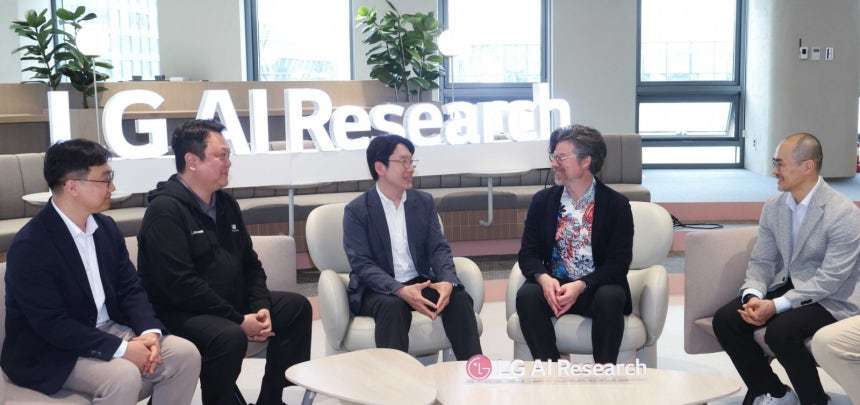
On the 21st at LG AI Research Institute in Magok, Seoul, (from left) Lee Jin-sik, Head of EXAONE Lab at LG AI Research Institute; Kim Yoo-chul, Head of Strategy at LG AI Research Institute; Lim Woo-hyung, Co-Head of LG AI Research Institute; Bryan Catanzaro, Vice President of Applied Research at NVIDIA; and Jung So-young, Country Manager of NVIDIA Korea, meet to strengthen their technology alliance. Provided by LG
EXAONE goes global… the heart of the AI strategy
The core of LG’s software AI strategy is LG AI Research Institute, established in 2020. EXAONE, the large-scale AI model developed by the institute, began as Korea’s first multimodal model and has now fully entered the global frontier competition for AI leadership. “K-EXAONE,” unveiled in January this year as the first outcome of the national flagship AI project, scored 32 points on the intelligence index of Artificial Analysis, a global AI performance evaluation agency, ranking seventh in the world among open-weight models and first among domestic models. It is the only Korean model listed in the global top 10, which is otherwise dominated by Chinese (six) and US (three) models.

This month, the institute released EXAONE 4.5, which significantly enhances visual information processing and logical reasoning capabilities. EXAONE 4.5 outperformed OpenAI’s GPT-5 mini in major indicators for science, technology, engineering and mathematics (STEM), thereby demonstrating global-level technological competitiveness. This serves as a preparatory step for expanding the modalities of K-EXAONE. After the second phase of the project concludes in August this year, LG AI Research Institute plans to embark in earnest on modality expansion.
To expand the K-EXAONE ecosystem, the institute is also strengthening its technology alliance with NVIDIA. The parties plan to broaden cooperation by combining EXAONE with NVIDIA’s “Nemotron” open ecosystem to jointly develop domain-specialized models. LG AI Research Institute and NVIDIA have maintained close technical collaboration throughout the development of EXAONE 3.0, K-EXAONE and EXAONE 4.5.
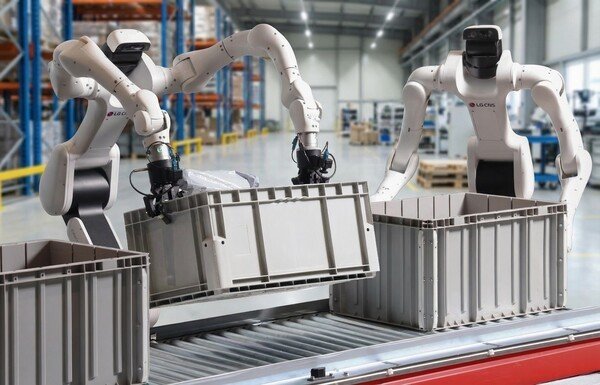
A scene of LG CNS training the Dexmate humanoid robot for deployment in industrial sites. Provided by LG CNS
“One Team AI” strategy maximizes synergy across affiliates
It is not only LG AI Research Institute and LG Electronics that are preparing for the AI era. Affiliates such as LG Energy Solution, LG Display, LG Innotek and LG Uplus have established a “one team” collaboration system to jointly enhance AI competitiveness. This reflects the judgment that in an environment of global supply chain restructuring and rising geopolitical risks, the competitiveness of partners directly translates into corporate competitiveness.
The industry is watching closely to see whether LG Group will succeed in reshaping the playing field. Even without a semiconductor division, if the group can effectively combine its hardware know-how in home appliances, its proprietary EXAONE model and the one-team strategy among affiliates, expectations are that LG Group could secure a leading position as an “AI powerhouse.”
Understanding LG Group’s AI strategy through Q&A
Q. What is LG Electronics’ DQ-C chip?
A. The DQ-C chip adopts an “on-device AI” approach that performs AI computations directly within the device without going through cloud servers. This fundamentally eliminates the risk of users’ life data being leaked externally.
The DQ-C chip analyzes user behavior inside the appliance and diagnoses the product’s condition in real time. It effectively provides the foundation for continuously evolving the functions of home appliances, much like updating a smartphone app.
LG Electronics regards DQ-C as the core platform for AI home appliances. The company is reportedly planning to begin mass production of DQ-C2, an enhanced version, in the first half of this year. It intends to install the chip in major AI appliances to be launched this year, including TVs, washing machines and robot vacuum cleaners.
Q. How is the performance of EXAONE 4.5?
A. EXAONE 4.5 has strengths in accurately reading and reasoning over complex documents commonly used in industrial settings, such as contracts, technical drawings, financial statements and scanned documents.
It has also proven its competitiveness in terms of performance. It scored an average of 77.3 across five indicators measuring STEM (science, technology, engineering and mathematics) performance, surpassing OpenAI’s GPT-5 mini (73.5), Anthropic’s Claude Sonnet 4.5 (74.6) and China’s Qwen3 235B (77.0).
In the average score across 13 visual capability evaluation indicators, EXAONE 4.5 outperformed GPT-5 mini and Claude Sonnet 4.5 as well. In particular, on LiveCodeBench, a coding performance indicator, it achieved a score of 81.4, exceeding Google’s latest model Gemma 4 (80.0).
Furthermore, EXAONE 4.5 has 33 billion parameters (33B), about one-seventh the size of the existing K-EXAONE, but by applying a hybrid attention architecture and other techniques, it has achieved comparable performance in text understanding and reasoning.
Q. What outcomes has the collaboration between LG AI Research Institute and NVIDIA produced?
A. During the development of EXAONE, LG AI Research Institute utilized NVIDIA’s Nemotron open dataset to ensure data training quality, while NVIDIA supported optimization of AI model training and improvements in inference performance and efficiency by providing its latest GPU, Blackwell, along with its AI development platform (NeMo Framework) and TensorRT-LLM, software for enhancing inference performance.
The collaboration has yielded tangible results. In the recent “AI Index Report” published by the Stanford University Institute for Human-Centered Artificial Intelligence (HAI) in the United States, Korea ranked third after the United States and China in terms of the number of noteworthy AI models, with five models selected. Of these, four were from LG AI Research Institute’s EXAONE series: ▲ “EXAONE Deep,” Korea’s first inference model ▲ “EXAONE Path 2.0,” a medical-specialized AI ▲ “EXAONE 4.0,” Korea’s first hybrid model ▲ “K-EXAONE,” the national flagship AI model.

ⓒ dongA.com. All rights reserved. Reproduction, redistribution, or use for AI training prohibited.
Popular News