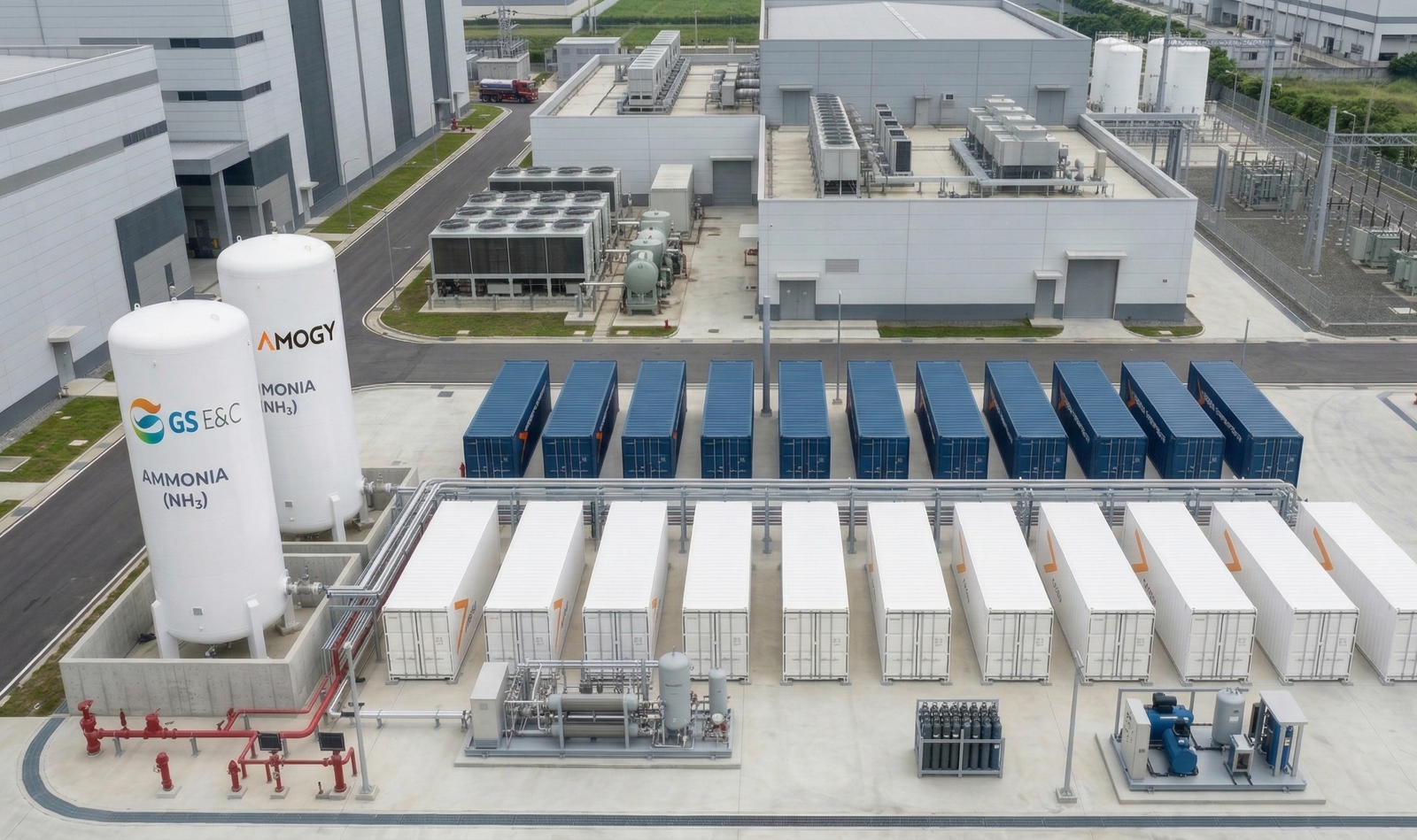
Concept diagram of the “carbon-free distributed power generation” project being promoted by GS Engineering & Construction and Amogy. Provided by GS E&C
GS Engineering & Construction (GS E&C) announced on the 10th that it will make a full-scale entry into the carbon-free power business in partnership with US company Amogy.
The two companies have signed a joint venture (JV) agreement for a green ammonia-based distributed generation business and plan to expand the project into a commercial plant of up to 40 MW after conducting a demonstration project in Pohang.
The joint venture is being promoted to establish a new model of carbon-free power generation by combining GS E&C’s capabilities in plant engineering, procurement and construction (EPC) with Amogy’s ammonia-based hydrogen conversion technology. In particular, it is seen as significant in that it is a strategic collaboration aimed at securing next-generation energy sources that can replace existing fossil fuel power generation, while responding to the global energy transition trend toward the expansion of distributed power systems.
Amogy is a company that possesses technology to produce power by decomposing ammonia into hydrogen and then using the hydrogen as fuel. Ammonia is attracting attention as a next-generation clean energy source because it is relatively easy to store and transport and does not emit carbon dioxide during combustion. Based on this technology, the two companies plan to realize a distributed generation model capable of producing power without the need for separate large-scale power plants.
GS E&C stated that the green ammonia-based distributed generation model being pursued by the two companies is expected to be highly efficient, as it can be installed on relatively small sites and enables power to be produced and supplied directly near demand centers. In particular, when applied in areas with concentrated power demand, such as industrial complexes, it is evaluated as an alternative that can reduce transmission losses and at the same time dramatically lower greenhouse gas emissions.
The two companies plan to carry out a 1 MW demonstration power plant project in a specialized distributed energy zone within the Yeongilman Industrial Complex in Pohang. The project is based on the concept of “local production for local consumption” (地産地消), whereby power produced locally is consumed locally, with the goal of easing the burden on the central power grid while enhancing energy self-sufficiency. In addition, after verifying technological stability and economic feasibility through the demonstration project, the companies intend to move ahead with full-scale commercialization.
GS E&C plans to use this demonstration project as a springboard to expand power generation capacity to up to 40 MW and operate commercial plants for tenant companies within industrial complexes. With carbon emission regulations being strengthened and corporate demand for a stable supply of carbon-free power increasing, the company expects the relevant market to grow rapidly.
Going forward, the companies will actively pursue entry into global markets beyond domestic projects. As demand for carbon-free distributed generation is expanding particularly in regions with strict carbon regulations, such as Europe and North America, they plan to leverage this project as a basis for winning overseas orders.
A GS E&C representative said, “Through this joint venture, we have laid the foundation to lead a new market for carbon-free power generation based on green ammonia,” adding, “We will successfully carry out the Pohang demonstration project to secure technological capabilities and, on this basis, continue to expand our energy business portfolio.”
Meanwhile, GS E&C is actively expanding its eco-friendly energy business to respond to the national greenhouse gas reduction target (NDC) and tightening global carbon regulations. In particular, as corporate burdens increase due to rising carbon credit prices and the introduction of the Carbon Border Adjustment Mechanism (CBAM), the company expects industrial demand for carbon-free power to grow rapidly and is fostering related businesses as future growth engines.
ⓒ dongA.com. All rights reserved. Reproduction, redistribution, or use for AI training prohibited.
Popular News