■ Development of a Predictive Model for Delayed Recurrence in Young Breast Cancer Patients, etc.
A model has been developed that can predict the risk of recurrence after 5 years in young breast cancer patients. Estrogen receptor-positive (ER+) and human epidermal growth factor receptor 2-negative (HER2-) breast cancer shows good initial treatment outcomes but is characterized by continued recurrence even 5 years after surgery, making long-term management important.
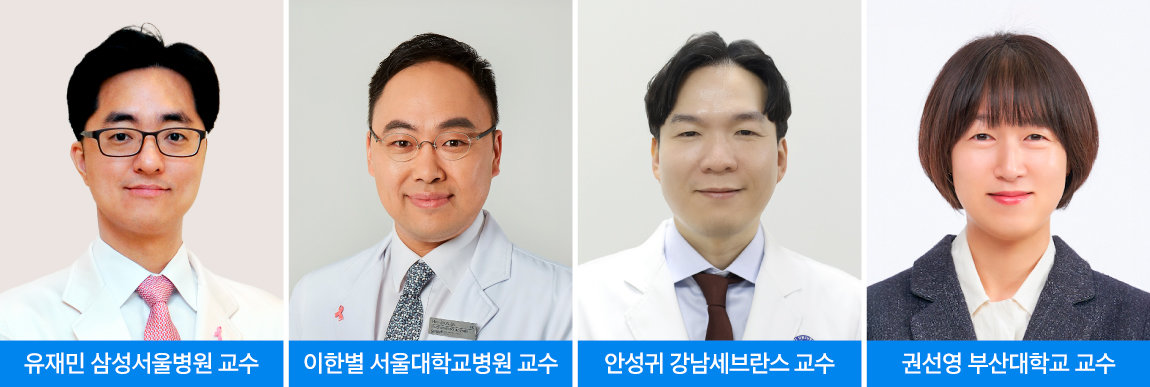
A research team led by Professor Yoo Jae Min of the Department of Breast Surgery at Samsung Medical Center, Professor Lee Han Byul of the Division of Breast and Endocrine Surgery at Seoul National University Hospital, Professor Ahn Sung Kwi of the Department of Breast Surgery at Gangnam Severance Hospital, and Professor Kwon Sun Young of Pusan National University developed a delayed recurrence prediction model for premenopausal patients aged 45 or younger and published it in the international journal The Breast. The team analyzed 1,701 patients who had no recurrence for 5 years after surgery between 2000 and 2011, and among them, 6.3% experienced distant metastatic recurrence between 5 and 10 years. The researchers built an artificial intelligence (AI)-based model (AUC=0.78) that predicts recurrence risk using only eight clinical variables, including age, tumor size, and number of lymph node metastases. Analysis showed that the high-risk group had more than seven times the recurrence risk of the low-risk group, and that extending hormone therapy in the high-risk group reduced recurrence risk by approximately 68%.
The research team stated, “For young patients, the survival period is long, so managing delayed recurrence is crucial,” adding, “This model is expected to help in determining treatment strategies.”
■ Uijeongbu Eulji University Medical Center Holds Robotic Surgery Symposium
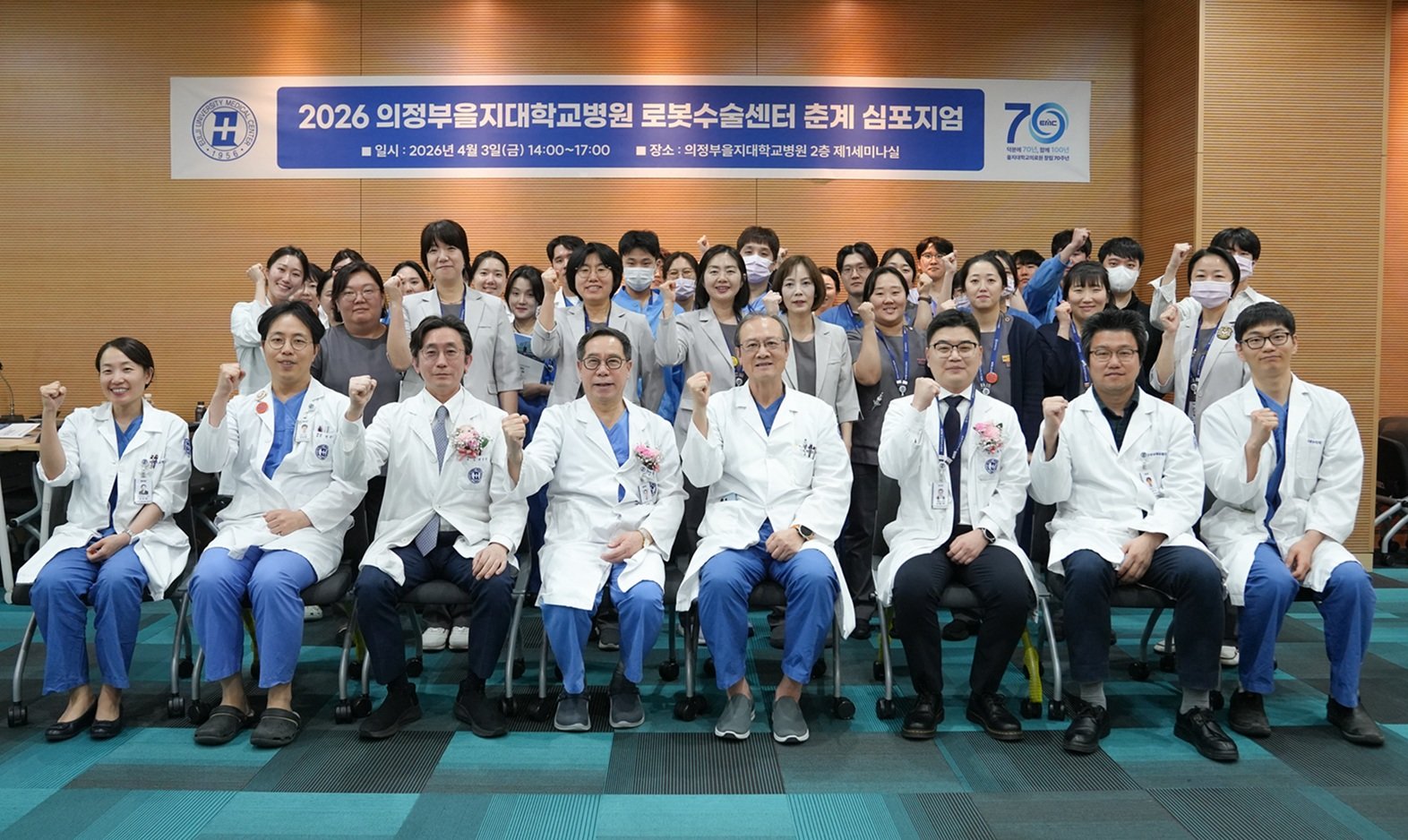
Uijeongbu Eulji University Medical Center announced that on the 3rd it held the “2026 Spring Robotic Surgery Center Symposium,” sharing the latest insights into robotic surgery and clinical application cases. The event was organized to facilitate academic exchange centered on robotic surgery experiences by department, with medical staff from inside and outside the hospital in attendance.
In the first session, Robotic Surgery Center Director Park Jin Sung (Department of Urology) presented the center’s current operating status and future development direction. Professor Nam Kyung Sik of the Department of Thoracic and Cardiovascular Surgery then presented cases of applying robotic surgery to lung, esophageal, and mediastinal tumors, explaining its potential use in complex thoracic procedures.
In the second session, Professor Park Shin Hoo of the Department of Gastrointestinal Surgery compared laparoscopic and robotic approaches in gastrointestinal surgery and introduced the latest trends in minimally invasive surgery. Professor Na Chung Sil of the Department of Thyroid and Endocrine Surgery reviewed both the advantages and limitations of robotic thyroid surgery and proposed clinical application strategies.
Uijeongbu Eulji University Medical Center is expanding the use of robotic surgery across various departments, including Urology, Obstetrics and Gynecology, and Hepatobiliary and Pancreatic Surgery. Director Park Jin Sung stated, “We will broaden the scope of application through collaboration among departments,” while Hospital Director Song Hyun commented, “We will strengthen precision medicine as a regional hub surgical center.”
■ Symposium on the Present and Future of AI Health Check-ups
As artificial intelligence (AI) technology in the health check-up field expands beyond image reading and lesion detection into disease prevention and personalized management, the health screening paradigm is changing. In line with this trend, a symposium will be held to examine the present and future of AI health check-ups.
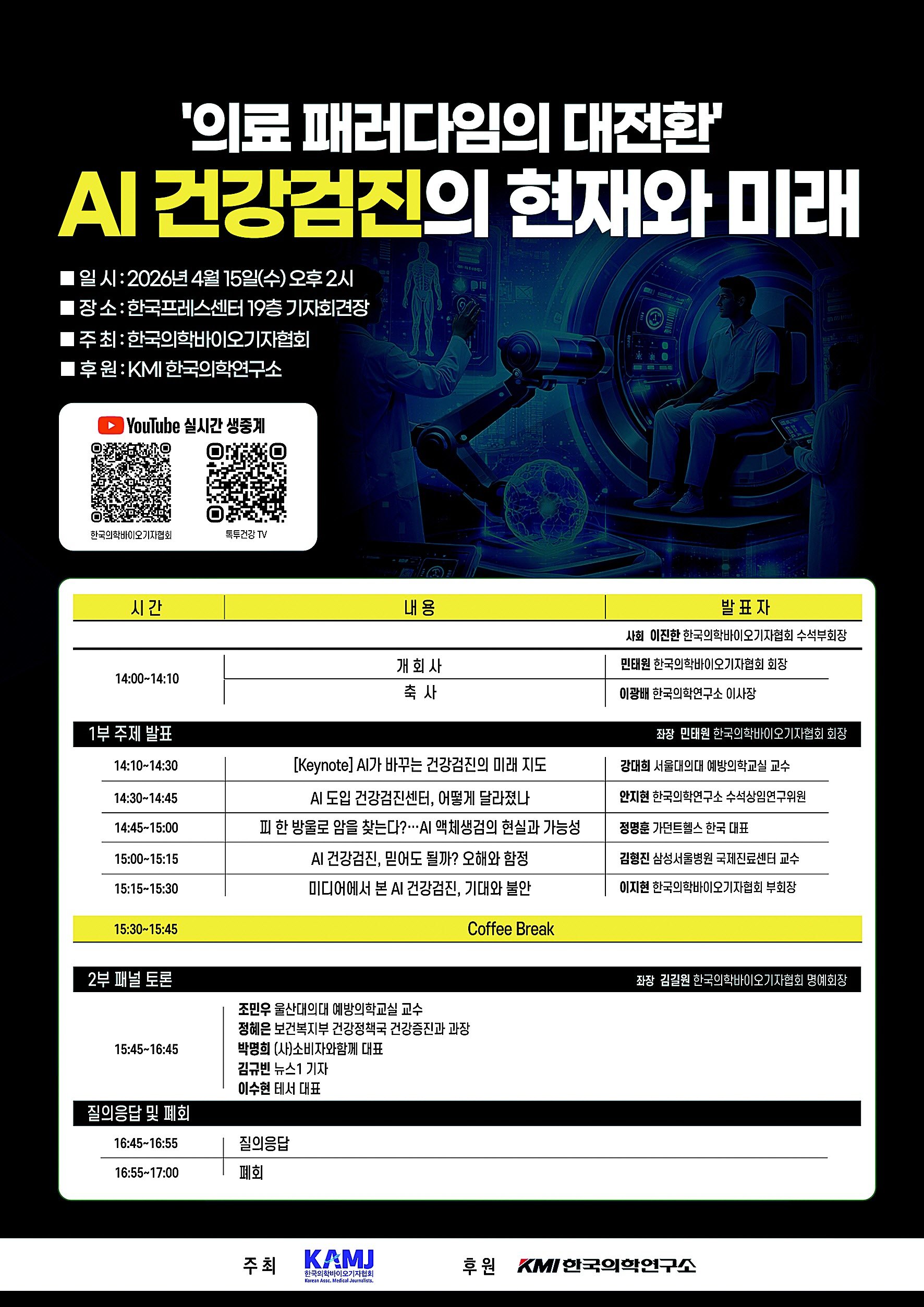
The Korea Medical & Bio Press Association (Chairman Min Tae Won) announced that it will hold a symposium titled “Great Shift in the Medical Paradigm: The Present and Future of AI Health Check-ups” at 2 p.m. on the 15th at the Korea Press Center in Jung-gu, Seoul.
In Part 1, starting with a keynote lecture by Professor Kang Dae Hee of the Department of Preventive Medicine at Seoul National University College of Medicine, presentations will cover topics including changes in screening centers adopting AI, the potential of AI-based liquid biopsy, the reliability and limitations of AI health check-ups, and expectations and concerns from a media perspective. In Part 2, Honorary Chairman Kim Kil Won of the association will chair a panel discussion involving experts from the medical community, government, industry, and the media.
The event is sponsored by the Korea Medical Institute (KMI) and will be broadcast live through the association’s and “Talk to Health TV” YouTube channels.
■ Miracell Stem Cell Extraction System Wins U.S. FDA Clearance
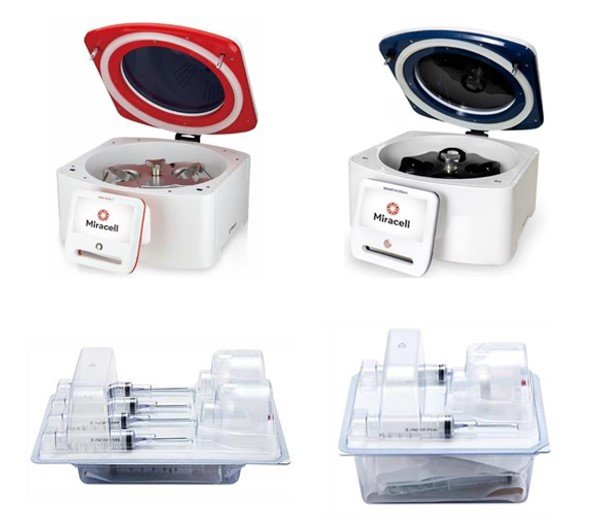
Stem cell specialist company Miracell announced that its stem cell extraction system “Smart MCell” and its dedicated kits (BSC Blood Kit, BMSC Bone Marrow Kit) have obtained 510(k) clearance from the U.S. Food and Drug Administration (FDA).
This clearance was granted after the system passed an equivalence evaluation with “SmartPReP,” developed by the Immune Disease Institute (IDI) of Harvard Medical School and used worldwide. The company explained that this demonstrates its technological capabilities are at a global level.
Smart MCell is characterized by improved yield and purity while preserving the biological characteristics of cells. In particular, the company stated that it has achieved high-purity cell extraction through the design of the device and kits, and has enhanced cell activity by applying an optical system inside the device.
A Miracell representative said, “The higher the cell purity, the greater the therapeutic effect,” adding, “With this clearance recognizing our technology, we plan to accelerate our entry into global markets.”
ⓒ dongA.com. All rights reserved. Reproduction, redistribution, or use for AI training prohibited.
Popular News