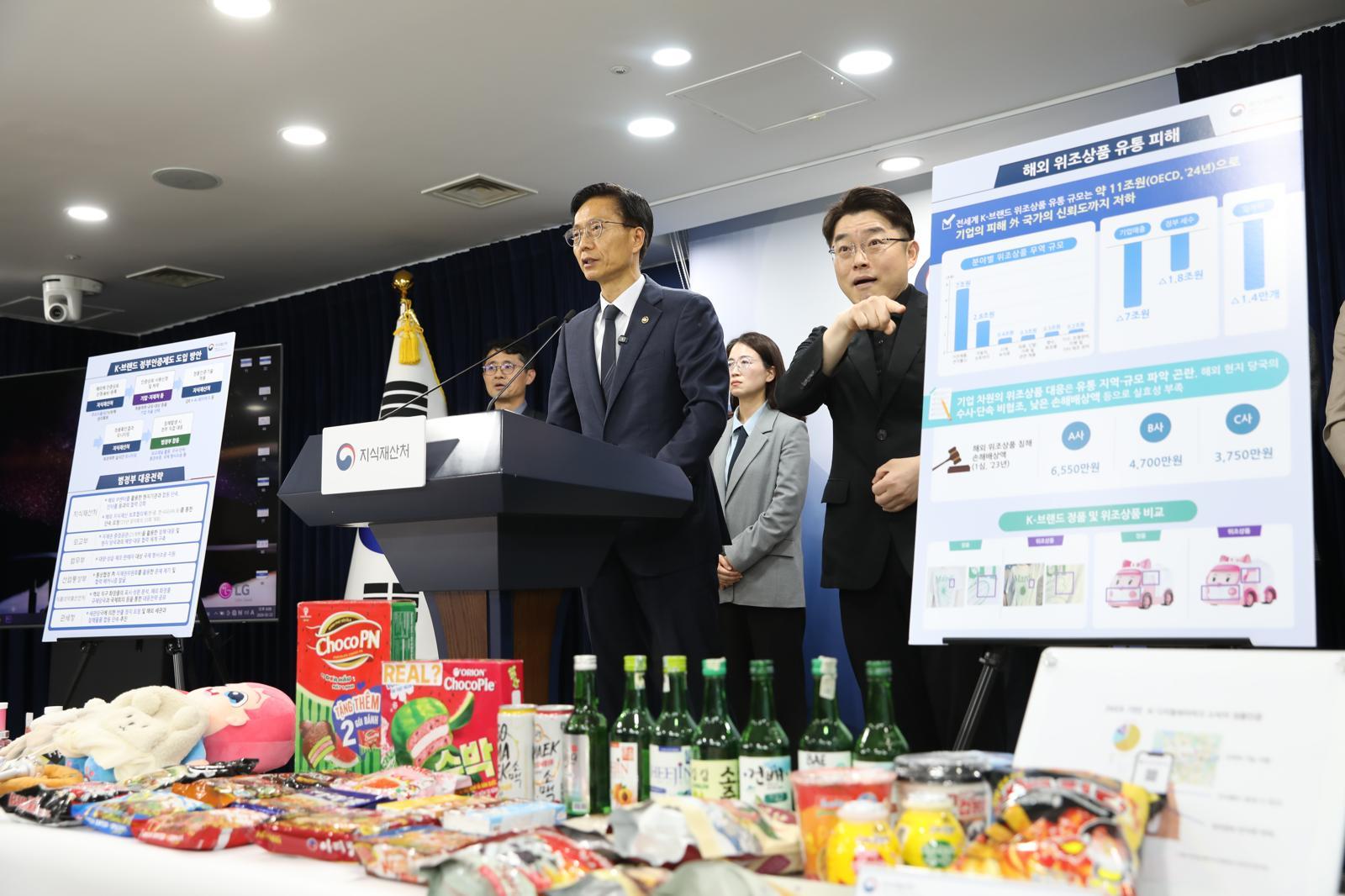
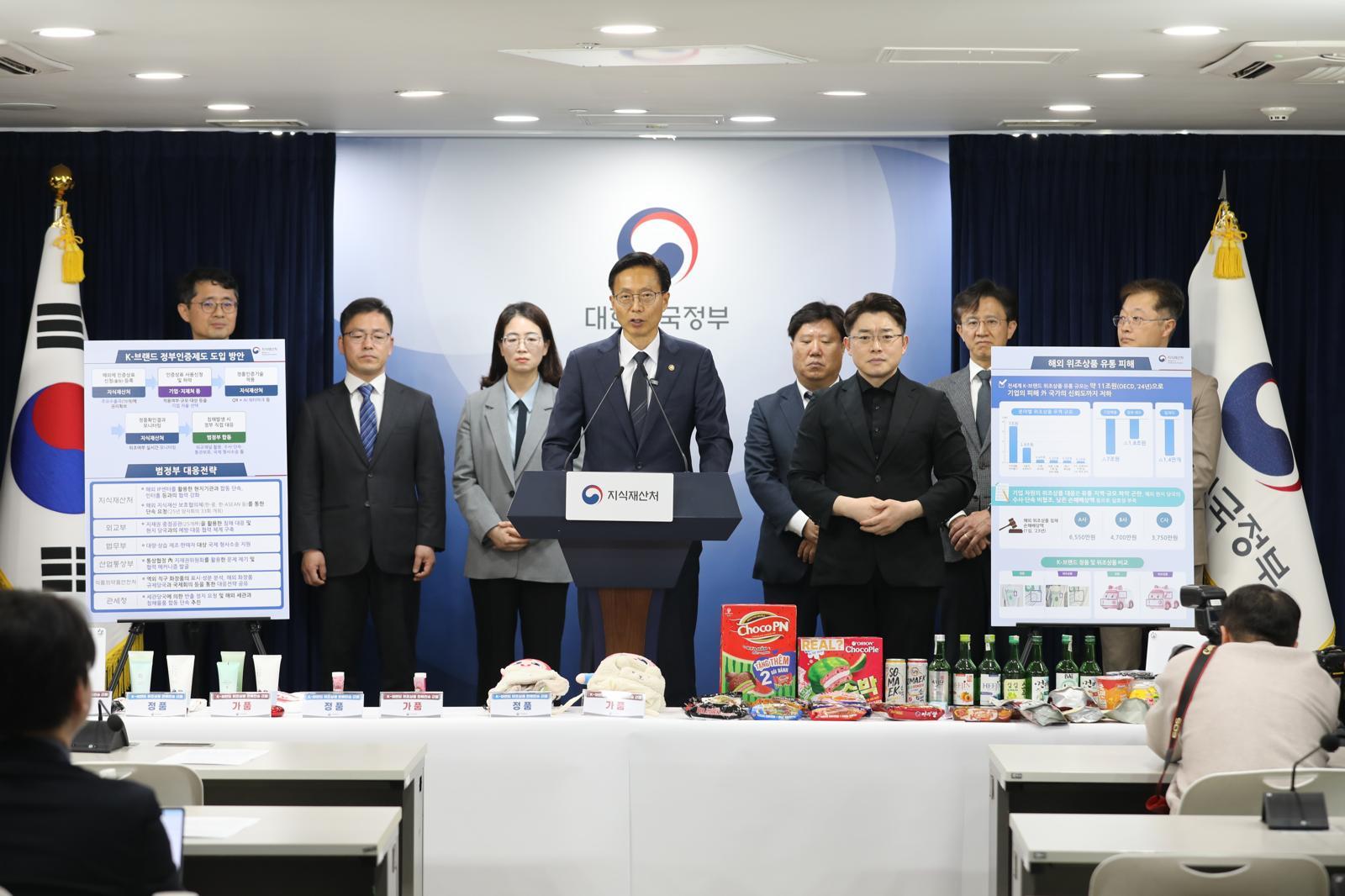
On 31 March at the Government Complex Seoul in Jongno-gu, Seoul, Kim Yong-seon, Commissioner of the Intellectual Property Office, explains the “K-Brand Government Certification System” to respond to counterfeit K-brand products. Provided by the Intellectual Property Office.
The government will introduce a “K-Brand Government Certification System,” under which it becomes the trademark holder for the relevant products, to resolve the growing issue of counterfeit K-brand products overseas. Until now, the government has only provided support when companies faced counterfeit product problems, but it now intends to become a direct party and exercise rights itself.
According to the Intellectual Property Office on 1 April, from the second half of the year (July–December) the government will operate a system under which it directly responds to the manufacture and distribution of counterfeit goods overseas as the rights holder of the K-brand certification trademark. The K-brand government certification trademark is a mark by which the government certifies that a product is from a Korean company. The government plans to develop the certification trademark by June and register it in 70 countries including those in Southeast Asia. The timing of completion of registration will differ by country.
According to a 2024 OECD announcement, the global distribution scale of counterfeit K-brand products is estimated at about KRW 11 trillion. The resulting damage includes a corporate sales decline of KRW 7 trillion, a loss of 14,000 jobs, and a government tax revenue loss of KRW 1.8 trillion. It has been difficult for affected companies to respond on their own due to challenges in identifying the production and distribution channels of counterfeit goods, the passive investigations and enforcement by local authorities, and low levels of damages awarded.
On 31 March at the Government Complex Seoul in Jongno-gu, Seoul, Kim Yong-seon, Commissioner of the Intellectual Property Office, explains the “K-Brand Government Certification System” to respond to counterfeit K-brand products. Provided by the Intellectual Property Office.
The newly introduced system is characterized by the government going beyond simple support to directly securing trademark rights overseas and responding as the rights holder. The government will directly register the K-brand certification trademark in 70 countries that are major export destinations or have high risks of counterfeit product distribution, and Korean companies will be able to voluntarily affix the certification mark to their products. When trademark rights are infringed, the government will mobilize all government-wide response measures, including diplomatic, trade, and customs suspension actions against local authorities.
K-brand products that receive certification will incorporate the latest genuine product authentication technologies. Overseas consumers will be able to immediately verify authenticity by photographing the product with a mobile phone camera, and the government will, through a monitoring system linked to the product image data, identify in real time whether products are counterfeit. Because it can confirm how many times and in which regions products have been photographed, it will be able to respond swiftly when certifications are concentrated in specific areas.
Once the distribution of counterfeit goods is confirmed, related ministries and agencies such as the Ministry of Foreign Affairs, Ministry of Justice, Ministry of Trade, Industry and Energy, Ministry of SMEs and Startups, Ministry of Agriculture, Food and Rural Affairs, Ministry of Food and Drug Safety, and the Korea Customs Service will cooperate to immediately respond, including by requesting investigations, crackdowns, and customs suspensions from local authorities. Through this system, the government expects to reduce the time and cost burden on exporting companies in responding to counterfeit products, strengthen export competitiveness, and create an environment in which overseas consumers can confidently purchase genuine K-brand products.
Kim Yong-seon, Commissioner of the Intellectual Property Office, said, “With the introduction of the K-brand certification trademark, the government will advance the system so that it jointly responds to overseas counterfeit goods, a task that companies have thus far borne alone.”
ⓒ dongA.com. All rights reserved. Reproduction, redistribution, or use for AI training prohibited.
Popular News