[K-Defense, Taking Flight onto the Global Stage] Korea Aerospace Industries
Deliveries to the Republic of Korea Air Force from the second half of the year
Indonesia, which introduced 16 T-50s
High likelihood of becoming the first KF-21 customer
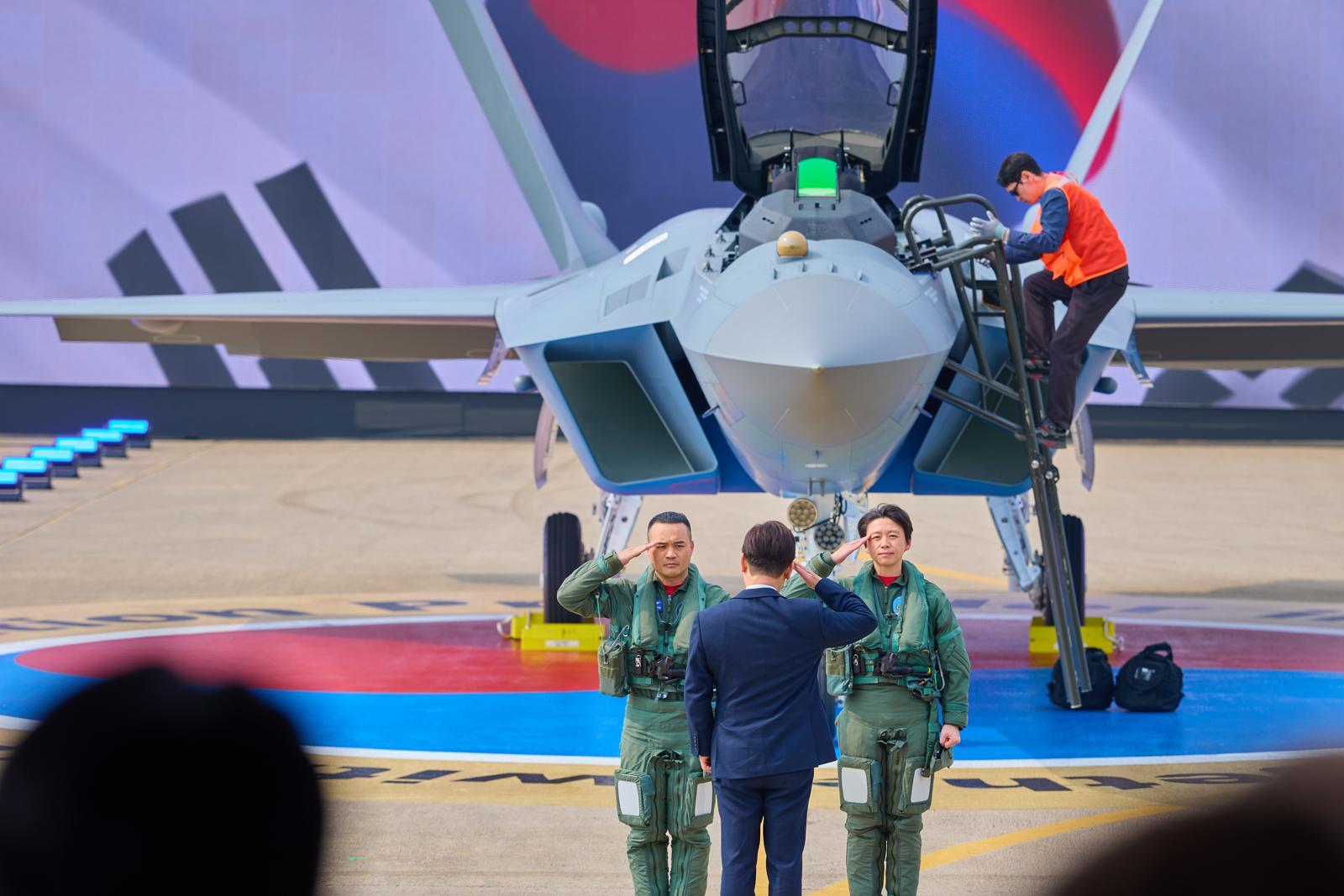
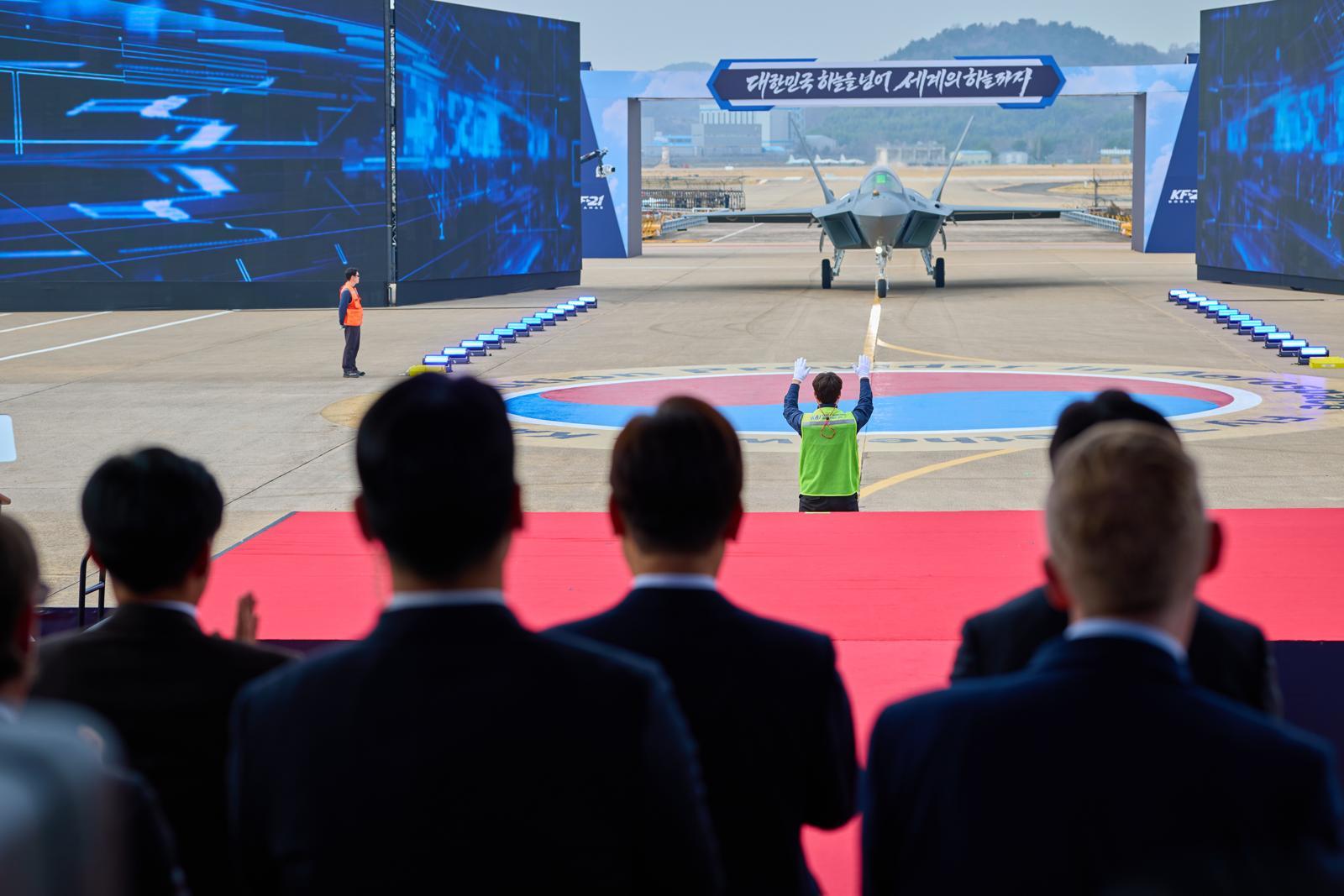
The rollout ceremony for the first mass-produced KF-21 “Boramae,” the culmination of the Republic of Korea’s aerospace industry, was held on the 25th at the headquarters of Korea Aerospace Industries (KAI) in Sacheon, Gyeongsangnam-do. Provided by the Office of the President
The rollout ceremony for the first mass-produced KF-21 “Boramae,” the culmination of the Republic of Korea’s aerospace industry, was held on the 25th at the headquarters of Korea Aerospace Industries (KAI) in Sacheon, Gyeongsangnam-do. Until now, prototype KF-21 aircraft had been showcased at events such as ADEX and the Sacheon Air Show, but this is the first public unveiling of a production model. As deliveries to the Republic of Korea Air Force are scheduled to begin in the second half of this year and the aircraft enters operational deployment, expectations for exports are also rising. Within the industry, the prevailing view is that Indonesia, the co-development partner, will become the KF-21’s launching customer (the first importing nation).
The first mass-produced KF-21 “Boramae” unveiled for the first time. Provided by the Office of the President
In the global defense market, final procurement decisions are made not only by comparing performance and price, but also by comprehensively considering strategic trust between the countries operating the weapon system and the stability of the operational ecosystem. In particular, because fighter jets are typically operated for around 40 years once acquired, importing countries prioritize how thoroughly the aircraft has been validated worldwide and how many countries operate the platform and attest to its reliability. In this context, Indonesia, as a co-development country, holds value as the most important guarantor of the KF-21’s global credibility and as its launching customer.
The power of a ‘global standard’ created by co-development nationsThe success of the F-35, regarded as the world’s most advanced stealth fighter, is firmly based on the “international coalition” demonstrated by its co-development nations. From the development stage, Lockheed Martin brought in the United Kingdom, Italy, the Netherlands, Australia and others as partners. These countries’ commitments to initial quantities and their decisions to adopt the F-35 as the mainstay of their air forces carry significance beyond mere procurement.
The very fact that major advanced countries in Europe and Oceania jointly developed and operate the aircraft has conferred on the F-35 a powerful status as a “global standard.” When non-participating countries such as the Republic of Korea, Japan and Israel later chose the F-35, they were certainly convinced by its performance, but the decisive factor was the “stable trust” that came from operating an aircraft used collectively by allied nations around the world. The presence of co-development countries sends a strong signal to the market that the platform will not be isolated over the coming decades in terms of parts supply, performance upgrades and sustainment.
Likewise, once Indonesia, as the KF-21 co-development partner, finalizes the aircraft’s operational deployment as launching customer, it will mark a decisive turning point in establishing the KF-21 as a “validated platform” in the global market.
Indonesia opened the door to T-50 exports… and it became a bestsellerThe Republic of Korea has already witnessed, through Indonesia, a successful formula in which “securing international trust” leads to exports. In 2011, Indonesia became the first country to introduce 16 units of the domestically produced T-50 supersonic advanced trainer, achieving the historic milestone of the first supersonic aircraft export in the history of the Korean aerospace industry. At the time, there were still question marks in the global market regarding the performance of Korean-built aircraft, but once the Indonesian Air Force adopted the platform and successfully operated it, thereby proving its reliability, the situation changed dramatically.
The Indonesian Air Force’s procurement subsequently became a key trigger for neighboring countries such as the Philippines and Thailand to select T-50 family aircraft. The large-scale export achievements to Poland in 2022 and Malaysia in 2023 were also made possible thanks to the “operational trust” accumulated over more than a decade by Indonesia and other early adopting countries.
If Indonesia, as the first overseas operator, proves the stability of the KF-21 on the global stage, the aircraft is expected to emerge as an option that potential customers in the Middle East and Europe will inevitably consider.
A virtuous cycle for aerospace development through securing a launching customerAs with all other products, the unit cost of a fighter jet declines as production volumes increase. Indonesia’s confirmed quantities, combined with those of the Republic of Korea Air Force, form a key pillar for realizing economies of scale. This could become a competitive advantage enabling the KF-21 to secure a price edge in the global market against rival models such as the Rafale and Gripen.
Furthermore, weapon systems evolve continuously after deployment through operational data and user feedback. For example, after the Philippines first introduced 12 FA-50PH aircraft in 2014, it requested radar and avionics upgrades and the addition of aerial refueling capability, and went on to sign a contract for 12 additional FA-5PH aircraft in 2025 along with performance upgrades for its existing fleet. As the customer base grows, a virtuous cycle emerges in which domestically produced fighters advance further.
The expansion of operating countries, including Indonesia, will verify the KF-21’s stability and provide both funding and justification for subsequent performance upgrade programs such as Block-II and Block-III. Ultimately, cooperation with Indonesia will serve as a strategic means to elevate the KF-21 from being merely “Korea’s fighter” to a “global platform.”
Moreover, the KF-21 program is a mega-project that underpins the foundation of the domestic aerospace manufacturing industry. Around 600 domestic partner companies are participating, and development is underway with a target localization rate of 65%. Through job creation and industrial spillover effects within Korea, the aerospace sector is expected to establish itself as a core future pillar of the national economy and contribute to economic development. According to a 2017 report by the Agency for Defense Development, the production inducement effect of the KF-21 is estimated at KRW 24 trillion, with a technology spillover effect of KRW 49 trillion. If additional production quantities are secured through an export contract with Indonesia, the economic effects are expected to expand further.
ⓒ dongA.com. All rights reserved. Reproduction, redistribution, or use for AI training prohibited.
Popular News