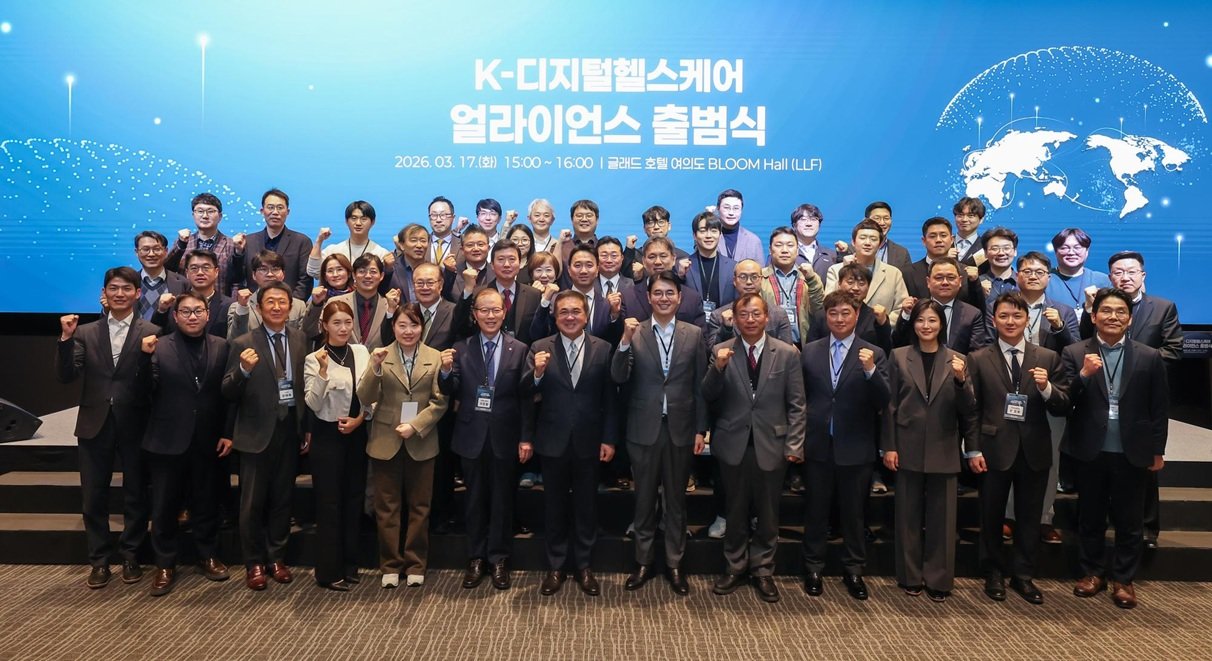
Forty domestic digital healthcare companies signed a joint memorandum of understanding (MoU) on 17 March at the Glad Hotel Yeouido in Seoul and declared the launch of the “K-Digital Healthcare Alliance.” Through this agreement, companies with competitiveness across all areas of digital healthcare—including artificial intelligence (AI), genomics, digital therapeutics, hospital IT, and healthcare platforms—will come together to pursue a new medical export model by jointly entering the global medical market, centered on overseas hub hospitals.
The launch of this alliance is significant in that private companies have proactively moved to target the global digital healthcare market in line with the government’s policy direction under the “15 Pioneering Projects for Ultra-Innovative Economy.”
In its economic growth strategy announced on 22 August last year, the government presented a strategy to foster digital healthcare as a core export industry of the future and to build a new medical export model. The alliance is being evaluated as the first case that concretizes, under private-sector leadership, a model for entering global markets in line with this policy direction.
Until now, domestic digital healthcare companies have sought global expansion through an “inside-out” approach, whereby they first generated results in the domestic market and then expanded overseas. However, due to institutional constraints such as domestic medical regulations and the national health insurance system, limitations have been continuously raised that market expansion and business model scaling are not easy.
Although Korea possesses simultaneously world-class medical data, excellent IT infrastructure, AI technology capabilities, and hospital systems with global competitiveness, there has been an assessment that the growth rate of the digital healthcare industry has fallen short of expectations due to such institutional constraints.
To overcome these structural limitations, the alliance has presented an “outside-in” strategy as its core model, whereby it directly establishes footholds in overseas medical markets. After securing hub hospitals in overseas locations, the alliance will apply Korean companies’ AI-based medical technologies and digital healthcare platforms in a packaged format centered on these institutions, and build and expand local medical ecosystems.
This constitutes a new medical industry model that goes beyond simple exports of medical devices and provides overseas medical institutions with a “digital healthcare integrated service package” that combines AI medical platforms, clinical data, genomic analysis, digital therapeutics, and hospital information systems.
The alliance includes companies with competitiveness across all segments of digital healthcare, such as AI-based medical services, genomics, digital therapeutics, healthcare platforms, and AX leading companies.
Participating companies are CGinvites, HealthConnect, Invites BioCore, Invites Genomics, Medisapiens, Huray Positive, K-DOC, Newbase, Newlive, Dr. Presso, Digital Healthcare Partners (DHP), Retimark, Marquesian Healthcare, Macrogen, MediArk, Main, BioBytes, SurgicalMind, Soldoc, Supass, CJ OliveNetworks, AC Healthcare, Atflow, Another Doctor, EVERX, Evertry, Aimnext, Answer, OpenHealthcare, Once Global, WE New, Wever Care, Emocog, JeronX, JS Link, Theragen Bio, HESSEL, Health on Cloud, Hippo T&C, and Hygge Life, all active in the digital healthcare field.
The alliance will be operated as an open alliance designed to pool capabilities across the entire digital healthcare industry, rather than as a closed cooperative body centered on specific companies. It plans to expand cooperation opportunities through a “Second Wave” recruitment of companies wishing to participate in global projects in the future.
Companies have faced various challenges in the course of overseas expansion, including responding to local regulations, securing testbeds for proof-of-concept, building hospital networks, and identifying purchasers. To resolve these issues, the alliance will implement a joint global market entry strategy by consolidating technologies and resources among companies.
Shin Yong-kyu, Chair of the Invites Ecosystem, said of this global expansion, “Just as Sillabang once served as a hub of the East Asian trade network, the goal is to build a Korean-style digital healthcare ecosystem centered on overseas hub hospitals and expand it into a global network,” adding, “The formation of this alliance will serve as a catalyst for the entire Korean digital healthcare industry to leap into the global market, beyond overseas expansion at the level of individual companies, through a new export model in which technology, talent, and capital move together.”
With the signing of this agreement, alliance member companies are set to fully activate inter-company cooperation mechanisms and gradually draw up plans to build overseas hub hospitals and promote global projects. In addition, in line with the government’s “private sector-led, corporate-driven” ultra-innovative economy policy stance, they plan to foster the digital healthcare industry as a new export sector for Korea and contribute to the creation of new national wealth in global markets.
ⓒ dongA.com. All rights reserved. Reproduction, redistribution, or use for AI training prohibited.
Popular News