Accessing information and translations through eyeglass lenses
Emerging as the next-generation device after smartphones
‘Meta Ray-Ban’ captures 80% of the overall market
Alibaba unveils enhanced-feature ‘Qwen’ model
Samsung also developing the technology in collaboration with domestic and global partners
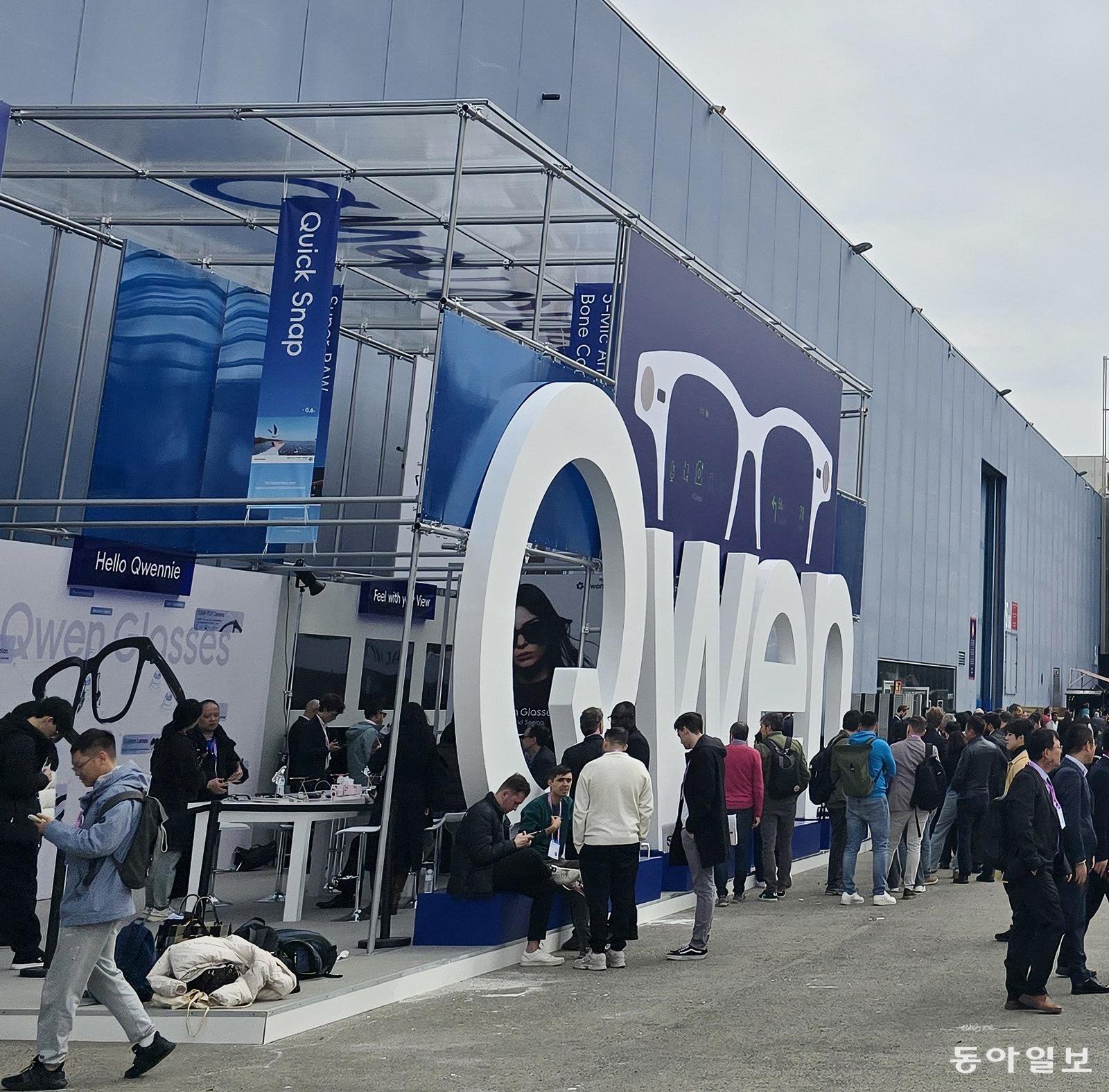
On the 3rd (local time), long lines formed for visitors to experience Qwen’s smart glasses at “Mobile World Congress 2026 (MWC26)” in Barcelona, Spain. Barcelona=Staff Reporter Kim Jae-hyung monami@donga.com
On the 3rd (local time), two conspicuously long lines stretched side by side in the outdoor area of the exhibition hall at “Mobile World Congress 2026 (MWC26)” in Barcelona, Spain. Right next to the booth of Meta, which leads the global smart glasses market, China’s Alibaba had set up a challenger booth. The two queues, each requiring more than 30 minutes just to reach the entrance, clearly illustrated the intensifying “global smart glasses war.”
●
“Qwen AI Glass” with AI agent capabilities Alibaba’s “Qwen AI Glass” is a pair of smart glasses equipped with its own artificial intelligence (AI) model “Qwen 3.5,” which has been streamlined and optimized. When tried on at the experience booth, Qwen AI Glass looked not much different from ordinary horn-rimmed glasses. However, displays were embedded in both lenses, and a battery capable of powering the device for up to seven hours was concealed inside the temples. In actual use, it could instantly capture objects in front of the wearer’s eyes, and a navigation screen unfolded in the field of view like an in-car head-up display (HUD). When the translation app was launched, the Chinese-speaking staff member’s voice was converted in real time into Korean subtitles, which appeared on the display.
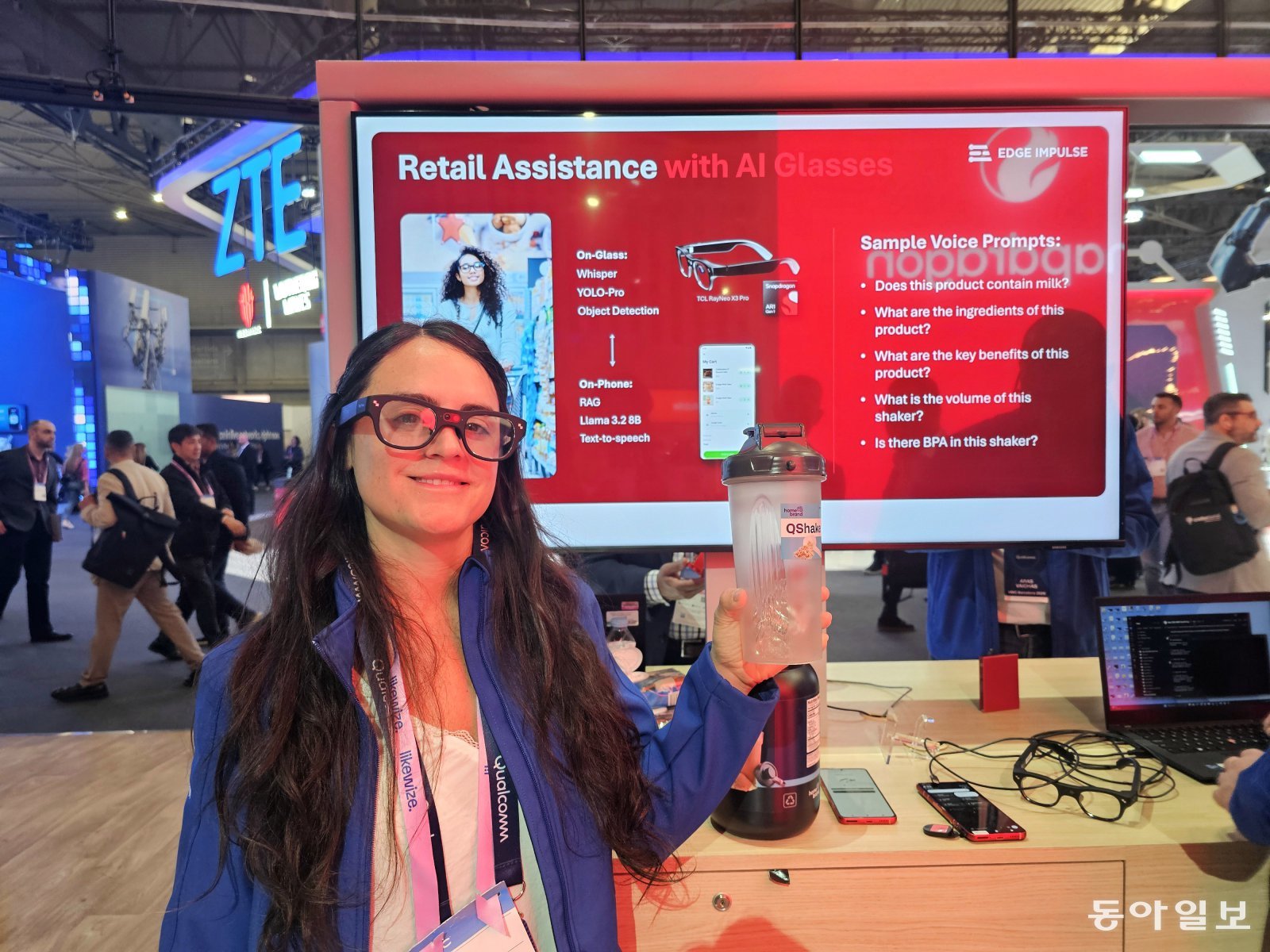
Qwen AI Glass is equipped with Qualcomm’s Snapdragon chipset dedicated to wearables, generating and displaying optimized answers. Barcelona=Staff Reporter Kim Jae-hyung monami@donga.com
The core is the Qualcomm Snapdragon augmented reality (AR) and wearable-dedicated chipset (NPU) built into the frame. The chipset first processes voice and visual information, and then, as needed, routes it through a mobile phone to generate optimal answers using retrieval-augmented generation (RAG)—a technique in which a large language model first searches an external knowledge base for relevant information and then generates a response.
A Qwen representative said, “We plan to introduce it first in the Asian market as a proactive agent capable of independently performing tasks such as payments and restaurant reservations, and then pursue expansion into Europe.”
●
Meta opened the smart glasses market; Korea and China join the race As the smartphone market gradually approaches saturation, “smart glasses” are rapidly emerging as a core next-generation AI device. By using smart glasses, users can obtain information on objects seen through the lenses, and can make calls or use interpretation functions via speakers built into the frames. However, as they must leverage both visual and auditory information, they are regarded as a device with a high degree of development difficulty.
On the 3rd (local time), long lines formed for visitors to experience Meta’s smart glasses at “Mobile World Congress 2026 (MWC26)” in Barcelona, Spain. Barcelona=Staff Reporter Kim Jae-hyung monami@donga.com
Meta currently leads this market. The “Meta Ray-Ban” series, developed in collaboration with eyewear brand Ray-Ban, accounts for around 80% of the entire smart glasses market. EssilorLuxottica, the manufacturer of Ray-Ban, stated in its earnings announcement for last year in February that more than 7 million units of “Meta Ray-Ban” were sold in the previous year alone. Sales volume for 2023 and 2024 combined stands at about 2 million units. This underscores how explosively the smart glasses market is growing.
Riding on the growth triggered by Meta, Korea has also entered this arena. Samsung Electronics, Korea’s leading player, which released the “Galaxy XR” extended reality (XR) headset in October last year, is developing smart glasses in collaboration with domestic eyewear brand Gentle Monster and U.S. eyewear brand Warby Parker. If Samsung releases smart glasses, the fact that they can interoperate with Samsung’s existing smart devices such as smartphones, smartwatches, and smart rings is cited as a competitive edge over Meta and Qwen.
Google also plans to unveil smart glasses loaded with its AI Gemini within this year. An industry insider said, “Since the market has only just opened, latecomers still have ample opportunity to overtake the early movers.”
ⓒ dongA.com. All rights reserved. Reproduction, redistribution, or use for AI training prohibited.
Popular News