Pursuing Approval in Principle (AIP) for the LR concept as the first step in EU regulation-compliant decarbonization solutions
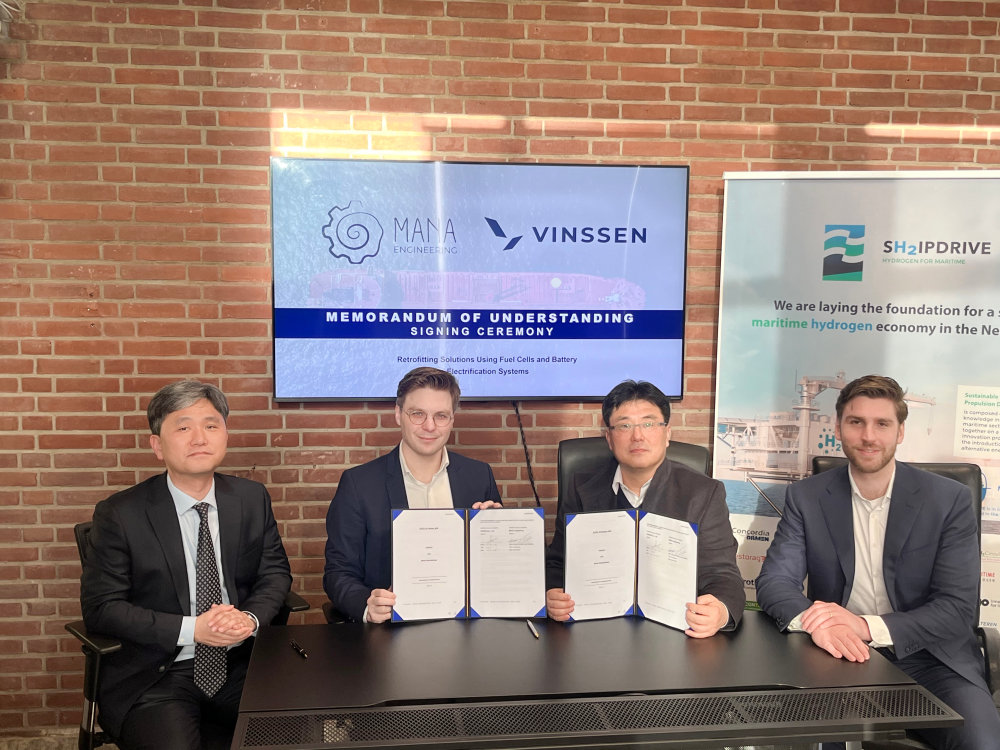
Executives and employees of Vincen and MANA Engineering pose for a commemorative photo after signing an MOU.
Vincen, a specialist company in hydrogen fuel cell and battery propulsion systems for eco-friendly vessels (CEO Lee Chil-hwan), announced on the 23rd that it has signed a memorandum of understanding (MOU) with Dutch marine engineering specialist MANA Engineering for cooperation on a hydrogen fuel cell-based ship conversion project.
Under this MOU, which was signed on the 12th, the two companies will conduct a technical feasibility review and seek Approval in Principle (AIP) from UK classification society Lloyd’s Register (LR) for a conversion solution for 800 TEU-class feeder container ships currently operating along the coasts of Northern Europe and the Baltic Sea. The AIP to be secured will serve as the technological foundation for proceeding to an actual ship conversion project, and will comprehensively verify the practical applicability of hydrogen fuel cell and battery systems.
In the European shipping market, stricter environmental regulations and rising carbon emission costs have recently made the transition of existing vessels to eco-friendly systems an urgent task. However, shipowners have continued to express concern over the heavy burden posed by high initial investment costs for a full fuel switch or the introduction of newbuilds, as well as uncertainty in the future fuel market.
To meet these market needs, the two companies are focusing on securing “hydrogen retrofit” technology, which maintains the existing propulsion system while replacing onboard power (hotel load) for lighting, heating and cooling, and auxiliary power with hydrogen fuel cell and battery systems. By applying swappable hydrogen containers to the integrated fuel cell and battery system, it will be possible to supply zero-carbon electricity while at berth without separate onshore power supply (AMP). When green hydrogen is used, the system will also be well positioned to respond to strengthened European environmental regulations such as FuelEU.
The swappable hydrogen storage system to be introduced by the two companies is designed to minimize the risk of operational downtime. The control system is configured to allow seamless switching with existing diesel power generation equipment, thereby ensuring operational stability, while hydrogen is supplied through container replacement, reducing operational inconvenience. The converted vessels are expected to contribute not only to compliance with EU onshore power usage requirements, FuelEU and EU ETS, but also to improvements in the ships’ Carbon Intensity Indicator (CII).
The companies plan to combine MANA Engineering’s European market network and engineering capabilities with Vincen’s hydrogen fuel cell and battery system technologies, and to continue collaborating for application in the local market.
Vincen CEO Lee Chil-hwan stated, “This MOU is a collaboration to establish a foundation for assessing the technical feasibility of the container ship conversion project and for pursuing LR class AIP,” adding, “We expect to generate synergies in the local market by combining MANA Engineering’s engineering competitiveness with Vincen’s technological capabilities.”
MANA Engineering CEO Dennis Lensing said, “We look forward to working closely with our Korean partners from risk assessment and concept design stages through to subsequent phases,” and added, “Through this cooperation, we will build a solid foundation for the demonstration and application of hydrogen conversion solutions in the European market.”
ⓒ dongA.com. All rights reserved. Reproduction, redistribution, or use for AI training prohibited.
Popular News