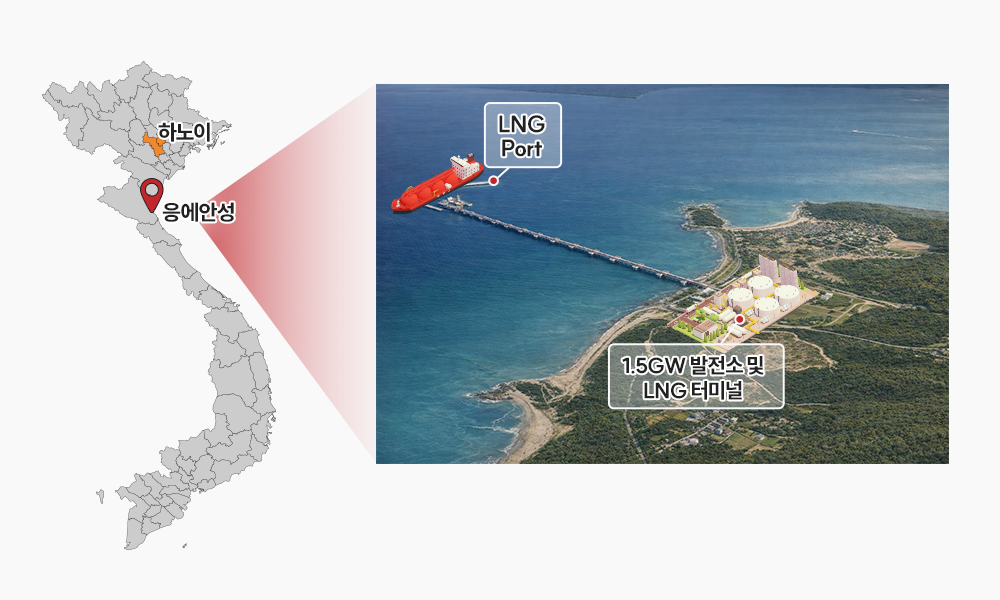
Bird’s-eye view of the Quynh Lap LNG power generation project in Nghe An Province, Vietnam. SK Innovation
SK Innovation announced on the 19th that it has been selected as the operator for a liquefied natural gas (LNG) power generation project in Vietnam. The project is an extra-large one with a total investment of approximately USD 2.3 billion (about KRW 3.3 trillion).
This project is the “Quynh Lap LNG Power Generation Project,” which was awarded by the Nghe An provincial government to a consortium formed by PV Power, a power generation company under Vietnam Oil and Gas Group (PVN), local company NASU, and SK Innovation.
The project is a large-scale infrastructure development to simultaneously build a 1,500 MW-class gas combined-cycle power plant, a 250,000 ㎥-class LNG terminal, and a dedicated port in Quynh Lap, Nghe An Province, located 220 km south of Hanoi. Construction is scheduled to begin in 2027 with completion targeted for 2030.
According to SK Innovation, the significance of its selection lies in the fact that it is the first time its LNG value chain model, which it was the first Korean private company to complete domestically, has been validated in an overseas market.
SK Innovation explained that, unlike the conventional approach of simply building power plants or buying and selling LNG, it proposed an integrated business model that utilizes its global LNG portfolio to transport LNG to the Vietnamese terminal and use it directly as fuel for the power plant. It added that linking this with its gas fields in North America, Australia and other regions enhances fuel supply stability and creates a structure that can respond flexibly to global market fluctuations, which it cited as the core of its competitiveness. In the initial tender in 2024, leading global companies from Korea, Japan, and Qatar participated, and SK Innovation was finally selected as the project operator after winning this competition.
The concept underlying this project is part of SK Group’s long-term strategy. SK Innovation stated that, through four years of joint research with the Vietnamese government, it developed the “SK Energy-Industry Cluster (SEIC)” model. Given that Vietnam, whose power mix is centered on coal and hydropower, suffers from chronic power shortages amid rapid industrialization and population growth, the company said it proposed a phased solution: first meeting power demand with LNG and then transitioning in the long term to carbon-free power sources. It further reported that it has also presented a plan to attract high value-added industries such as AI data centers and logistics hubs near the LNG power plant to help revitalize the regional economy.
SK Group Chairman Chey Tae-won visited Vietnam in February last year and held a direct meeting with General Secretary Nguyen Phu Trong to flesh out this concept, and is known to have secured government-level support when they met again during Nguyen Phu Trong’s visit to Korea in August of the same year. Subsequently, SK Innovation CEO Chu Hyung-wook has frequently traveled to Vietnam to coordinate detailed implementation plans with the Deputy Prime Minister and the Minister of Industry and Trade.
SK Innovation plans to use the Quynh Lap project as a springboard to expand its business across Vietnam. It added that it is also considering expanding the Quynh Lap LNG terminal into a hub terminal supplying gas to nearby power plants and other facilities. The company also presented a goal of growing its current global LNG portfolio from around 6 million tons per year to 10 million tons by 2030 to become a global major operator.
An SK Innovation official said, “Our selection as the project operator demonstrates that SK’s LNG value chain competitiveness is recognized in the global market,” adding, “We will work to address both tasks of resolving Vietnam’s power shortage and promoting regional economic development.”
ⓒ dongA.com. All rights reserved. Reproduction, redistribution, or use for AI training prohibited.
Popular News