[Secondary Hospitals Stronger Than Tertiary] 〈7〉 Yongin Severance Hospital
Building an ‘IRS’ to monitor inpatients… enabling earlier clinical intervention and reducing mortality
AI solutions adopted for imaging and emergency care… dramatically improving diagnostic accuracy and speed
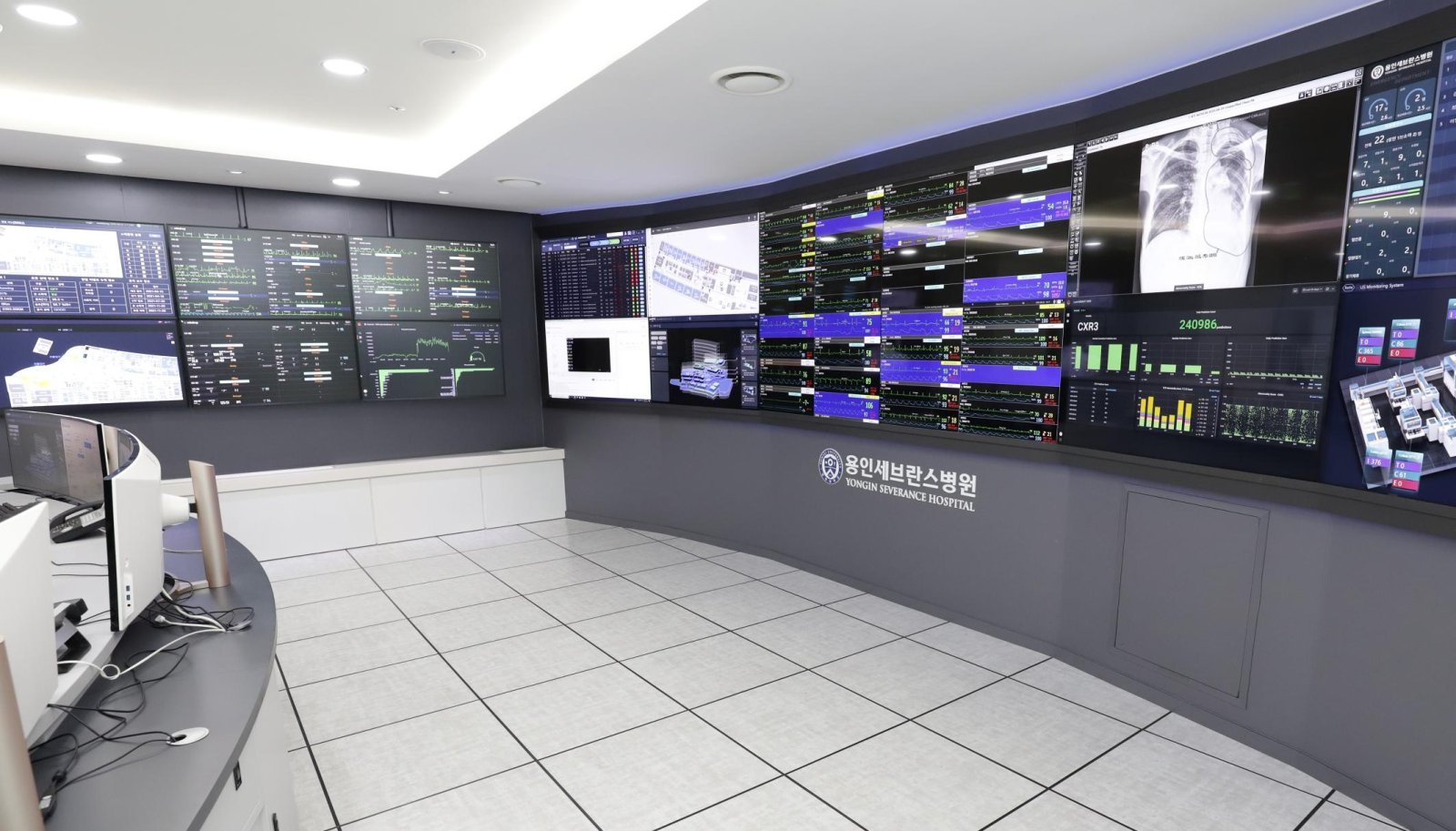
Integrated Response Situation Room at Yongin Severance Hospital, where everything that happens in the hospital can be checked in real time. It also plays a major role in reducing the mortality rate of inpatients. Provided by Yongin Severance Hospital
Yongin Severance Hospital, which faced the formidable challenge of the novel coronavirus infection (COVID-19) immediately upon its opening in 2020, instead turned this crisis into an opportunity to prove its “digital innovation.” Moving away from traditional epidemiological investigation methods that relied on patients’ recollections or closed-circuit (CC) TV, the hospital activated the nation’s first in-hospital 5G communication network and a Real-Time Location System (RTLS). As a result, it demonstrated efficiency by shortening the time required to trace confirmed patients’ movements by 96% compared with previous methods, setting a standard for “smart hospitals.” Yongin Severance Hospital is now going beyond digital and embedding artificial intelligence (AI) throughout hospital operations, accelerating its leap toward becoming an “AI hospital.”
● Integrated Response Situation Room reduces inpatient mortality The “Integrated Response Situation Room (IRS)” serves as the digital heart of Yongin Severance Hospital. Reminiscent of an aircraft control tower, this room aggregates in real time all data generated within the hospital, including vital sign monitor outputs, emergency room and operating room status, and control programs for medical service robots.
Its role goes beyond simple monitoring. AI algorithms analyze patients’ vital signs and electronic medical records (EMR) to calculate risk scores in real time. When abnormal signs are detected, the “AI-based Rapid Response System (AI-RRS)” immediately sends alerts to attending physicians and nurses, enabling early intervention. In practice, following the system’s introduction, the net mortality rate of patients in general wards (the proportion of patients who died more than 48 hours after arriving at the hospital) declined significantly, leading to improved safety indicators. On the strength of these achievements, Yongin Severance Hospital has proven its digital transformation capabilities by winning in the general hospital category of the “DX Service Award” for five consecutive years.
● Protecting the ‘golden hour’ using AI diagnostics
The digital infrastructure is combining with AI in clinical settings to amplify impact. In particular, in imaging diagnostics, AI functions as a reliable “second set of eyes” for medical staff. In chest X-rays, mammography, and brain magnetic resonance imaging (MRI), AI prioritizes the detection of subtle lesions or abnormal findings, dramatically enhancing both the accuracy and speed of image interpretation.
The effect is most striking in emergency care. AI solutions in the emergency care center analyze imaging data of acute stroke patients to support decisions on whether immediate intervention is required. As a result, the cerebrovascular interventional team at Yongin Severance Hospital performs procedures on 70% of stroke patients within 90 minutes of arrival. This is more than double the average (30%) at major university hospitals in Korea, demonstrating that AI is a key driver in safeguarding the life-saving “golden hour” for patients.
● From dementia to rare diseases… specializing in ‘personalized precision medicine’ In terms of quality of care, the hospital has established expertise that rivals that of tertiary hospitals. The Degenerative Brain Disease Center is the largest specialized center in Korea encompassing not only dementia and Parkinson’s disease but also rare and intractable disorders. It is leading personalized precision therapies such as prescribing the new Alzheimer’s drug “Leqembi” and providing gait rehabilitation using wearable robots, while also expediting genomic research and therapeutic development.
Its achievements in pediatric rare diseases are also attracting attention. Since successfully administering the gene replacement therapy “Zolgensma” in 2022 to an infant with spinal muscular atrophy (SMA)—the third such case in Korea and the first under criteria excluding cross-administration—it has successfully treated a total of six patients to date. This is the highest number in the country, underscoring that Yongin Severance Hospital possesses top-tier competitiveness even in the treatment of highly complex rare diseases.
Kim Eun-kyung, President of Yongin Severance Hospital, stated, “The most important mission of a medical institution entrusted with lives is to create a ‘hospital where patients are safe,’” adding, “Based on a philosophy that prioritizes people over technology, the hospital will leverage digital and AI technologies to strengthen patient safety and set the standard for the future of medicine.”
ⓒ dongA.com. All rights reserved. Reproduction, redistribution, or use for AI training prohibited.
Popular News