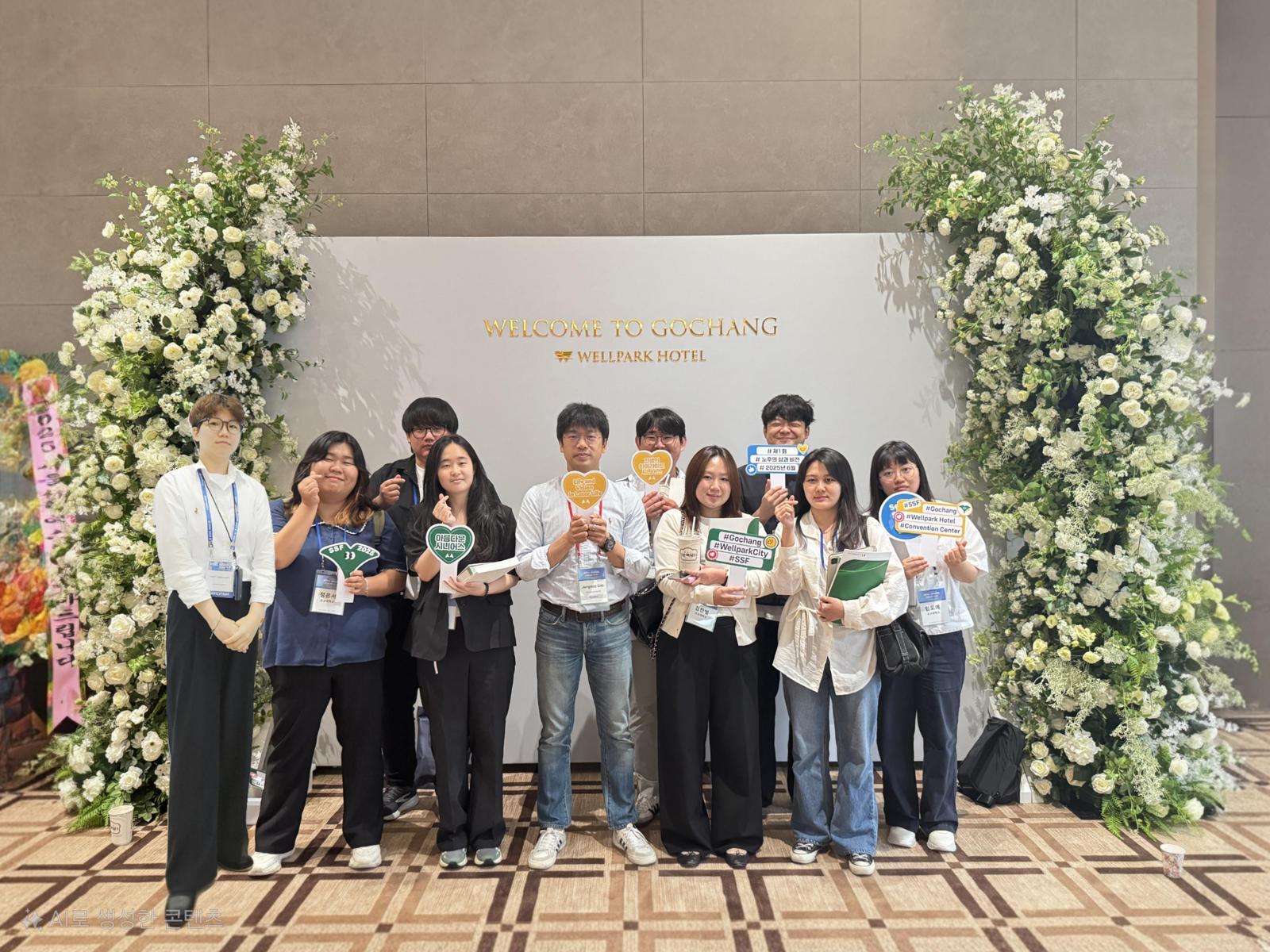
Professor Kim Jung-su (center) of the Department of Biomedical Science at Chosun University, who gave a lecture on the theme of the “Spectrum of Aging” at the Seoul Senior Forum held in Gochang, Jeollabuk-do last year, poses for a commemorative photo with students. Provided by Chosun University
The human brain is composed of approximately 100 billion neurons. In the process of these neurons exchanging signals with one another, subtle electrical signals are generated; electroencephalography (EEG) amplifies and measures these signals. A “digital brainwave map” is a technology that measures EEG and then organizes, as digital data, where in the brain the signals appear, in what form, and to what extent, and visualizes them like a map.
Because EEGs vary greatly among individuals and have complex structures, they are difficult to interpret with the naked eye. Instead, if artificial intelligence (AI) learns EEG data from tens of thousands to hundreds of thousands of people, it can detect at an early stage abnormal signals that impair quality of life, such as brain aging, depression, sleep disorders, and cognitive decline. The digital brainwave map is not a technology for treating diseases after they occur, but is focused on informing individuals in advance about their current brain condition and potential future risks. This is why it is attracting attention as a core tool in “well-aging” technology, which aims to “grow old without illness.”
Chosun University is launching a full-scale initiative to build such digital brainwave maps. The Chosun University Glocal University Promotion Group announced on the 4th that from this year through 2030 it will pursue a project titled “Construction of Brainwave Maps through Digital Brain Function Standard EEG Big Data.” This project is a key task within the well-aging specialization strategy presented by Chosun University under the Glocal University 30 program.
The research will be jointly led by Professor Kim Jung-su of the Department of Biomedical Science and Professor Yeom Hong-ki of the School of Electronic Engineering. Professor Kim is a leading researcher in wearable-based digital biomarkers through studies on predicting genetic risk for Alzheimer’s disease. Professor Yeom, who holds a PhD in brain science from Seoul National University, is an AI expert serving as an advisor to the Presidential Committee on the National AI Strategy.
Through this project, Chosun University plans to build standard EEG big data focused on four major brain disorders: epilepsy, depression, cognitive decline at the prodromal stage of dementia, and sleep disorders. Based on this, it aims to develop AI-based predictive models that can be used in clinical settings.
The university intends to improve data reliability by equipping high-density and wearable EEG devices and an electromagnetic shielding environment, while also securing EEG data measured in everyday environments. The collected data will be aggregated at the university’s AI data center for large-scale analysis.
Chosun University plans to enhance the practical use of research outcomes through a phased implementation structure that moves from data accumulation to fundamental technology development and commercialization. The accumulated data and technologies will be utilized by faculty-founded spin-offs to develop AI diagnostic algorithms and brain health management solutions.
Chosun University campus in Seoseok-dong, Dong-gu, Gwangju. The Chosun University Glocal University Promotion Group will fully implement the “Construction of Brainwave Maps through Digital Brain Function Standard EEG Big Data” project from this year through 2030. Provided by Chosun University
Chosun University will operate an open testbed (experimental environment) based on the constructed data, with participation from domestic and overseas companies, to support product verification and demonstration for digital healthcare companies and to expand industry-academia collaboration.
Kim Sun-jung, head of the Chosun University Glocal University Promotion Group, stated, “This project is the starting point for expanding the university’s research achievements into regional industries and global markets,” adding, “By concentrating the university’s infrastructure and research capabilities, we will leap into the global leading group in the field of brain well-aging.”
ⓒ dongA.com. All rights reserved. Reproduction, redistribution, or use for AI training prohibited.
Popular News