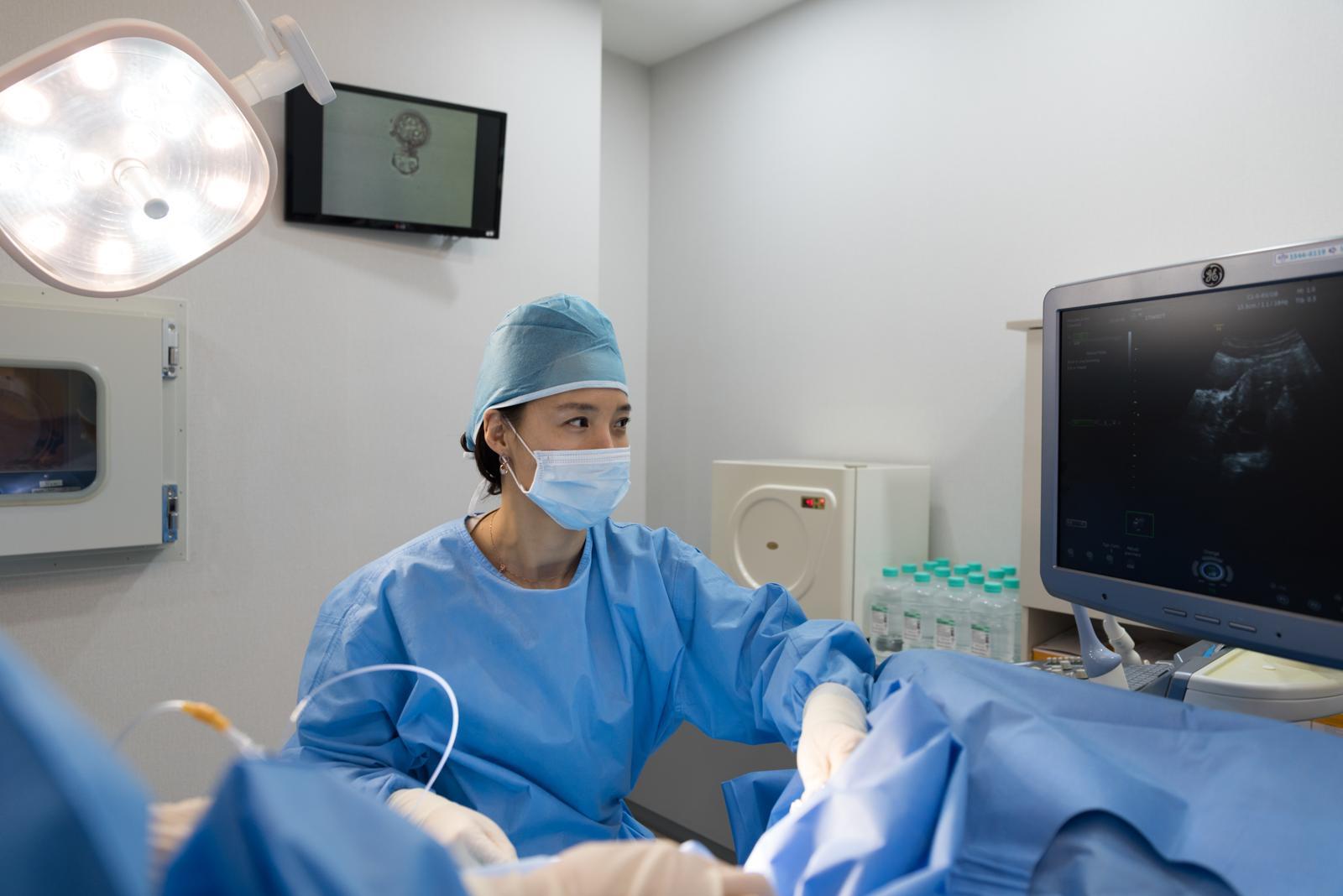
Director Park Joo-hee of Sarang-i Women’s Clinic. Provided by Sarang-i Women’s Clinic
Director Park Joo-hee of Sarang-i Women’s Clinic, a medical institution specializing in infertility clinics, stated on the 23rd that she had observed cases in which embryo implantation was confirmed during in vitro fertilization (IVF) procedures in some patients with severe ovarian function decline after injecting autologous blood-derived cell concentrate (BSC·blood-derived cell concentrate) into the ovaries.
The number of infertility patients in Korea is increasing every year. According to the National Health Insurance Service, as of 2023 the number of patients diagnosed with infertility in Korea exceeded 250,000. The number of patients who underwent infertility treatment procedures also increased from 140,458 in 2022 to approximately 161,083 in 2024.
Experts analyze that, alongside rising ages at marriage and childbirth, lifestyle factors such as stress, overwork, and lack of sleep, as well as obesity and nutritional imbalance, lead to a decline in ovulatory function and are contributing to the increase in infertility. In particular, women’s reproductive capacity gradually decreases with age; pregnancy success rates generally drop markedly around age 35, and the risk of infertility is known to rise sharply after age 40.
According to Park, the procedure applied in this case involved using Miracell’s SMART M-CELL to concentrate cellular components extracted from the patient’s own blood and then injecting them into both ovaries prior to IVF treatment. The procedure was carried out in a manner similar to conventional oocyte retrieval.
This observation involved a total of 30 patients, including 6 postmenopausal patients and 24 patients with diminished ovarian function. Comprehensive observations were made of changes in anti-Müllerian hormone (AMH) levels, an indicator of ovarian function, as well as the number of oocytes, embryo quality, and pregnancy outcomes during the IVF process before and after the procedure.
Among them, 12 patients attempted embryo transfer, and early-stage implantation was confirmed in 2 of these cases. Both patients in whom implantation was confirmed were of advanced maternal age in their 40s, with very low pre-procedure AMH levels of 0.27 and 0.39, respectively. They had previously undergone multiple IVF cycles but had repeatedly failed to obtain transferable embryos.
Park explained, “Although these are only a small number of cases observed in a high-risk group of patients with diminished ovarian function who had not responded to existing treatments, BSC stem cell procedures may be meaningful as a signal that warrants further research.”
She added, “In addition to the pregnancy cases, some patients showed an increase in the number of oocytes or improvements in embryo quality, but it is difficult to draw definitive conclusions about the efficacy of the procedure based on these observations alone,” and continued, “There is a need to validate the clinical significance through more systematic research in the future.”
Park also said, “From a clinical perspective, it is significant that patients who had suffered psychological distress due to long-standing repeated treatment failures have gained new hope that they might attempt pregnancy again through this procedure,” and added, “It is hoped that autologous blood-derived cell-based approaches will be further examined as a research hypothesis for patients with diminished ovarian function.”
Park stated that she is preparing an academic paper on the basis of these clinical observation results.
ⓒ dongA.com. All rights reserved. Reproduction, redistribution, or use for AI training prohibited.
Popular News