Amazon launches ‘AI Health Agent’ From booking appointments to ordering prescriptions… OpenAI, Anthropic, and others join the race Amid debate over how far AI health advice should go, Big Tech stresses it is “only a supplemental tool”
Amazon is launching a healthcare management tool that uses artificial intelligence (AI). With OpenAI and Anthropic each rolling out AI tools this month to help users manage their health and handle medical administration, competition in “AI healthcare” involving major AI companies is entering a full-scale phase.
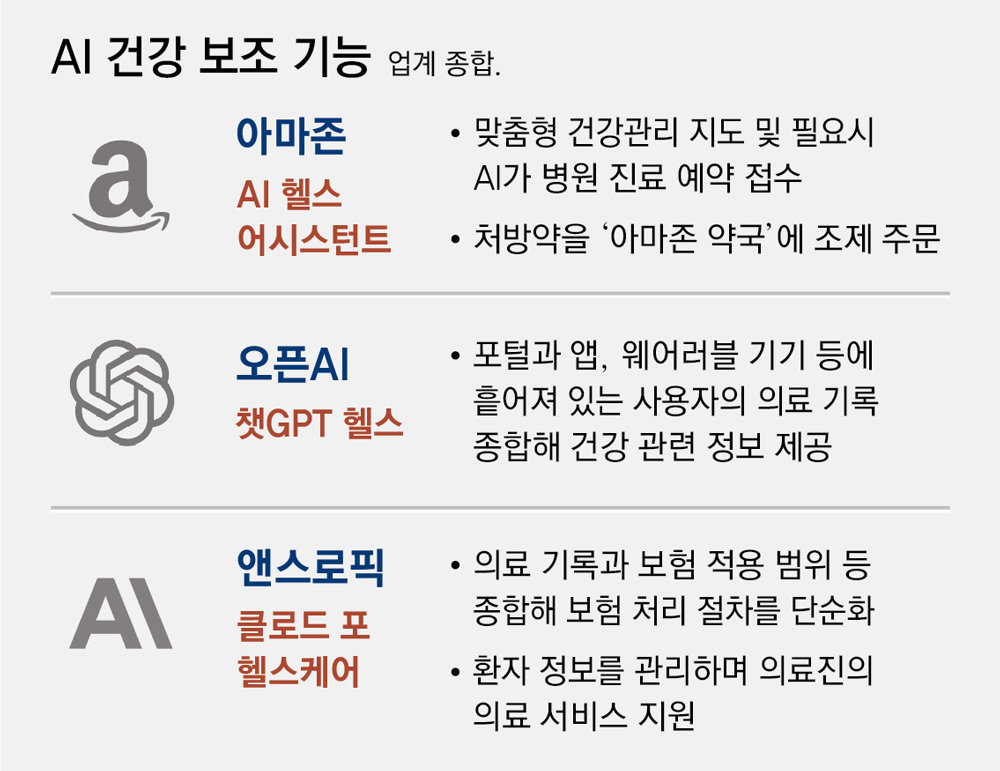
On the 21st (local time), Amazon announced that it will launch an “AI Health Agent” tool for paying members of its One Medical service. Operating on the AI platform Amazon Bedrock, this tool receives users’ medical records and provides personalized health management advice. After analyzing health information, it can book hospital appointments on behalf of users when it deems it necessary. It also includes a function that allows users to order prescribed medications from “Amazon Pharmacy,” which Amazon operates.
OpenAI, the operator of ChatGPT, also entered this field earlier this month by unveiling a “ChatGPT Health” feature and acquiring the medical AI startup “Tôtch.” According to OpenAI, ChatGPT Health allows users to receive health advice in the form of conversations with generative AI. The health advice provided by ChatGPT Health is based on aggregated information about users’ health status scattered across various portals, applications (apps), wearable devices, and medical records.
Anthropic is going a step further by targeting the “medical administration” domain. Anthropic’s “Claude for Healthcare” assists with the complex insurance claims procedures that are considered a chronic problem in the U.S. healthcare system. Anthropic explains that Claude for Healthcare connects with the database of the Centers for Medicare & Medicaid Services (CMS), a federal agency under the U.S. Department of Health and Human Services, to support users’ health insurance processing procedures.
The reason big tech companies are successively rolling out services that collect patient health data and support medical services using AI is that this field has significant monetization potential. OpenAI stated that an analysis of anonymized conversations between ChatGPT and users showed that more than 230 million people ask health-related questions each week. OpenAI explained, “Health is one of the areas in which ChatGPT is most widely used today.” Once they navigate healthcare-related regulations in each country, they can also expect to generate revenue through business-to-business (B2B) transactions with medical institutions, insurers, and pharmaceutical companies.
However, social debate over big tech companies’ AI-based health services has not yet been resolved even in the United States. It has not been decided to what extent mental health and medical advice provided by AI chatbots should be allowed. For this reason, each operator is emphasizing that the health information provided by AI is “supplementary information.” Amazon said, “AI Health Agent does not replace doctors.” In introducing ChatGPT Health, OpenAI similarly explained, “This feature is designed to complement medical services.”
Because AI healthcare involves handling sensitive medical information about users, operators are also stressing security. Amazon emphasized, “We do not sell personal data, including health information, to external parties.” OpenAI stated that it stores users’ health information separately.
Park Jong-min
AI-translated with ChatGPT. Provided as is; original Korean text prevails.
ⓒ dongA.com. All rights reserved. Reproduction, redistribution, or use for AI training prohibited.