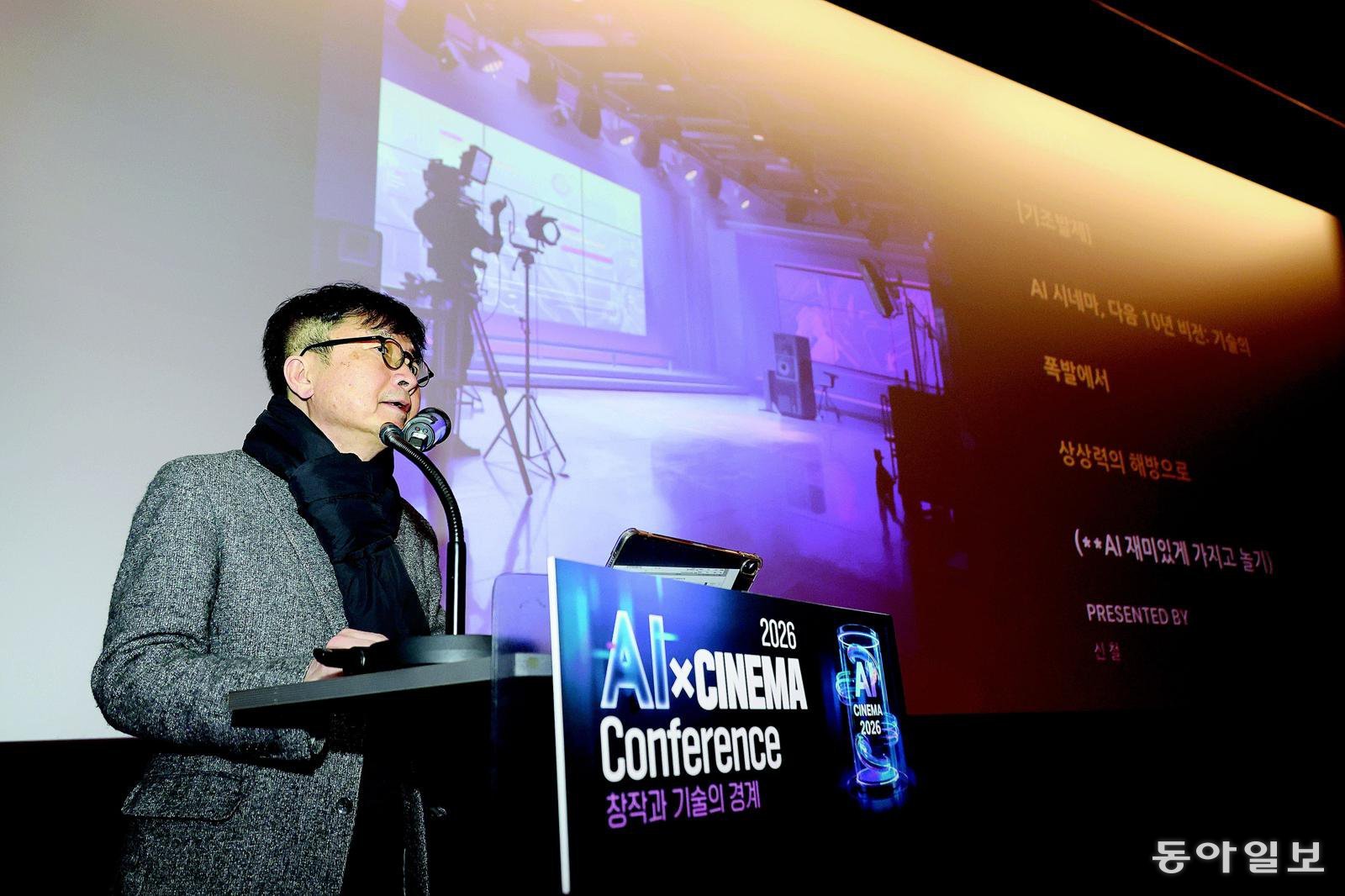
On the 13th, at an AI film lecture held at the Seoul Film Center in Jung-gu, Seoul, Executive Committee Chair Shin Cheol delivers a keynote address titled “The Next 10 Years of Film in the AI Era.” Reporter Jeon Young-han scoopjyh@donga.com
“The only remaining difference between director James Cameron and you is now ‘imagination.’ This is because advances in artificial intelligence (AI) technology are dismantling capital barriers in the film industry.”
At the “2026 AI Cinema Conference” held in Theater 1 on the first basement level of the Seoul Film Center in Jung-gu, Seoul, on the 13th, Executive Committee Chair Shin Cheol, appearing as the keynote speaker, cited Hollywood master director Cameron as an example to explain that the film production environment, which had been premised on massive capital and technology, is rapidly changing due to AI. It meant that the scope of imagination, once reserved for a small number of major producers, is now opening up to individual creators.
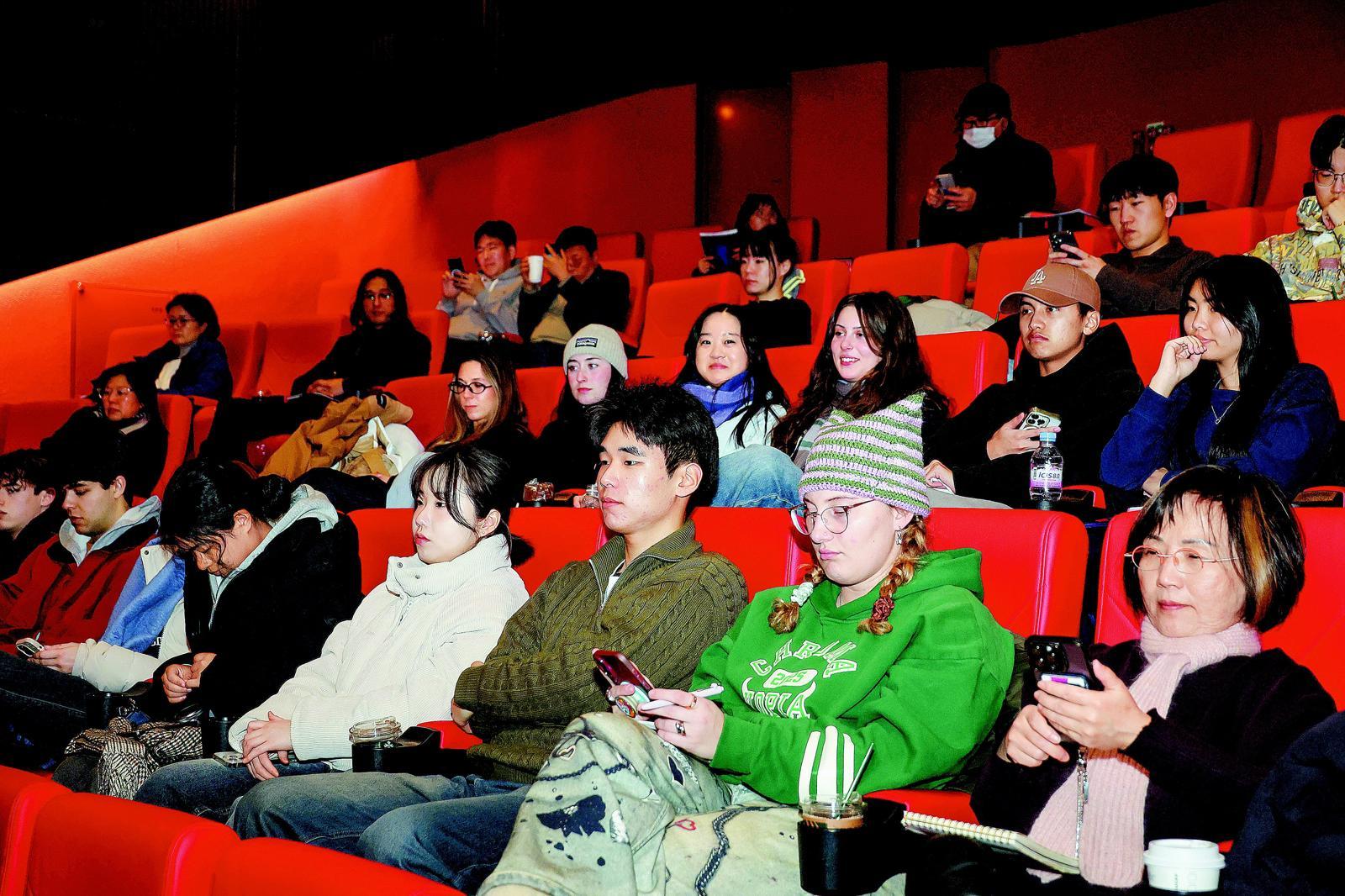
The 166-seat theater was packed with AI researchers, film students, and aspiring creators. Attendees could be seen throughout the venue taking notes from the speakers’ explanations or photographing the presentation materials.
●
Film production sites transforming amid AI proliferationAs artificial intelligence (AI) technology rapidly reshapes the film production environment, a public event was held where film professionals and citizens jointly discussed future modes of creation. The conference was jointly planned by the RISE Industry-University Cooperation Foundation of Dongguk University and the Seoul Film Center.
Academia, the film industry, and technology sector stakeholders all gathered at the venue. After each session, some attendees lined up in the aisles to pose questions directly to the directors. As questions continued on how AI is actually used in story development, directing, and editing processes, the lectures ran beyond the scheduled time.
Speakers included Executive Committee Chair Shin, head of the film production company “ShinCine,” which planned and produced the film “My Sassy Girl” (2001) and who also serves as Executive Committee Chair of the Bucheon International Fantastic Film Festival; director Yang Ik-june, who won the Grand Prize at an international AI film festival with the AI short films “Mateo” and “Witness”; and director Park Yu-young, who directed the dramas “Good Girl Boo Sae-mi” and “The Kidnapping Day.” Recalling his younger days going around to raise capital in order to make films, Shin said, “AI is a platform that can realize the imagination that creators could not unfold because they were blocked by capital.” He went on to stress, “AI technology should be learned and used responsibly within a framework that protects creators’ rights.”
Director Yang said, “If traditional films belong to the realm of shooting and large-scale collaboration, AI films are generation-based, allowing a single creator to encompass directing, scriptwriting, and editing,” adding, “One must be able to explain why this film has to be made with AI rather than as live action.”
On the 13th, attendees listen attentively to Executive Committee Chair Shin Cheol’s keynote address titled “The Next 10 Years of Film in the AI Era” at an AI film lecture held at the Seoul Film Center in Jung-gu, Seoul. Reporter Jeon Young-han scoopjyh@donga.com
●
XR Center to open in Mapo this yearThe Seoul Metropolitan Government does not view the AI Cinema Conference as a one-off event, but as part of a policy experiment to respond to changes in the film industry. The city aims to create a public platform where creators and citizens can jointly discuss the direction of change at a time when AI technology is spreading across all stages of film production.
The Seoul Film Center is the base for this concept. The city plans to use this space not simply as a film screening facility, but as a multifaceted hub that encompasses training for emerging creators, industry exchange, and content education for citizens. Education programs tailored to changes in the AI and OTT environment, as well as exchange events for creators, will also be gradually expanded.
In addition, this year the city plans to open the Seoul XR (Extended Reality) Center in the Digital Media City (DMC) area of Mapo-gu to support XR companies and operate a citizen experience space. Through this public hub connecting film, video, and XR, the city intends to simultaneously promote the development of the content industry and the enjoyment of culture by citizens. A city official said, “The AI conference is a case where the growth of film professionals and cultural education for citizens were considered together amid technological change,” adding, “We will continue to use public spaces to run programs that respond to changes in the creative environment.”
ⓒ dongA.com. All rights reserved. Reproduction, redistribution, or use for AI training prohibited.
Popular News