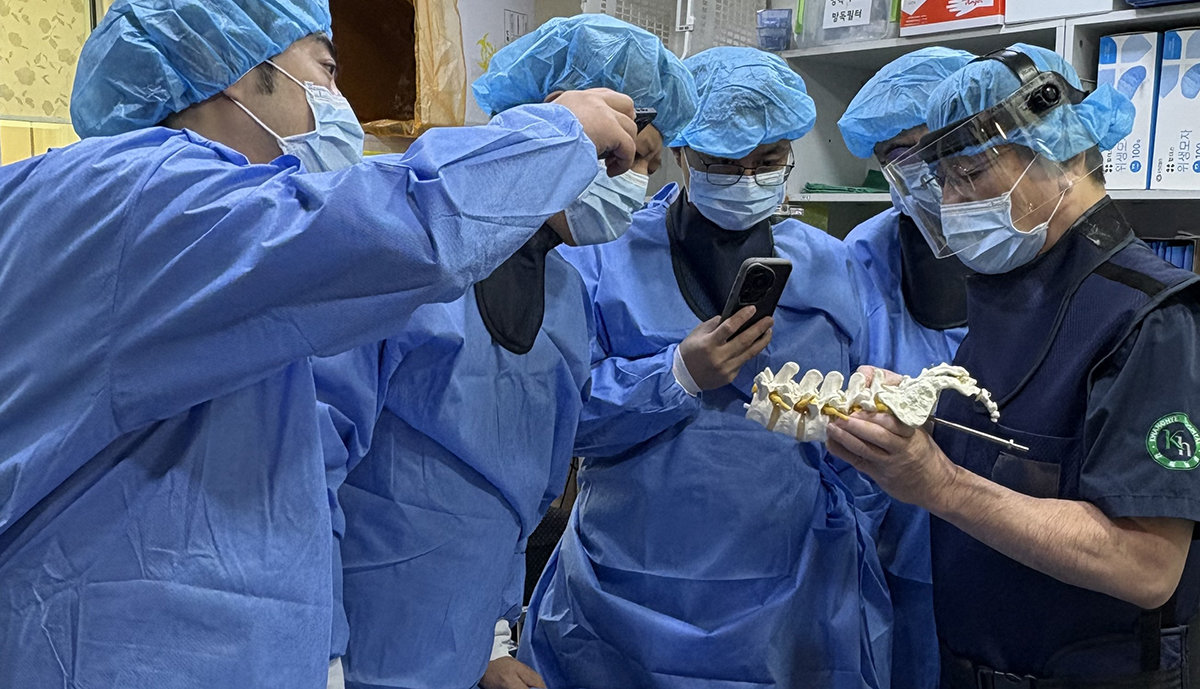
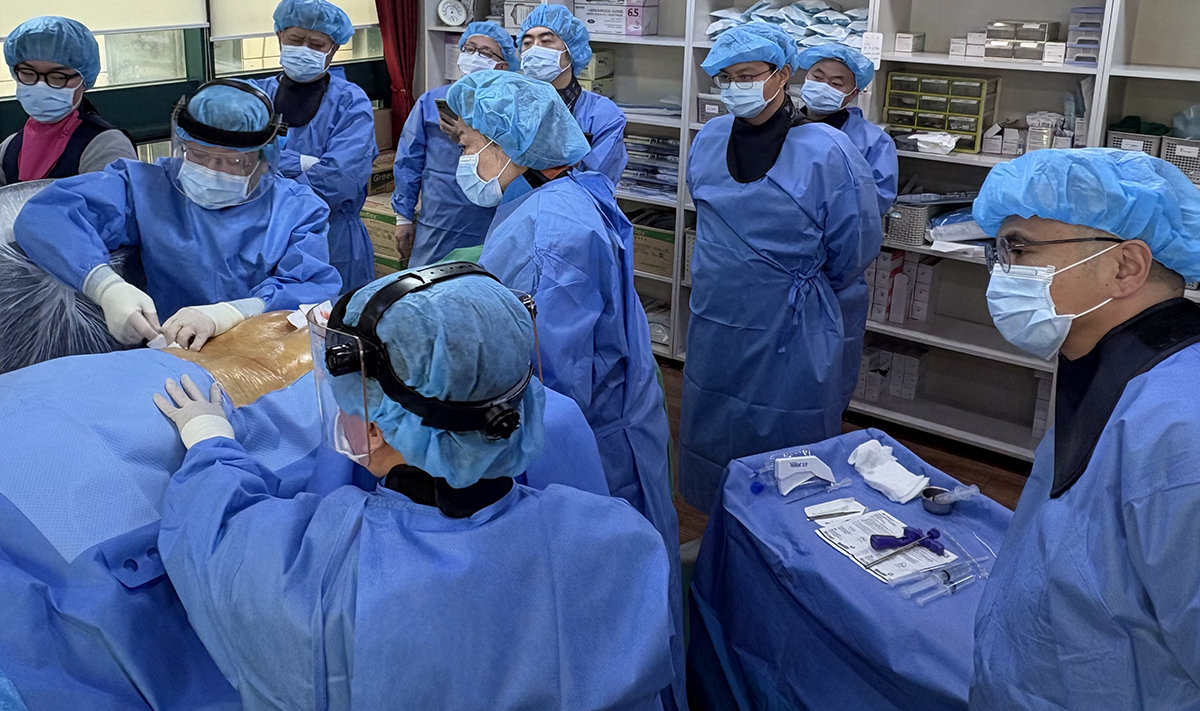
CEO and Medical Director Park Kyung-woo explains foramen-expansion procedures to Chinese medical staff.
The period during which international medical exchanges were virtually suspended due to the COVID-19 pandemic was a long one, with academic conferences and in-person visits cut off. In that vacuum, technological exchange also contracted, but there is a Korean spinal treatment technology that China’s medical community has recently begun to focus on again: foramen-expansion procedures and semirigid fixation. The person who has been introducing these two treatment techniques in China for over 20 years is Park Kyung-woo, CEO and Medical Director of Seoul Gwanghye Hospital.
In the early 2000s, as medical exchanges expanded following the establishment of diplomatic relations between Korea and China, Park began promoting spinal treatment technologies locally in China and worked on exporting medical devices and transferring surgical techniques. His direct experience of the entire evolution of China’s medical device approval system—from SFDA (State Food and Drug Administration) to CFDA (China Food and Drug Administration) and then to NMPA (National Medical Products Administration)—and his long-term engagement with the Chinese medical market are emblematic of his career.
Semirigid fixation is a surgical technique that simultaneously considers spinal stability and flexibility by inserting a long, screw-shaped cylindrical cage in the anterior portion of the spine and a nitinol spring rod-based Bioflex in the posterior portion. The anterior cage was produced and supplied in cooperation with a local Chinese company, while the posterior product was manufactured in Korea and exported. Park went beyond simple device sales, using academic conferences across China to educate medical staff on the structural and biomechanical differences from conventional rigid fixation as well as on surgical methods. Around 20 years ago, he also invited hundreds of Chinese medical professionals to Korea for long-term training programs.
Chinese medical staff observing CEO and Medical Director Park Kyung-woo’s foramen-expansion procedures during a visit to Seoul Gwanghye Hospital. Courtesy of Seoul Gwanghye Hospital
Foramen-expansion procedures are also techniques that have been steadily disseminated in China. They are non-surgical treatments that use a caudal approach catheter and a lateral foraminal access kit to enlarge the intervertebral foramen, the neural passageway, and remove inflammatory agents.
Park commuted between Seoul and China, combining education with live demonstrations. However, for both techniques, an understanding of not only device usage but also access routes and procedural steps is essential, so time was needed for initial adoption.
The spread of COVID-19 around 2020 put a brake on this trend. With academic and in-person exchanges suspended, companies that had entered the Chinese market found it difficult even to maintain their approvals. In particular, NMPA approvals must be renewed every five years, making it burdensome to maintain them when exports were halted. Nevertheless, Park renewed all approvals for Bioflex and foramen-expansion-related devices, maintaining a foothold in the Chinese market.
In the meantime, clinical outcomes continued to accumulate. Long-term follow-up data of more than 15 years on average for semirigid fixation have been published in international journals, verifying its safety and effectiveness. Foramen-expansion procedures have far exceeded a cumulative total of 30,000 cases as of the end of 2025, and related technologies have been granted patents in Korea, the United States, and Japan. On the back of these achievements, interest within the Chinese medical community is again growing. In the second half of 2025, key Chinese clinicians and technical staff visited Seoul Gwanghye Hospital on three occasions for training and to observe procedures, and there has since been a movement to present these technologies at local academic conferences. The number of medical professionals hoping to visit in 2026 is also increasing.
Park assesses that although exchanges were halted by COVID-19, technologies and data were in fact accumulated. He characterizes foramen-expansion procedures and semirigid fixation not simply as treatment techniques but as a shift in the perspective on spinal care, and he expects Korean spinal treatment technologies to spread in earnest in the Chinese market going forward.
ⓒ dongA.com. All rights reserved. Reproduction, redistribution, or use for AI training prohibited.
Popular News