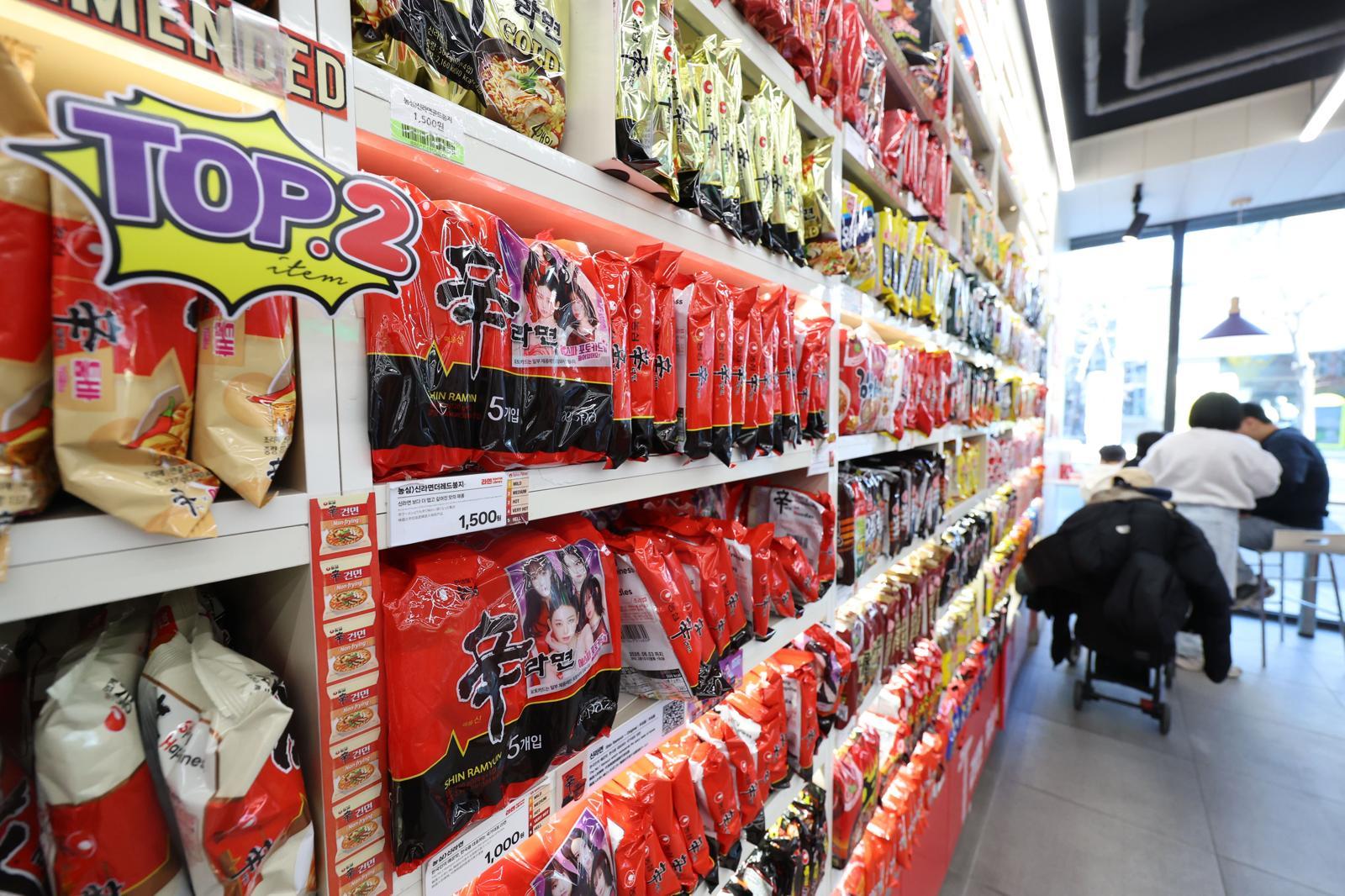
Korean ramen, which has emerged as a leading K-food product, surpassed USD 1.5 billion in annual exports for the first time ever. According to the Korea Customs Service, last year’s Korean ramen exports increased 21.8% year-on-year to a record provisional total of USD 1.521 billion (about KRW 2.2 trillion). The photo shows ramen displayed at the CU Hongdae SangSang store in Mapo-gu, Seoul, on the 11th. 2026.01.11. [Seoul=NEWSIS]
Last year, exports of so-called “K-Food Plus (+),” which combines K-food and agri-industry items, exceeded USD 13.6 billion (about KRW 20 trillion), setting a new all-time high. Ramen and spicy sauces captured foreign consumers’ tastes and led the upward trend.
According to the Ministry of Agriculture, Food and Rural Affairs on the 12th, last year’s K-Food+ exports totaled USD 13.62 billion, up 5.1% from a year earlier. K-Food+ refers to the combined exports of food products, smart farms, and agricultural machinery and materials. Since statistics began to be compiled in 2022 (USD 11.92 billion), K-Food+ exports have increased every year.
Last year’s agri-food exports rose 4.3% year-on-year to USD 10.41 billion, surpassing USD 10 billion for the first time. Ramen had a major impact. Ramen exports last year reached USD 1.52 billion, up 21.9% from the previous year. Export volumes increased not only in existing core markets such as the United States (18.2%) and China (47.9%), but also in Central Asia (38.7%) and the Middle East (22.0%).
With “K-spicy” products such as Buldak sauce gaining global popularity, exports of sauces including gochujang also rose 4.6% year-on-year to USD 410 million. In China, spicy sauces that had mainly been sold online began to be sold in offline stores as well, driving up exports. In the United States, gochujang and tteokbokki sauces became popular, helped by the influence of K-content. Exports of ice cream (21.6%) and agri-industry items such as fertilizers (8.0%) also increased, contributing to growth.
Ice cream exports (USD 111 million) grew 21.6%, mainly to the United States, Canada, and Japan. Fruit exports also showed a marked increase, particularly grapes, which rose 46.3% to USD 84 million.
By region, the United States accounted for the largest share of K-Food+ exports at USD 1.8 billion, followed by China (USD 1.588 billion), Europe (USD 770 million), and the Middle East (USD 410 million). The Middle East, in particular, recorded a high export growth rate of 22.6%.
Minister of Agriculture, Food and Rural Affairs Song Mi-ryeong said, “This year, we have raised the K-Food+ export target from the previous USD 15 billion to USD 16 billion,” adding, “We will support our companies’ exports with the ‘K-Food Export Task Force’ involving both the public and private sectors.” The ministry significantly raised this year’s K-Food+ export growth target to double digits (17.5%). By sector, it aims to achieve USD 12.2 billion in agri-food exports and USD 3.8 billion in agri-industry exports.
President Lee Jae-myung said at last week’s “National Briefing on Economic Growth Strategy” that “K-food and K-beauty are promising new areas,” and stressed the need to support K-food exports, saying, “The government needs to be told what it should do to help individual companies develop local markets.”
ⓒ dongA.com. All rights reserved. Reproduction, redistribution, or use for AI training prohibited.
Popular News