[South Korea–China Summit] Business Leaders’ Forum Held in Beijing for First Time in 9 Years
Lee invokes Goryeo–Song-era ‘Pyongnando’… “Trade did not stop even amid diplomatic conflict”
Xi’s “economic strategist” He Lifeng: “Inseparable neighbors”
Chey Tae-won: “A turning point for restoring Korea–China relations” … Chung Euisun: “We will proceed with humility”
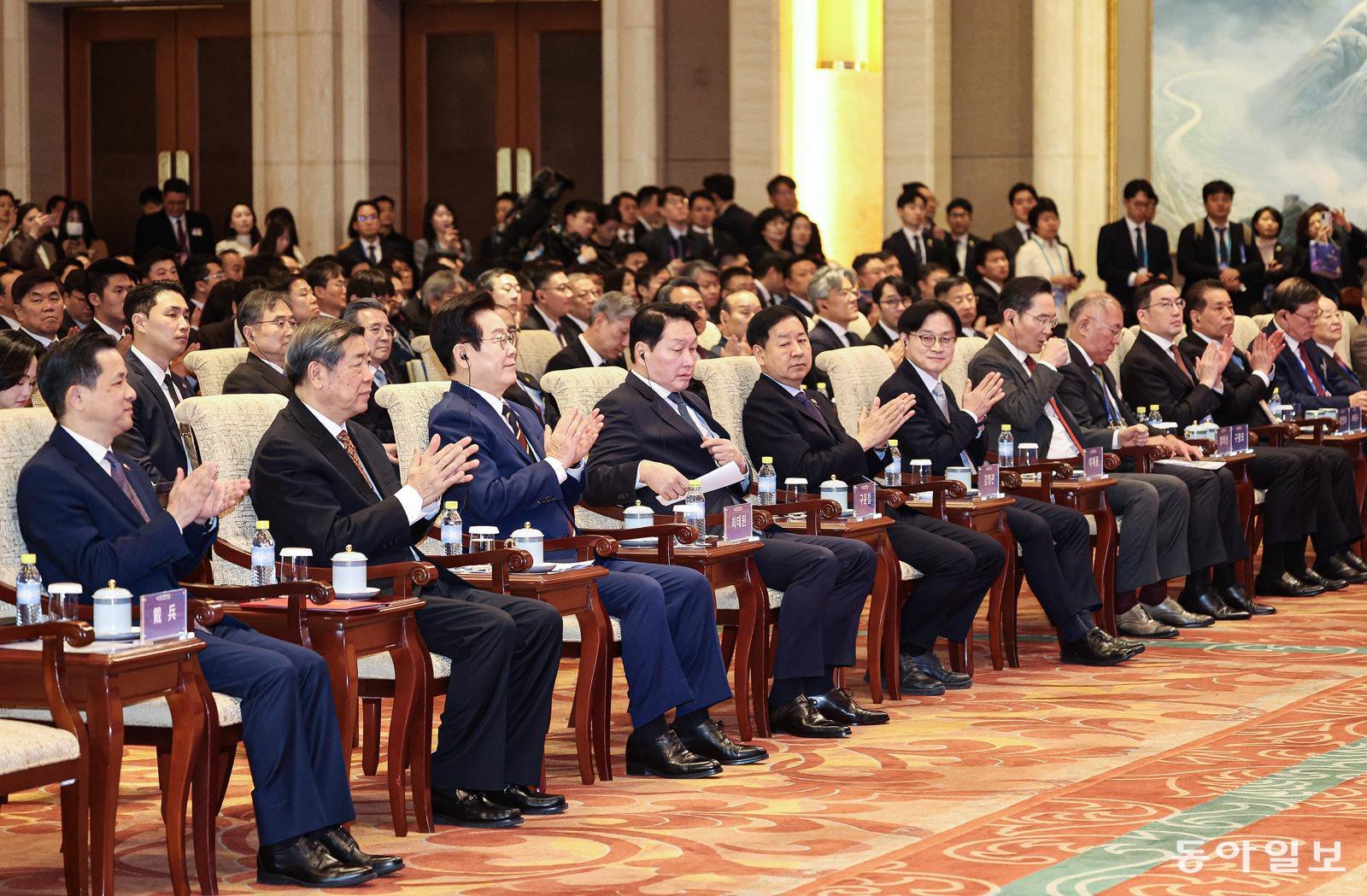
President Lee Jae-myung (third from left), who is on a state visit to China, applauds together with participants at the Korea-China Business Forum held on the 5th at Diaoyutai (釣魚臺) State Guesthouse in Beijing. In his keynote speech, President Lee told business leaders from both countries, “It is said that a good neighbor is so precious that even ten million pieces of gold cannot buy one. You yourselves are exactly those neighbors, more precious than ten million pieces of gold.” Beijing = Reporter Song Eun-seok silverstone@donga.com
President Lee Jae-myung attended the Korea-China Business Forum on the 5th and, referring to Byeokrando, the trade hub between the Goryeo Dynasty and the Song Dynasty, stressed the importance of economic cooperation between the two countries by saying, “Even during periods of diplomatic tension and conflict, trade through Byeokrando did not stop.” The forum, held in Beijing for the first time in nine years since 2017, drew about 600 leading business figures from both countries, reflecting expectations for an improvement in Korea-China relations. In particular, He Lifeng (何立峰), the Chinese vice premier in charge of the economy and known as “Xi Jinping’s economic strategist,” attended and emphasized that Korea and China are “neighbors that cannot be separated.” Korean companies also expressed expectations, calling the event “an important turning point for the full restoration of Korea-China relations.”
● Lee: “New opportunities must be opened through stable supply chains” At the Korea-China Business Forum held that day at Diaoyutai (釣魚臺) State Guesthouse in Beijing, President Lee mentioned Byeokrando, the trade hub between the Goryeo Dynasty and the Song Dynasty, and said, “Just as the waterways of Byeokrando once connected the continent and the ocean as one, today’s Korea-China cooperation should, through industrial innovation and stable supply chains, enable us to jointly open new opportunities beyond our respective markets.”
Calling China a “good neighbor,” President Lee said, “Is it not said that a good neighbor is so precious that even ten million pieces of gold cannot buy one? You are neighbors more precious than ten million pieces of gold,” adding, “Do not look far away for good friends. Instead, seek each other in Korea and China, neighbors who cannot move away and cannot be separated.” He continued, “As close neighbors, I hope we can build a mutually beneficial and friendly relationship also in the economic sphere.”
At a preliminary meeting with Korean and Chinese business leaders held before the forum, President Lee also emphasized, “Korea and China are in the same position as ships sailing together across the same sea toward the same direction,” adding, “It is now time to head toward a new route.” He went on, “Consumer goods such as household items, beauty products, and food, as well as cultural content like films, music, games, and sports, will serve as new breakthroughs,” and added, “Artificial intelligence (AI) will broaden and deepen the scope of cooperation across all sectors including manufacturing and services.”
Vice Premier He also placed emphasis on strengthening economic cooperation in his congratulatory remarks. He said, “China-Korea (Korea-China) relations are those of neighbors who cannot move away and cannot be separated,” and added, “We must maintain close communication and work to ensure that China-Korea relations deepen in a sound and stable manner, and that this forward-looking relationship can proceed steadily and over the long term.” He continued, “The international situation is becoming more complex, and as two major countries in the world, China and Korea must maintain a sound and stable China-Korea trade relationship in order to accommodate each side’s interests and mutual, reciprocal enhancement,” stressing, “We must strengthen economic ties.” According to China’s state-run Xinhua News Agency, Vice Premier He stated, “China will steadfastly expand its high-level openness to the outside world,” and “We welcome companies from all countries, including Korean companies, to invest in China and share development opportunities.”
● Business community focuses on “new phase” in Korea-China relations The forum was attended by 416 people from 161 Korean companies as part of the Korean economic delegation, including the heads of major Korean conglomerates such as Chey Tae-won, chairman of the Korea Chamber of Commerce and Industry and chairman of SK Group; Lee Jae-yong, chairman of Samsung Electronics; Chung Euisun, chairman of Hyundai Motor Group; and Koo Kwang-mo, chairman of LG Group. From the Chinese side, more than 200 corporate leaders were present, including Ren Hongbin (任?斌), chairman of the China Council for the Promotion of International Trade (CCPIT); Hou Qijun (侯啓軍), chairman of Sinopec; Liao Lin (廖林), chairman of Industrial and Commercial Bank of China; Li Dongsheng (李東生), chairman of TCL Technology Group; and Zeng Yuqun (曾毓群), chairman of CATL. In contrast to the 2017 bilateral business forum, when no Chinese government representative at the ministerial level attended and only vice president-level executives from companies participated, this forum saw a large turnout of chairmen-level figures. Heavyweights from the energy, finance, display, and battery sectors, which both compete and cooperate with Korea, gathered in large numbers.
In his opening remarks, Chey Tae-won, chairman of the Korea Chamber of Commerce and Industry, said, “Korea-China relations are at an important turning point for a full restoration,” and added, “When discussing Korea-China relations, the expression ‘seeking common ground while reserving differences’ (求同存異) is often used. I hope this will be an opportunity for business leaders to move beyond differences and jointly find clues for growth.”
Speaking to reporters, Hyundai Motor Group Chairman Chung Euisun said, “In China, sales and production volumes of Hyundai Motor Group vehicles have declined significantly, but we plan to increase production and sales in China with a humble attitude,” and added, “If relations between the two countries improve through this Korea-China summit, it is expected to be of great help to Hyundai Motor as well.” He said, “We will work hard with a humble attitude.”
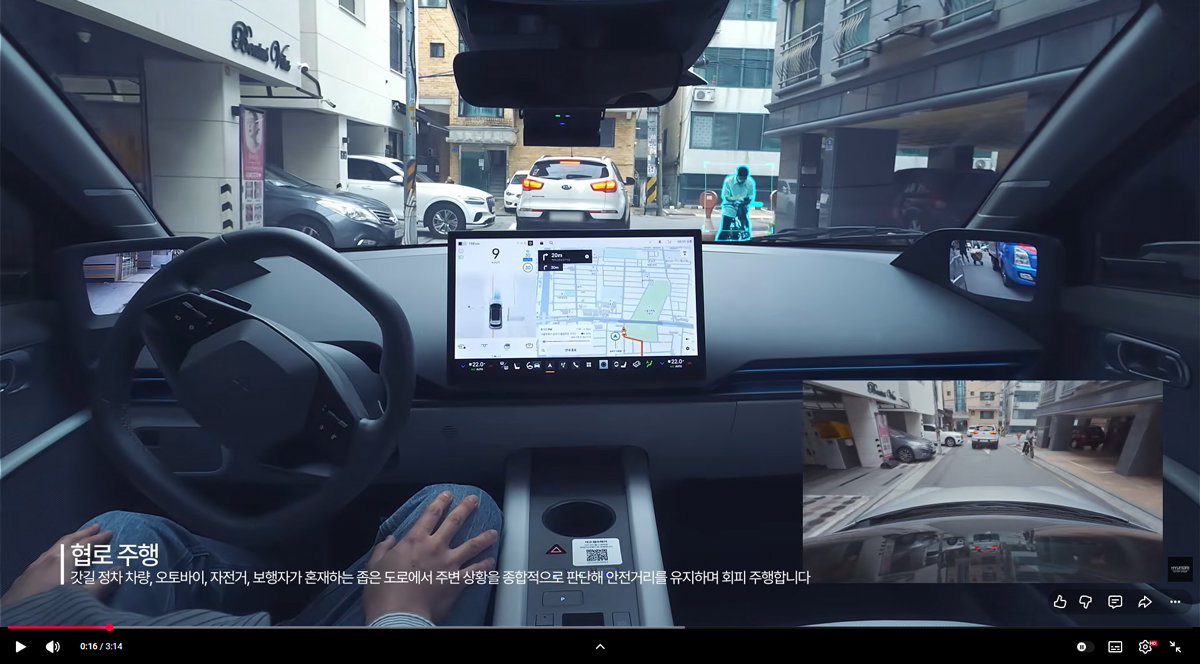
The Korea Chamber of Commerce and Industry announced that companies from both countries signed 32 memorandums of understanding (MOUs) that day, including cooperation on AI and autonomous driving development, collaboration on K-pop artist content, and expansion of consumer goods and food market entry. Separately, the Ministry of Trade, Industry and Energy announced that it had signed a total of nine MOUs, including cooperation on AI and autonomous driving platform development, cooperation to expand the entry of consumer goods and food products, and cooperation on K-pop artist intellectual property (IP) content.
ⓒ dongA.com. All rights reserved. Reproduction, redistribution, or use for AI training prohibited.
Popular News