Government to purchase KRW 1.46 trillion in additional budget
and fully support development of ‘neural processing units’
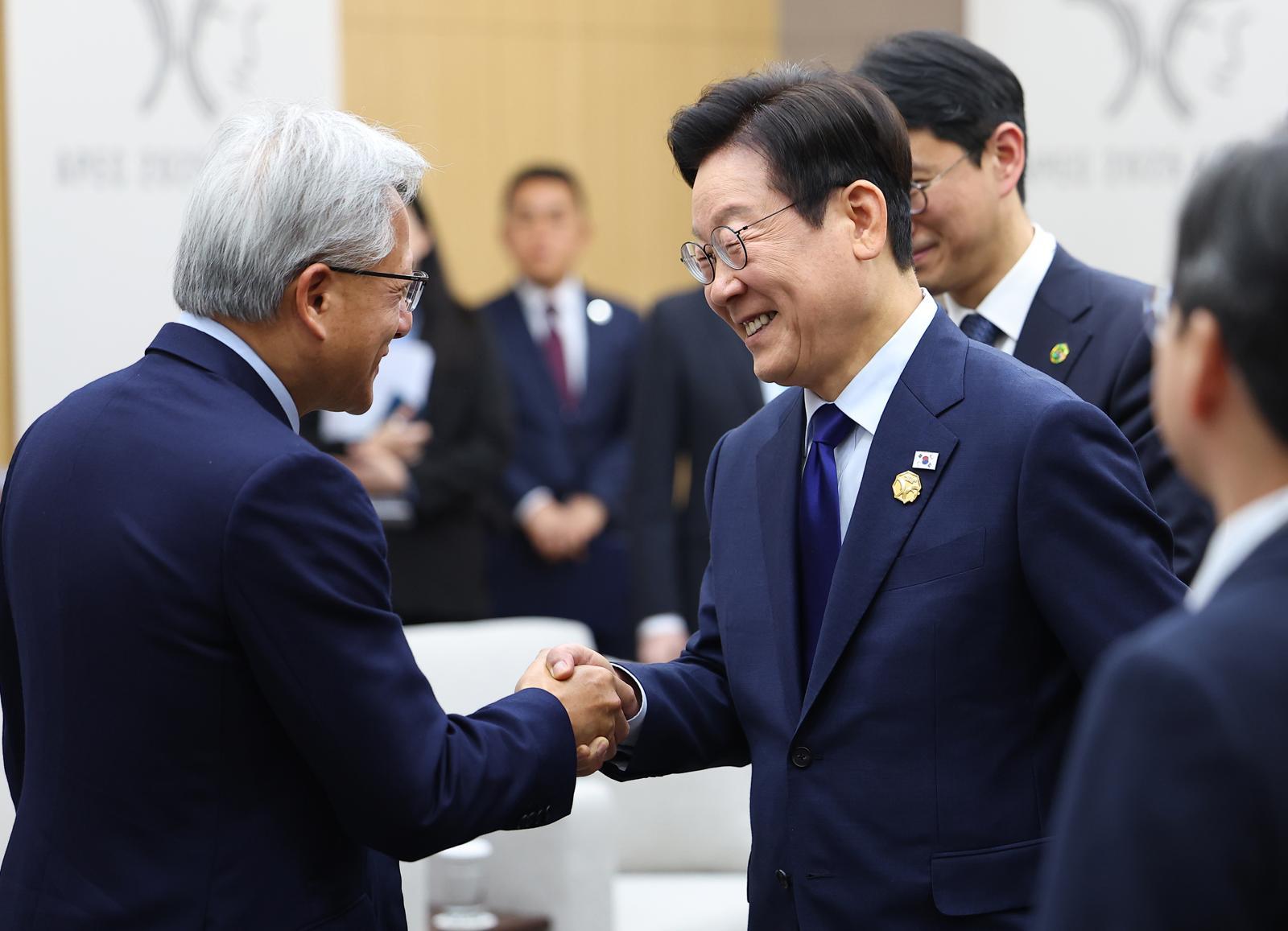
President Lee Jae-myung shakes hands with Nvidia CEO Jensen Huang on the 31st at the Gyeongju Hwabaek International Convention Center (HICO) in North Gyeongsang Province, the venue of the APEC summit. 2025.10.31. Presidential Office Press Corps
The government plans to supply 10,000 advanced graphics processing units (GPUs) to domestic startups and academia starting in February next year. At the same time, it will begin development of domestically produced artificial intelligence (AI) semiconductors to strengthen national competitiveness in the AI supply chain.
The Ministry of Science and ICT announced on the 18th that it held the “2nd Meeting on Science and Technology Affairs” at the Government Complex Seoul and deliberated and approved the “Strategy for Securing and Allocating Advanced GPUs for National AI Innovation.” Bae Kyung-hoon, Deputy Prime Minister and Minister of Science and ICT, who chaired the meeting, said, “AI semiconductors and AI bio will become the heart of future industries, and we will connect the world via an AI highway built with advanced GPUs and our independent network technology,” adding, “All ministries will join forces to deploy every resource and personnel effectively.”
During the Asia-Pacific Economic Cooperation (APEC) meetings held in Gyeongju in October this year, the government agreed with Nvidia to secure 52,000 GPUs by 2030. Among these, 10,000 GPUs purchased with KRW 1.46 trillion from the first supplementary budget this year will be made available to startups and academia starting in February. The government is reviewing a plan to allocate 30% to industry, 20% to academia, and 50% to national projects such as the “Independent AI Foundation Model” program.
At the same time, to secure sovereignty in an AI supply chain currently concentrated in the United States and China, the government plans to provide full support for domestic development of neural processing units (NPUs). NPUs are semiconductors specialized for AI computation and operate with far lower power consumption than GPUs, making them essential for “physical AI” and “industrial AX (AI transformation),” which are regarded as future growth engines. However, they currently have limited demand due to lower versatility and more complex design. According to the Software Policy & Research Institute, only about 30% of companies have plans or intentions to adopt NPUs.
Taking this situation into account, the government plans to play a priming role for the early market by identifying public-sector demand. It will launch the “K-NPU Project” to enhance the performance of domestic NPUs in connection with the ongoing Independent AI Foundation Model program. The goal is to secure commercial-level NPU performance by 2027.
In addition, starting next year, the government plans to promote the “Seven Leading Public K-NPU Projects,” including establishing AI utilization infrastructure for administrative tasks, AX in public safety and defense, and AI CCTV conversion. Companies that invest in NPU-based AI computing infrastructure and facilities will be given tax credit benefits.
The government will also pursue a “Hyper AI Network Strategy” to secure sixth-generation (6G) telecommunications technology, which is essential for physical AI. It has set goals of commercializing 6G by 2030, achieving a 20% global market share in 6G and AI networks, and fostering five companies with annual revenue of more than KRW 500 billion.
ⓒ dongA.com. All rights reserved. Reproduction, redistribution, or use for AI training prohibited.
Popular News