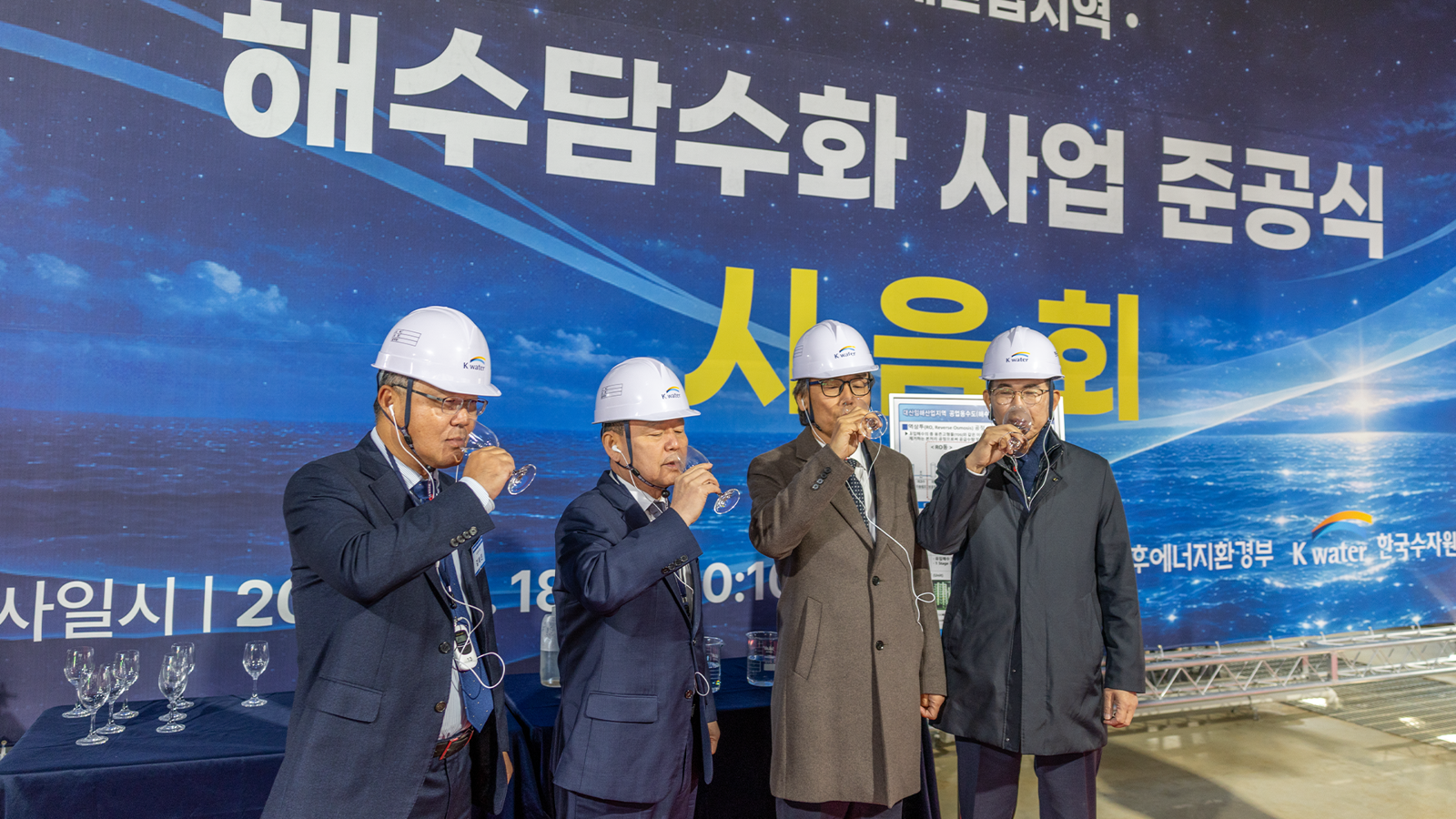
Guests attending the completion ceremony for the Dae산 Coastal Industrial Area industrial water supply project on the 18th are tasting desalinated water. (From left) Kim Tae-jin, President of GS Engineering & Construction, Yoon Seok-dae, President of Korea Water Resources Corporation, Keum Han-seung, 1st Vice Minister of the Ministry of Climate, Energy and Environment, and Lee Wan-seop, Mayor of Seosan. GS E&C
GS Engineering & Construction (GS E&C) announced that on the 18th it held a completion ceremony at the Dae산 Coastal Industrial Area industrial water supply (seawater desalination) site in Daesan-eup, Seosan-si, Chungcheongnam-do, attended by around 100 participants including officials from the Ministry of Climate, Energy and Environment, Korea Water Resources Corporation (K-water), and GS E&C.
The newly completed Dae산 Coastal Industrial Area industrial water supply project was promoted to ensure a stable supply of industrial water to the Daesan Industrial Complex in Seosan, Chungcheongnam-do, where numerous refining and chemical production facilities are concentrated. Commissioned by Korea Water Resources Corporation, the project has a total cost of KRW 317.5 billion and is currently the largest seawater desalination facility in Korea.
According to GS E&C, construction of the facility began in 2021 and included the establishment of an intake pumping station, dual filtration facilities, reverse osmosis (RO) equipment, and a wastewater treatment building. The plant has a production capacity to convert up to 100,000 tons of seawater per day into industrial water. Following the completion ceremony, full-scale operation is scheduled to begin next year.
The Dae산 Coastal Industrial Area industrial water supply facility is designed with dual pipelines to prevent any interruption in water supply even in emergency situations, and the equipment has been arranged in a stepped layout to enhance operational efficiency. In the seawater desalination process, reverse osmosis (RO) technology with higher energy efficiency than conventional evaporative methods has been applied. GS E&C expects to reduce energy consumption and achieve operating cost savings through the use of an energy recovery device (ERD).
GS E&C plans to use the completion of this seawater desalination plant as a springboard to broaden its capabilities in water-related businesses. A GS E&C official stated, “Based on the track record of constructing this largest domestic seawater desalination facility, the company has established a foundation for expanding projects aimed at addressing water scarcity caused by climate change and ensuring a stable supply of industrial water required for the nation’s advanced strategic industries.”
Hwang So-young 기자 fangso@donga.com
AI-translated with ChatGPT. Provided as is; original Korean text prevails.
ⓒ dongA.com. All rights reserved. Reproduction, redistribution, or use for AI training prohibited.