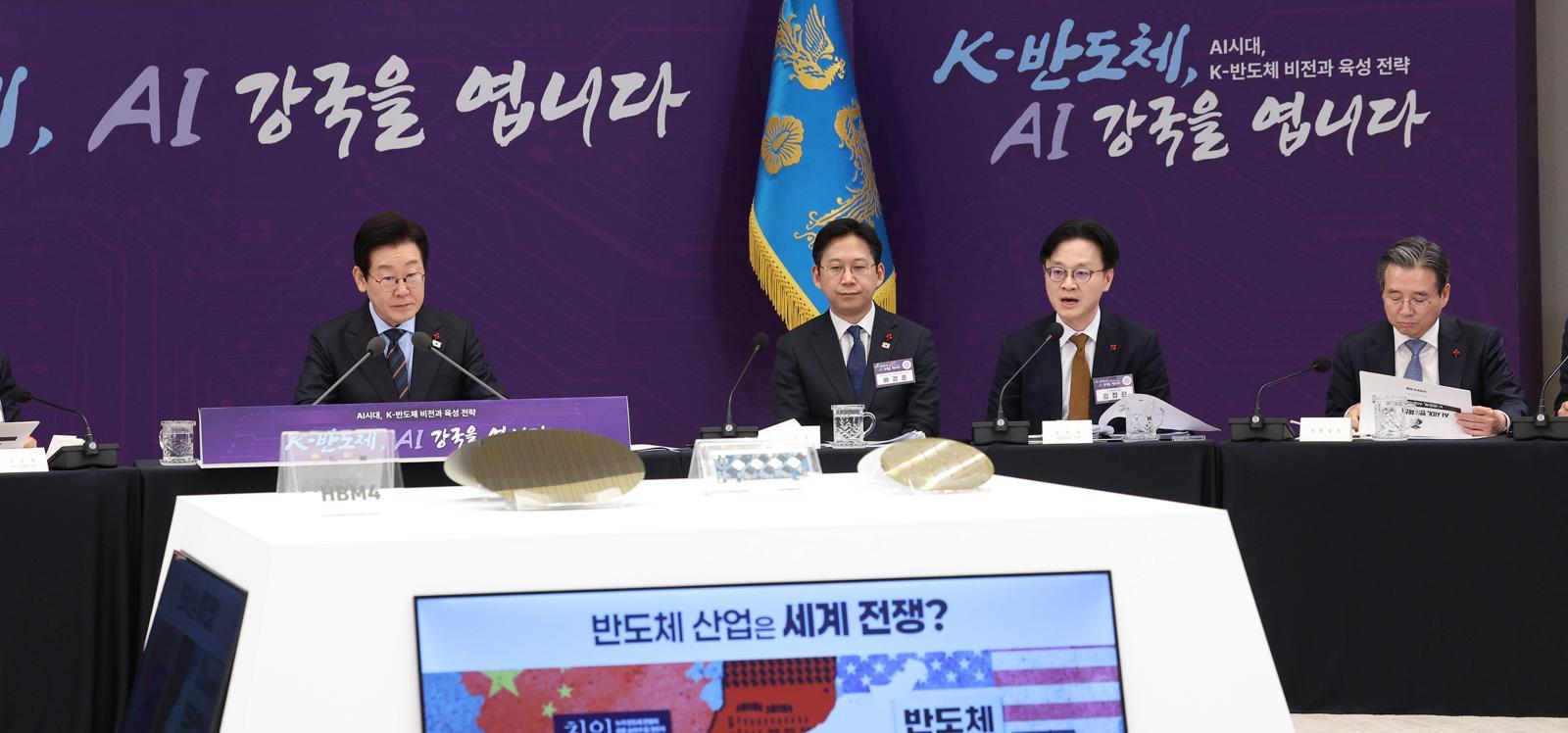
Minister of Trade, Industry and Energy Kim Jung-kwan (second from right) speaks at the “AI Era: Vision and Fostering Strategy for K-Semiconductors” briefing held at the Presidential Office in Yongsan-gu, Seoul, on the 10th. Presidential Office Photo Press Corps
The government’s pledge on the 10th to provide extensive support for the semiconductor industry along with regulatory easing stems from the fact that the artificial intelligence (AI) hegemony race is spreading into a “nation-versus-nation” competition.
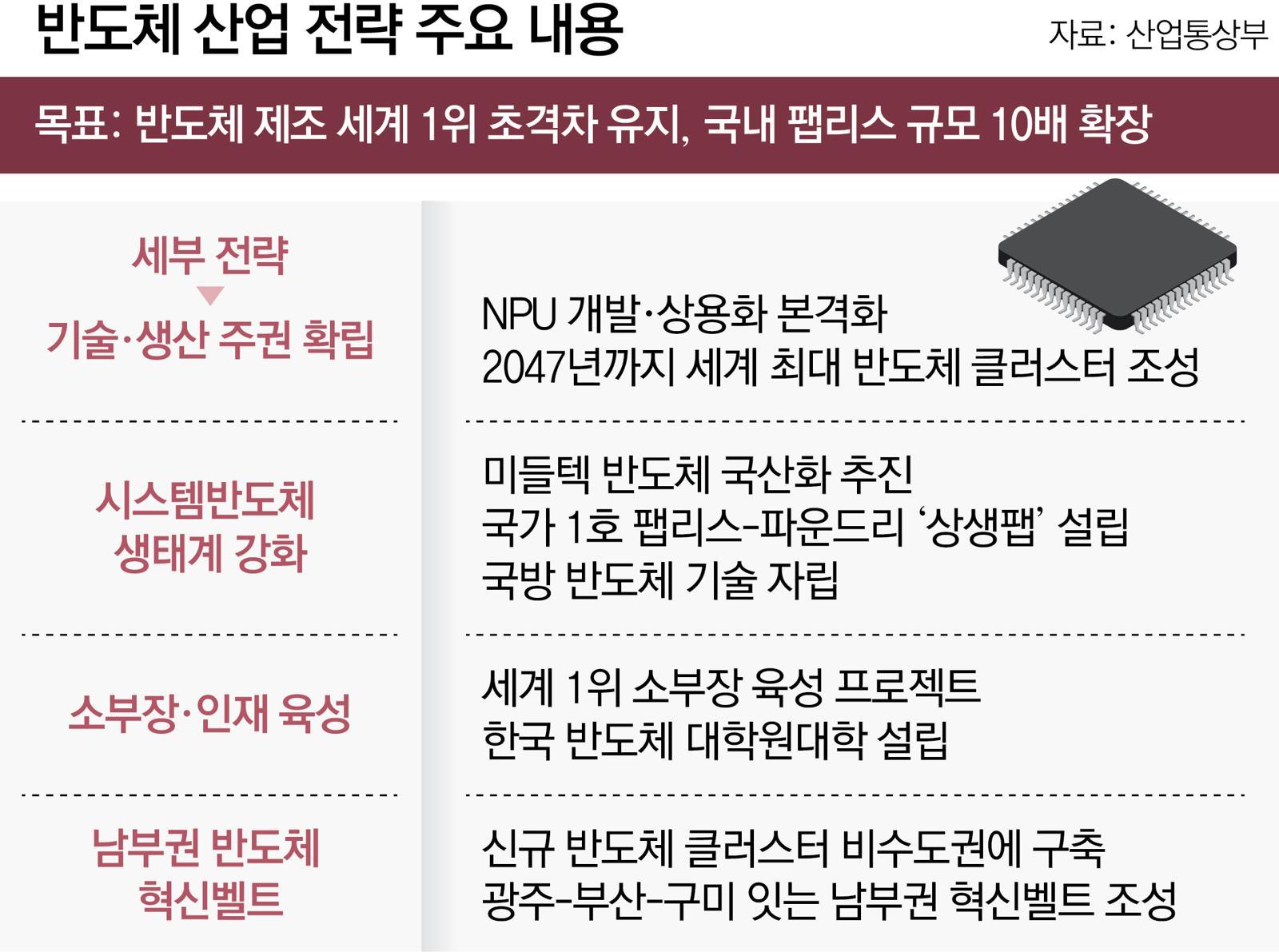
Accordingly, in order to induce astronomical investments from large corporations, the government will ease regulations such as the separation of industrial and financial capital, and will support the system semiconductor ecosystem by building government-led semiconductor plants so that startups and small and medium-sized enterprises can also enter the sector. Among AI “brain” chips, the government has designated the Neural Processing Unit (NPU), considered the segment where Korea is best positioned, as a future growth engine and plans to inject budgetary funds into it.
The semiconductor industry strategy announced this day by Minister of Trade, Industry and Energy Kim Jung-kwan includes a plan to foster the system semiconductor ecosystem, where Korea has been weak, and expand the scale of “fabless” (semiconductor design) companies by more than tenfold going forward.
First, around KRW 300 billion will be injected by 2032 to localize “middle-tech” semiconductors, such as chips for telecommunications and automobiles, which sit between cutting-edge and general-purpose technologies, thereby establishing a stable profit base for the domestic fabless industry. The government will then build factories under state leadership that can directly manufacture products once fabless companies complete their designs. This is the so-called first national “co-prosperity fab” (foundry, or contract semiconductor manufacturing plant). A total of KRW 4.5 trillion will be invested through a public-private partnership (a 52% share under review for the private sector and 48% for the public sector) to construct a 12‑inch, 40‑nanometer‑class process, middle‑tech semiconductor‑dedicated foundry, with production capacity to be allocated exclusively for domestic fabless companies. Minimum order quantity and cost burden thresholds will also be significantly relaxed to prevent cases where, despite having completed chip designs, companies cannot secure production at domestic foundries due to small order volumes.
The strategy aims to move beyond a large conglomerate‑centric structure and expand the base of the semiconductor ecosystem so that startups and small and medium‑sized enterprises can also participate. President Lee Jae-myung stated, “Concentration is sometimes necessary for growth, but just as when a large old tree grows, all the shrubs around it can disappear, the surrounding ecosystem may collapse.”
The government will also invest KRW 1,267.6 billion by 2030 to develop and commercialize NPUs, the on-device AI brain, as the next-generation chip to lead the market after HBM. Unlike GPUs (graphics processing units), the AI chips dominated by Nvidia, NPUs are regarded as more suitable for on-device AI because they are strong in inference and consume less power. On-device AI refers to AI that runs directly on a device rather than in the cloud. As Korea directly manufactures devices such as smartphones, laptops, automobiles, and home appliances, it sees a competitive edge in developing on-device AI that operates within the devices themselves.
New advanced industry specialized complexes will be designated only in non-capital regions, and the government will also pursue the creation of a southern semiconductor innovation belt connecting Gwangju–Busan–Gumi in North Gyeongsang Province. To induce corporate investment outside the capital area, the government is reviewing incentives such as easing working‑hours regulations in regional areas only.
The principle of “local production, local consumption” (jisansiso), under which electricity tariffs are lowered in power generation regions, was also presented. President Lee stated, “According to the distance‑based transmission tariff system, the so‑called principle of jisansiso, the government’s policy to keep electricity prices lower in power production areas is unavoidable,” adding, “Electricity tariffs between regions may be reversed going forward. It is impossible not to reflect this in production costs.”
Neural Processing Unit (NPU)
A dedicated semiconductor optimized for AI computation and inference. Compared with GPUs (graphics processing units), where Nvidia is dominant, NPUs consume less power and have drawn attention as AI chips suited to “on-device AI” (AI executed within a device). Both Samsung Electronics and SK hynix have been developing NPUs.
ⓒ dongA.com. All rights reserved. Reproduction, redistribution, or use for AI training prohibited.
Popular News