[SeoulTech x IT Donga Joint Planning] The Preliminary Startup Package Support Program (hereinafter referred to as "Preliminary Startup Package") is a major startup support initiative by the Ministry of SMEs and Startups and the Korea Institute of Startup & Entrepreneurship Development, aimed at assisting the launch of promising ideas. The Startup Support Group at Seoul National University of Science and Technology (SeoulTech) is the organizing body for the 2025 Preliminary Startup Package, aiding the growth and development of new enterprises. IT Donga, in collaboration with SeoulTech's Startup Support Group, examines promising startups in the growth phase.
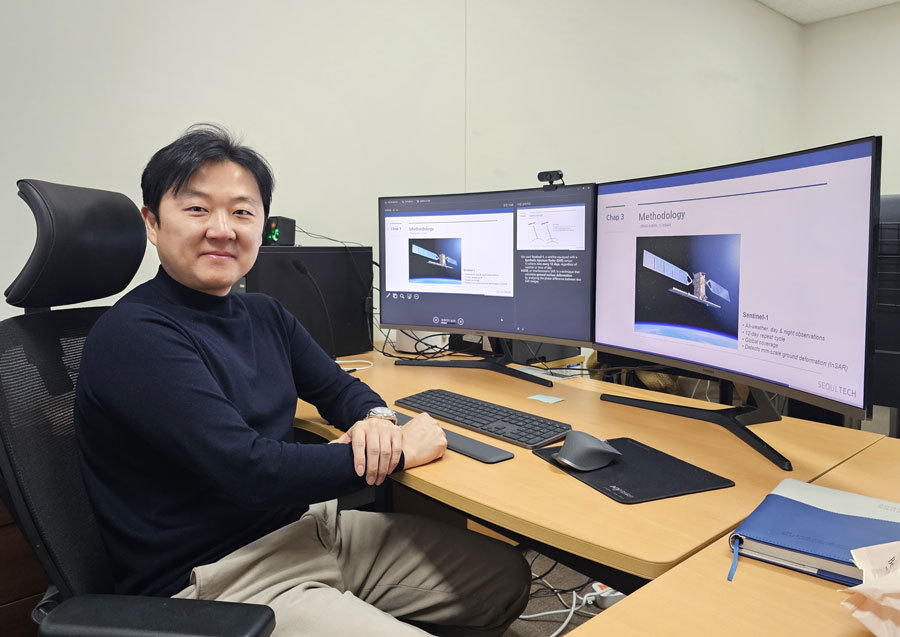
Seo Hyung-jun, CEO of Geo-AI Monitoring Center / Source=IT Donga
Recent ground-related accidents such as the sinkhole in Myeongil-dong, the collapse of the Sinansan Line, and the subsidence accident at Busan Station have shocked society. The severity of these incidents is compounded by the difficulty in predicting them or identifying their causes. It is impractical to install measuring devices indiscriminately without knowing where an accident might occur.
However, advances in various cutting-edge technologies and the efforts of scientists and engineers continue to address these issues. Some institutions and companies have introduced accident response solutions using these technologies, gaining attention.
The 'Geo-AI Monitoring Center' (CEO Seo Hyung-jun) is one such startup with technology to solve these problems. It uses proprietary technology called 'MSRS' that combines various elements such as satellites, drones, and fiber optic sensors to measure and prevent ground subsidence and structural deformation. Although founded in May this year, CEO Seo Hyung-jun is a professor in the Department of Civil System Engineering at SeoulTech and an expert who has conducted related research in the UK for 11 years. The interview with CEO Seo Hyung-jun provided insights into the present and future of ground safety monitoring technology.
- It is impressive that a scholar serving as a university professor has ventured into startup entrepreneurship. What journey led to this point?: After obtaining a Ph.D. in Korea, spending about 11 years abroad with various experiences influenced me. I worked as a researcher at the University of Cambridge in the UK for three years, then served as a professor at Xi'an Jiaotong University in China for four years, and again at the University of Liverpool in the UK for four years.
What was particularly impressive in the UK was the development of civil engineering as an integrated discipline with electrical, electronic, and computer engineering. Research was actively conducted on assessing building stability using laser scanning or monitoring structural conditions with drones and satellites. I received extensive guidance on these integrated technologies from professors like Kenichi Soga and Robert Mair at Cambridge.
After joining SeoulTech last year, domestic public institutions showed significant interest in this technology. Public institutions such as the Korea Rail Network Authority, Korea Expressway Corporation, Korea Institute of Civil Engineering and Building Technology, and Korea Land and Geospatial Informatix Corporation focused on our technology's ability to measure ground deformation via satellite and detect sinkholes or ground subsidence.
However, these public institutions preferred collaboration with companies rather than research labs due to commercialization and associated liability issues. While schools focus on research, companies produce products and provide services, taking responsibility for the outcomes. For these practical reasons, a corporation was established in May this year. The timing coincided with the availability of the Preliminary Startup Package support program, which we utilized.
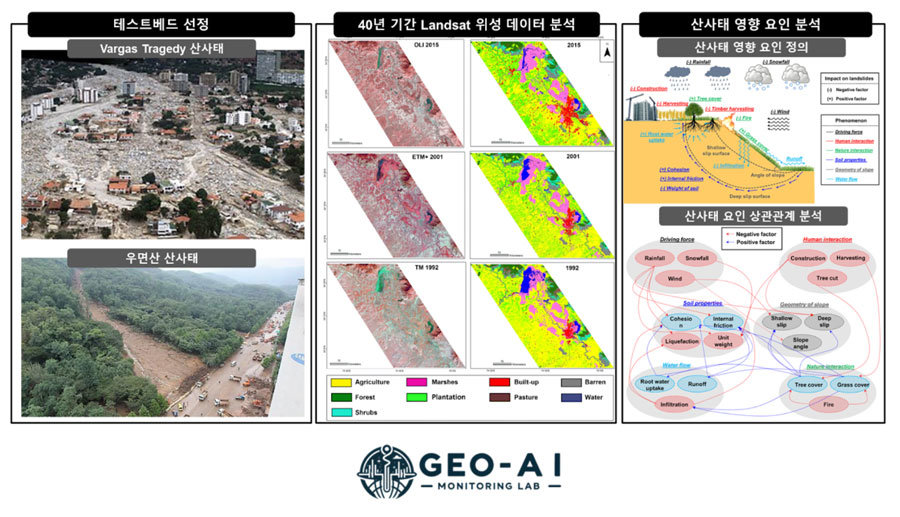
Landslide damage analysis and cause identification through satellite data analysis / Source= Geo-AI Monitoring Center
- Please explain the company's core solution in detail. What technology solves what problem?: The core of our solution is proprietary technology called 'MSRS (Multi-Scale Remote Sensing)'. As the name suggests, it is a technology for remotely sensing structures at various scales, composed of three 'eyes'.
The first is the 'Big Eye', which monitors the entire Earth based on satellites. Satellites continuously orbit the Earth, capturing the same area repeatedly. It's akin to a space-scale CCTV. By emitting microwaves and measuring the returning waves, it determines ground subsidence. Even remote areas like Antarctica can be measured. We have collaborated with the Turkish Polar Research Institute to measure ground subsidence in Antarctica and detected landslides and movements of cultural assets (castles) in the UK.
The second is the 'Small Eye', utilizing drones or laser scanning technology. When the Big Eye identifies a problematic area, the Small Eye examines it in more detail, similar to zooming in on a photo with a smartphone to monitor the risk area closely.
The third is the 'Penetrating Eye', using distributed fiber optic sensors. It involves installing optical cables inside actual structures and measuring reflected data by emitting lasers. The greatest advantage of this technology is its ability to measure deformation at 5 cm intervals when a fiber optic cable up to 50 km long is installed. The accuracy is at the micrometer level (1/1000 mm). To cover a wider area, additional 50 km units of fiber optic cables can be added.
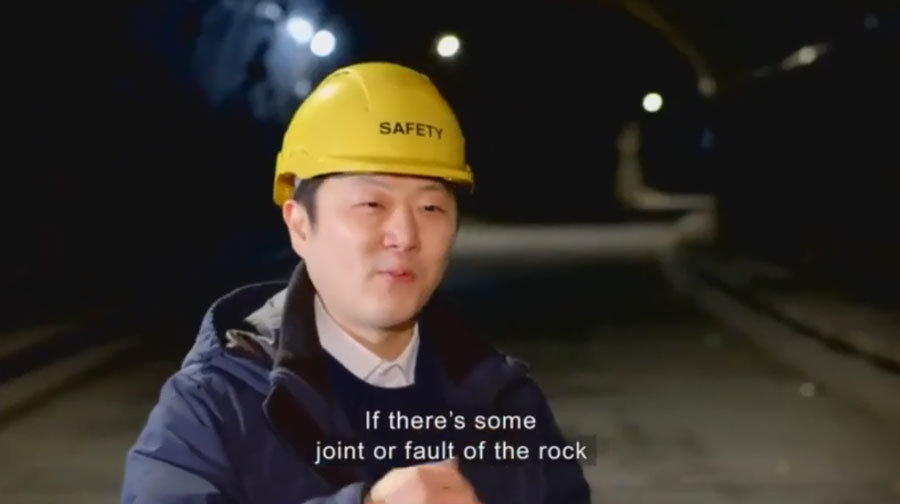
Seo Hyung-jun featured in the BBC documentary 'Underground World' / Source= Geo-AI Monitoring Center
- The fiber optic sensor technology is particularly impressive. What is the technical basis for measuring such a fine range?: The key lies in laser and microwave technology and the ability to analyze them. Simply detecting reflected signals is meaningless. The important part is analyzing the data content of the detected signals to derive results. This data analysis technology and know-how are the core of our solution.
Our solution incorporates proprietary coding and AI technology. We possess deep learning and machine learning technology to automatically detect structural damage. It can automatically analyze 3D image data. Over 50 related international papers have been published, and our research was featured in the BBC documentary 'Underground World'. It was covered as part of technology for preventing structural accidents such as tunnel incidents or identifying causes after accidents.
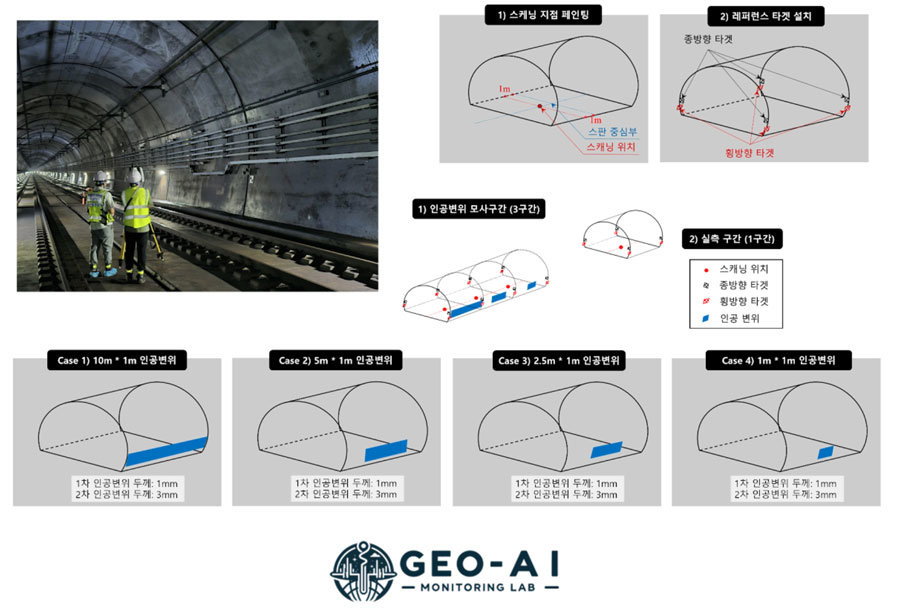
Tunnel safety review using MSRS technology / Source=Geo-AI Monitoring Center
- I understand the technical advantages and differentiation. How far has commercialization progressed?: It is already being applied in various projects. We participated in the subsidence and tunnel safety review work on the Bundang Line, commissioned by the Korea Rail Network Authority, in collaboration with the Korea Land and Geospatial Informatix Corporation. The Big Eye, Small Eye, and Penetrating Eye were all applied.
We are conducting research services with the Korea Institute of Civil Engineering and Building Technology to further refine this technology. It is also being applied to develop landslide prevention solutions with funding from the National Research Foundation under the Ministry of Science and ICT. We are jointly developing solutions for landslide prevention with Jeollabuk-do. Our solution primarily focuses on the B2G (business-to-government) sector.
- Transitioning from academia to entrepreneurship must have been challenging. What difficulties did you face, and how did you overcome them?: There were indeed many challenges. Even basic tasks like establishing a corporation or opening a bank account took several days. While I am confident in my experience and know-how as a scholar, I am a novice as an entrepreneur. I am very grateful for the help I have received from those around me.
- I heard you utilized the Preliminary Startup Package program through SeoulTech. What specific assistance did you receive?: It was incredibly helpful. I particularly remember the 1-night, 2-day workshop with various CEOs at Yangju Bloomvista. My mindset about running a business changed significantly. Initially, I thought of simply utilizing funding well, but seeing the passion and attitude of others running businesses made me resolve to work hard.
It was also instrumental in forming a network. I invited the CEOs I met then to give special lectures at the school. Above all, I received very detailed know-how on establishing and operating a business, down to the smallest processes. These were things I could never have done alone.
I am very grateful for the sincere help from SeoulTech administrative staff and students. I received assistance in all areas, including cost and material support, administrative procedures, network formation, and educational programs. I would highly recommend such programs to other startups.
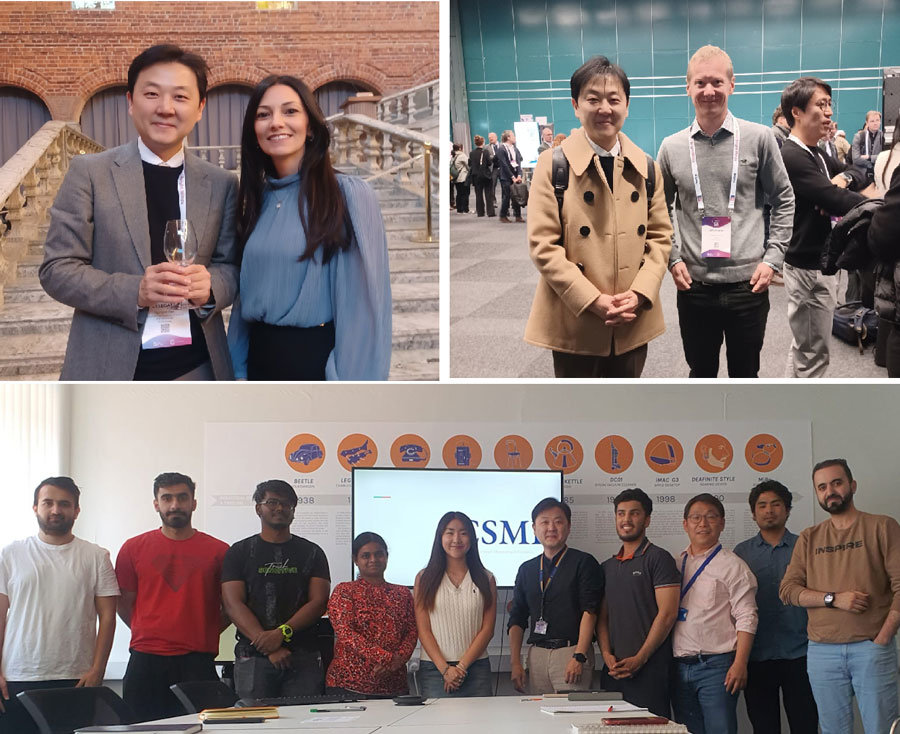
Seo Hyung-jun is aiming for global expansion through exchanges with domestic and international stakeholders / Source=Geo-AI Monitoring Center
- What are your future plans? In what direction do you plan to expand your business?: The goal is to apply our technology beyond Korea to the global market. Our solution is based on satellites and the cloud, allowing it to be used as a web service anytime, anywhere without visiting the site. We are currently pursuing entry into the Laos market through collaboration with a company called 'Defree'. We have met with the Laos government regarding a landslide prevention project, and they have shown great interest.
Above all, our aspiration is to go beyond merely making money to reach a higher level. In other words, we want to be like doctors in the civil and architectural fields. Just as endoscopy is used to detect cancer early in medicine, we hope our MSRS technology can prevent 'cancerous accidents' like ground subsidence or collapses in advance. We hope that various people in the global market will share our vision.
IT Donga Reporter Kim Young-woo (pengo@itdonga.com)
ⓒ dongA.com. All rights reserved. Reproduction, redistribution, or use for AI training prohibited.
Popular News