Article at a Glance
When acquired by private equity firm KL & Partners in 2019, Mom’s Touch was a mid-tier burger brand with many stores but weak brand positioning and profitability. Although it had a strong flagship product called Thigh Burger, its basic systems for purchasing, logistics, franchise management and menu operations were not in place, preventing its product competitiveness from being fully translated into business performance. KL & Partners viewed this not as a “stagnant brand” but as an “unmanaged asset,” and after the acquisition began restructuring by making the purchasing structure transparent, diversifying suppliers, integrating regional franchise branches and simplifying the menu. This is a case of “operational value-up,” in which a private equity firm increased corporate value by changing the operating structure instead of simply cutting costs to extract short-term profits. Through this process, Mom’s Touch evolved in Korea into a QSR (Quick Service Restaurant) platform that increases franchise store sales, while overseas it tested the possibility of global franchise expansion by using its directly operated Shibuya store in Japan as a bridgehead. It also built a “growth-based partnership” model in which the headquarters bears costs such as increases in chicken prices, facility investments and chef collaboration expenses while growing sales together with franchise stores.
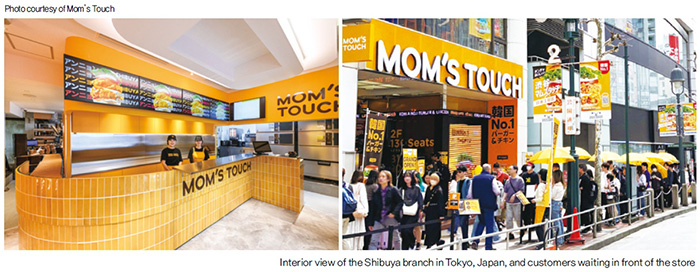
The 1st Tokyo Shibuya branch of “Mom’s Touch,” opened in April 2024 on the site where McDonald’s Japan had operated for 39 years. The 216-seat store, spanning from the 1st basement floor to the 2nd floor above ground, surpassed 700,000 cumulative visitors and 510 million yen (about 5 billion KRW) in cumulative sales in March 2025, 1 year after opening. That figure is twice the average store sales of McDonald’s Japan and 7 times the sales of local brand MOS Burger. It was an exceptional success in Japan’s food service market, which has been called a graveyard for restaurant brands. One Japanese weekly magazine even called the store a “Black Ships from Korea” (黒船, Kurofune).
1
The reason Mom’s Touch’s advance in Japan is drawing attention is that just 6 years ago, the company was a mid-tier brand by sales with little presence even in Korea. In 2019, Mom’s Touch posted sales of 288.9 billion KRW and operating profit of 19 billion KRW (operating margin of 6.6%), failing to deliver notable results in terms of profitability. Although it ranked 2nd in Korea by number of stores with 1,243 locations, its monthly average sales per store were around 36 million KRW because of its small-store structure centered on neighborhood commercial districts, about half that of Lotteria and far below McDonald’s. Also, despite its large number of stores, its brand presence was limited relative to its scale, as it was not included in the “Big 3” in consumers’ perception, which consisted of McDonald’s, Lotteria and Burger King, and remained in 4th place by actual purchase share.
2
Yet Mom’s Touch transformed itself in just 6 years. In 2025, sales reached 479 billion KRW and operating profit 89.7 billion KRW, up 66% and 373%, respectively, over 6 years. Its operating margin also rose from 6.6% to 18.7%. By number of stores, it became Korea’s No. 1 burger franchise, and consumer payments at its roughly 1,490 franchise stores nationwide exceeded 1 trillion KRW in 2025 for the first time since the company’s founding.
Copyright Ⓒ 동아비즈니스리뷰. All rights reserved. 무단 전재, 재배포 및 AI학습 이용 금지










 경제·경영 질문은


 닫기
닫기