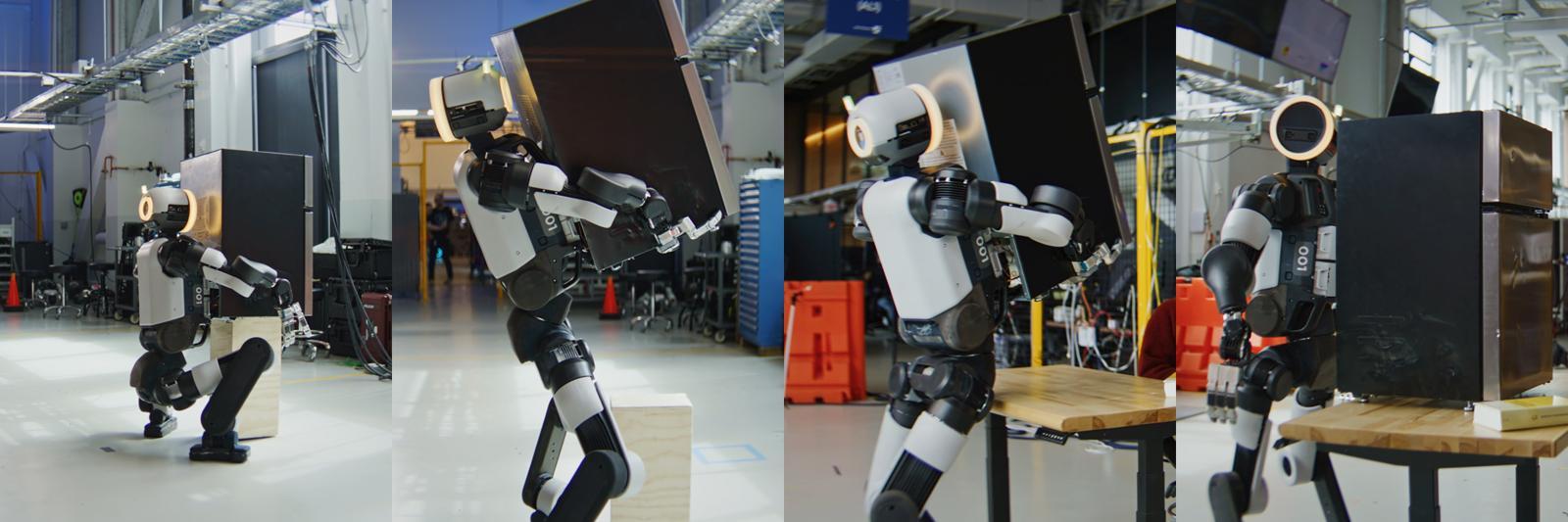
The process of the humanoid robot Atlas, developed by Hyundai Motor Group’s robotics affiliate Boston Dynamics, carrying a refrigerator, as revealed in a YouTube video on the 18th (local time). Atlas bent its knees and lifted the refrigerator with both arms, then rotated only its upper body 180 degrees and successfully placed the refrigerator on a table. Provided by Hyundai Motor Group
A video has been released showing Atlas, the humanoid robot of Boston Dynamics, the robotics subsidiary of Hyundai Motor Group that is scheduled for field deployment in 2028, lifting and moving a 23kg refrigerator. Earlier this month, the company released footage of Atlas performing gymnastics, emphasizing its ability to work in non-standard postures; it has now demonstrated its capability to transport objects. As Atlas showcases rapid progress and signals that its deployment to worksites is entering the “final countdown,” competition in the use of robots on global industrial sites is intensifying, with humanoid robots at BMW plants already contributing to the production of 30,000 vehicles.
● BD emphasizes Atlas’s readiness for field deployment
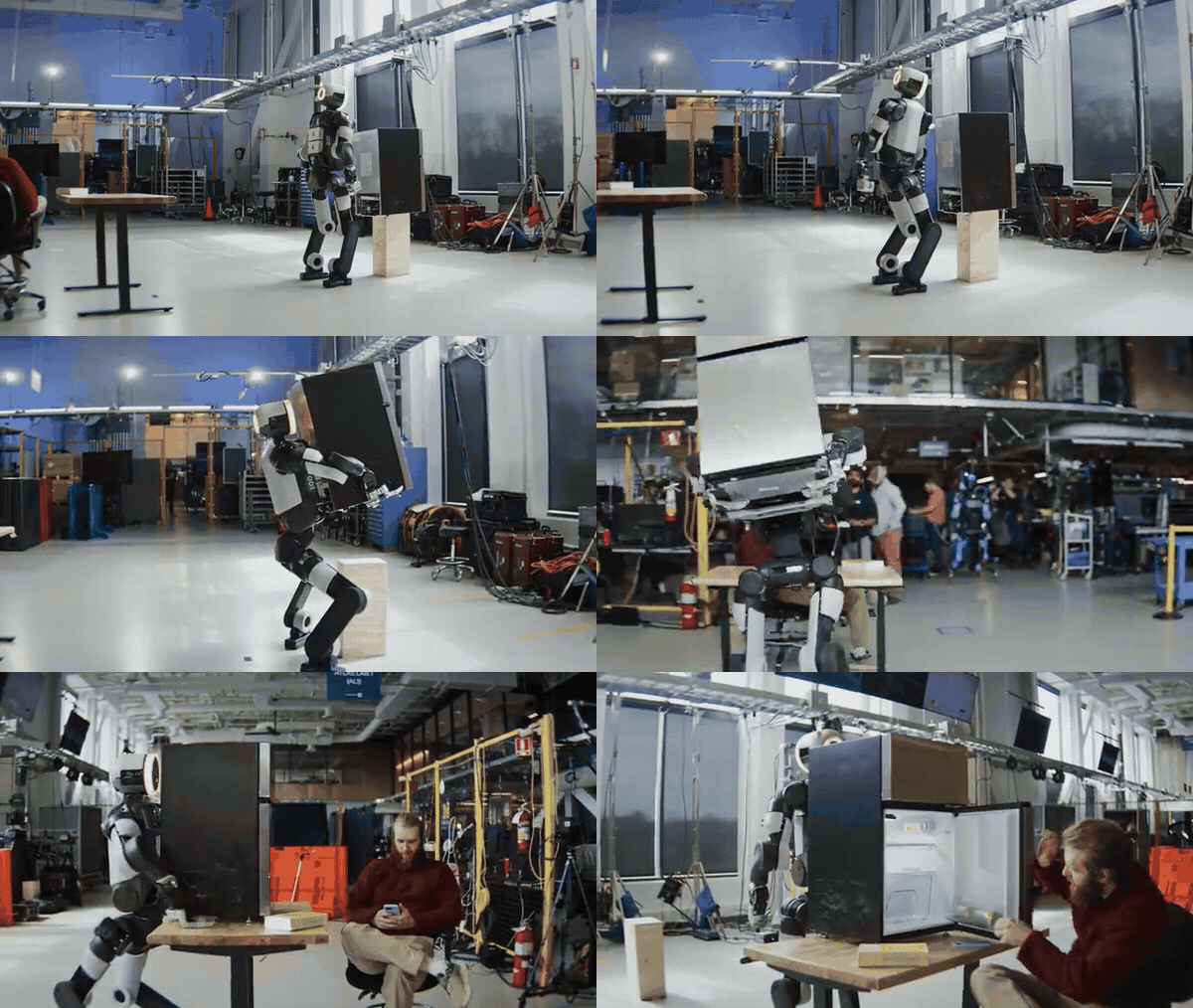
Boston Dynamics’ humanoid robot Atlas lifting and moving a 23kg refrigerator. Captured from Boston Dynamics’ YouTube channel
In a video titled “Atlas, can you bring me a drink?” posted on Boston Dynamics’ YouTube channel on the 18th (local time), Atlas is shown bending its knees halfway and steadily lifting a refrigerator with both arms. It then moves toward a table behind it while maintaining balance. Soon after, its upper body rotates 180 degrees and it gently places the refrigerator on the table. Boston Dynamics described the video as “an example demonstrating advancements in whole-body control technology” and stressed that “Atlas is moving beyond lab-level demos and entering a stage where it can perform tasks in industrial sites with numerous variables.”
On the same day, another YouTube video titled “How does Atlas learn?” revealed the training methodology behind this refrigerator-carrying capability. The company explained that Atlas implemented these movements in the real world within several weeks through large-scale simulation-based reinforcement learning. In other words, it repeatedly experienced success and failure in a “virtual space” and autonomously derived the optimal motions. In tests, it reportedly succeeded in carrying refrigerators weighing up to 45kg.
Hyundai Motor plans to begin mass-producing Atlas in 2028 and deploy it on automotive production lines. At a corporate presentation (IR) for overseas institutional investors held in Boston, USA, on the same day, Hyundai also announced a plan to introduce more than 25,000 Atlas units into Hyundai Motor and Kia production facilities.
● At BMW, robots already helping produce 30,000 vehiclesAtlas’s competitors are also moving quickly. Humanoid robots are being deployed one after another across global industrial sites. BMW in February released results from a 10‑month pilot operation of two “Figure 02” robots, developed by US startup Figure AI, at its Spartanburg plant in the United States. During that period, the Figure 02 units loaded more than 90,000 sheet metal parts, contributing to the production of 30,000 units of the X3 sport utility vehicle (SUV). Based on these results, BMW decided to deploy “EON,” a robot from Swedish robotics company Hexagon Robotics, to the electric vehicle battery assembly line at its Leipzig plant in Germany this summer.
Humanoid robots have also been introduced for the first time at a Japanese airport. From this month, Japan Airlines has deployed “G1” from Chinese robotics startup Unitree Robotics and “Walker E” from Ubtech Robotics at Tokyo’s Haneda Airport. During the trial period, which runs through 2028, the robots will be responsible for loading cargo containers onto aircraft. The company is also considering expanding their use to tasks such as cabin cleaning in the future.
Bank of America forecasts that global shipments of humanoid robots will reach about 90,000 units next year and increase to 1.2 million units by 2030. However, some point out that in Korea, the lack of safety standards is slowing the deployment of robots to worksites compared with other countries. Park Ji-hoon, industrial safety specialist at law firm HwaWoo, said, “If safety regulations lag behind, companies have no choice but to hesitate in adopting robots,” and emphasized, “As soon as international standards are established, they must be swiftly applied domestically so that companies can actively push ahead with robot adoption in line with both domestic and international requirements.”
ⓒ dongA.com. All rights reserved. Reproduction, redistribution, or use for AI training prohibited.
Popular News