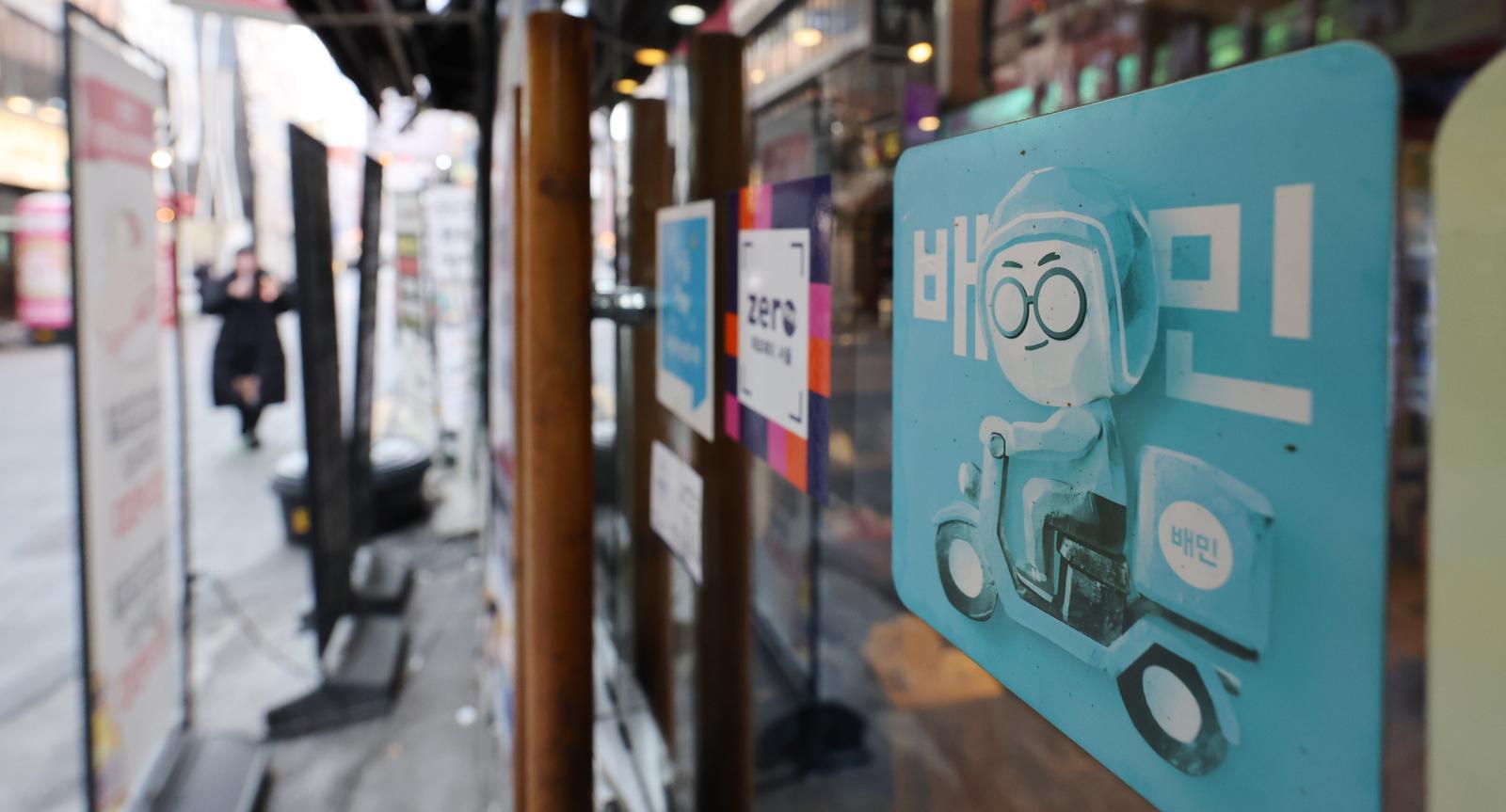
A delivery app Baedal Minjok (Baemin) sticker is attached to a restaurant in Seoul on the 22nd. 2025.1.22 ⓒ News1
Uber has additionally acquired shares in Delivery Hero (DH), the parent company of Baedal Minjok, becoming its largest shareholder.
On the 18th (local time), DH announced, “With Uber’s additional acquisition of our shares and financial instruments, Uber now holds 19.5% of our issued shares and an option to acquire an additional 5.6% stake.”
Through this share purchase, Uber has overtaken Prosus, the former largest shareholder of DH, to become DH’s largest shareholder. Previously, on April 16, Uber purchased shares worth EUR 270 million (approximately KRW 472.53 billion) from Prosus, securing a 7% stake.
DH welcomed Uber’s latest investment, describing it as a sign of confidence in its platform and strategy. However, DH projected that Uber is unlikely to immediately increase its stake to a level that would threaten management control. In a regulatory filing released the same day, DH stated, “Within the next 12 months, Uber may acquire additional voting rights or dispose of shares,” but added, “At present, there is no intention to acquire 30% or more of the voting rights in the issuing company.”
Meanwhile, on the 19th, Naver filed a disclosure in response to market rumors that it had formed a consortium with Uber and conveyed to Germany-based Delivery Hero (DH), Baemin’s largest shareholder, its intention to acquire Baemin. Naver stated, “The company is reviewing various options to strengthen business competitiveness, but nothing specific has been decided at this time.” Although no contract has been finalized, this effectively acknowledged that Naver is considering an acquisition of Baemin.
Naver’s weakest area in its aggressively expanding commerce business has been identified as delivery. Instead of operating its own logistics centers, Naver has been handling deliveries through the Naver Fulfillment Alliance (NFA), a coalition of multiple logistics partners. Compared with Coupang’s “Rocket Delivery,” which is backed by its own logistics network, Naver’s delivery service has been criticized as being fragmented, with only limited offerings such as “guaranteed arrival.” If Naver, together with Uber, succeeds in acquiring Baemin, it could significantly strengthen its delivery capabilities.
However, some in the market view the likelihood of Naver’s acquisition as low due to potential hurdles such as a business combination review by the Korea Fair Trade Commission (KFTC). Under the current Monopoly Regulation and Fair Trade Act, a large business group that comes to own 20% or more of the total issued shares of another company must report the business combination to the KFTC. In addition, Naver is currently undergoing review by financial authorities over its proposed merger with Dunamu, so another large-scale acquisition could be burdensome.
ⓒ dongA.com. All rights reserved. Reproduction, redistribution, or use for AI training prohibited.
Popular News