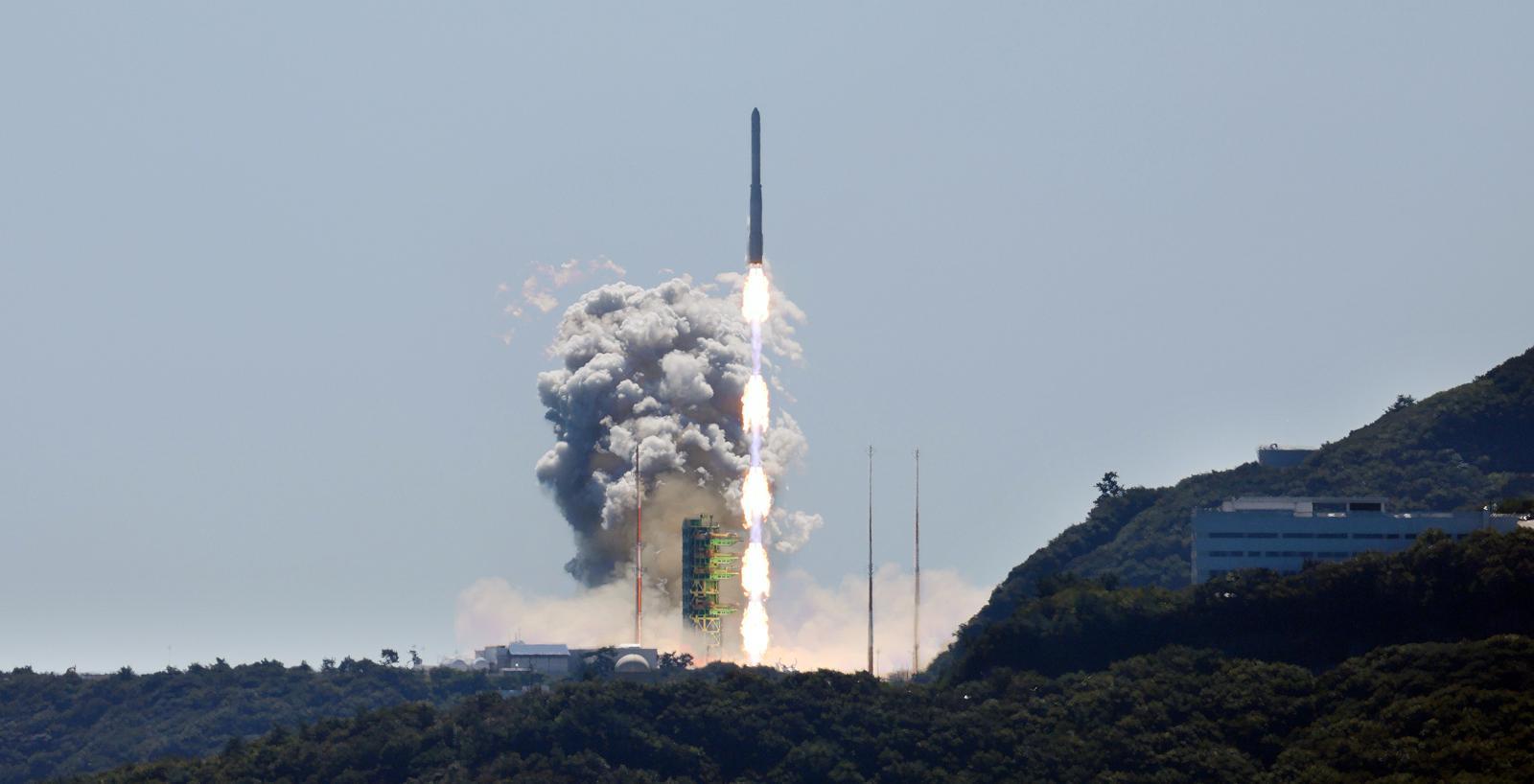
The Korean launch vehicle Nuri is launched from the Naro Space Center in Goheung-gun, Gwangju, Jeollanam-do, on the afternoon of the 7th. 2026.10.7 News1
Ten “CubeSats,” ultra-small satellites, were loaded onto Nuri for its fifth launch. Of these, nine separated normally from the launch vehicle. These CubeSats are tasked with verifying in space the performance of dementia drugs, semiconductors such as DRAM, and lunar exploration equipment. Through these ultra-small satellites developed by domestic companies, universities, and research institutes, they function as “space laboratories” that secure research data difficult to obtain on the ground.
The CubeSat “BEE-1012,” loaded onto Nuri launched on the 7th, contains donepezil, an active ingredient used in dementia treatments. This satellite, developed by domestic space medicine company Spacerintech, conducts experiments observing the process by which donepezil’s components transform into crystals. In the microgravity of space, the flow of liquids is calmer than on Earth, making it easier to observe the process by which drug components form crystals. Following the experiment with ingredients of the immuno-oncology drug “Keytruda” on Nuri’s fourth launch, the scope of experiments has been expanded to dementia treatments on this fifth launch.
The “Korean Device and Component Space Verification Platform-2,” developed by the Korea Aerospace Research Institute and others, carries DRAM and memory storage devices produced by SK hynix. It checks whether semiconductors that have passed ground tests operate normally in the space environment, where temperature fluctuations are large and radiation is strong. The CubeSat “ULYSSES” verifies the reliability of lunar exploration rover equipment manufactured by the Institute of Unmanned Vehicle Systems and the Korea Electrotechnology Research Institute, among others.
In addition, the total of nine satellites that successfully entered orbit are scheduled to carry out their respective missions, including verification of optical communication technology that transmits and receives data using light, and the collection of fine dust and radiation data. Meanwhile, the CubeSat “PERSAT-02,” which was scheduled to observe marine debris and ocean currents around Jeju, failed to separate in this launch.
Im Jae-hyuk
AI-translated with ChatGPT. Provided as is; original Korean text prevails.
ⓒ dongA.com. All rights reserved. Reproduction, redistribution, or use for AI training prohibited.