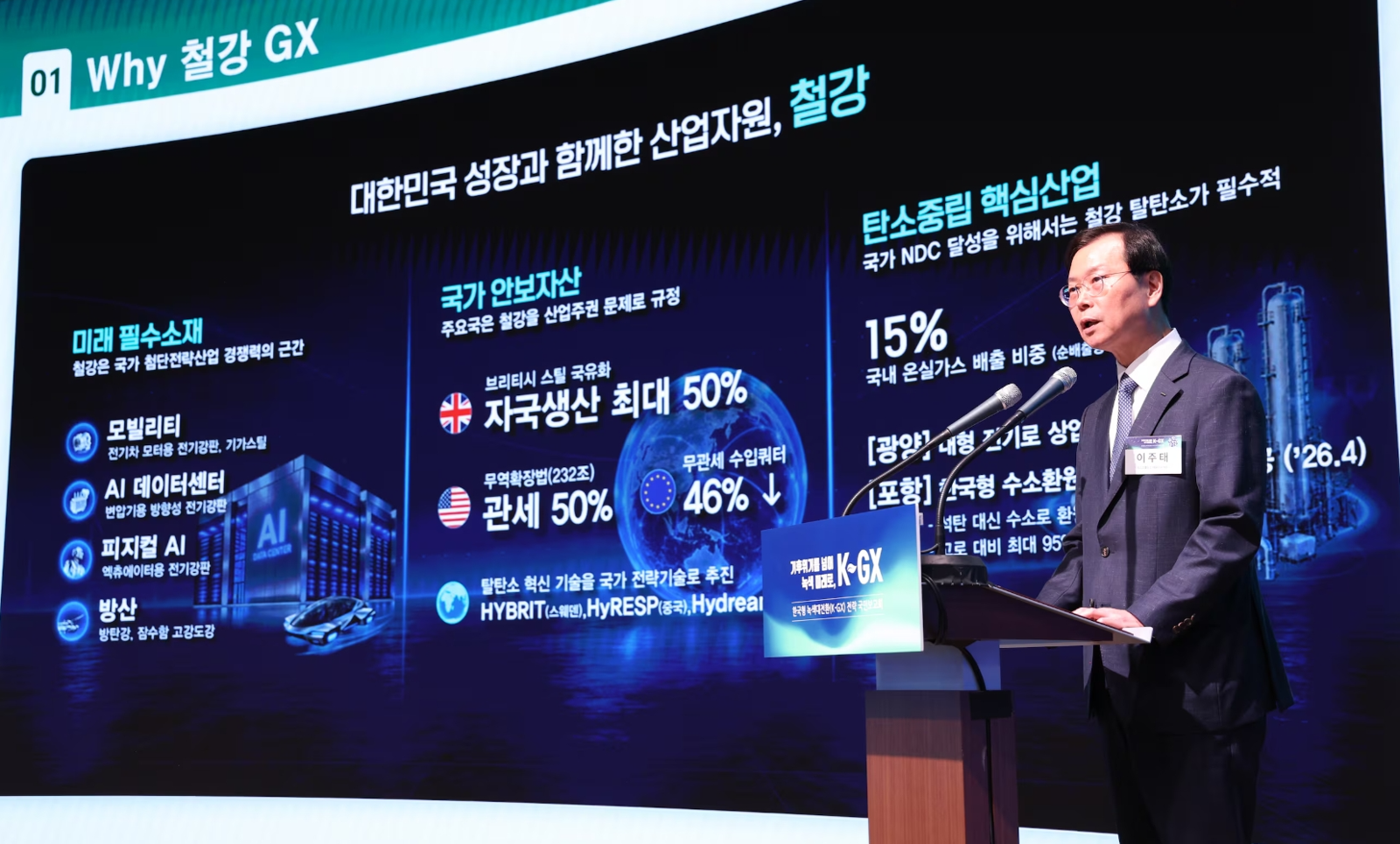
POSCO Holdings President Lee Joo-tae delivers a presentation at the Korean Green Transformation (K-GX) Strategy National Report on the 7th. News1
POSCO Group will participate in the government’s Korean Green Transformation (K-GX) strategy and promote the decarbonization of the steel industry centered on hydrogen-reduction steelmaking technology. The group plans to build a HyREX (Hydrogen Reduction Steelmaking) demonstration facility in Pohang with an annual capacity of 300,000 tons by 2028 and later expand related projects to Gwangyang.
POSCO Group announced on the 7th that it had presented its plan for “Establishing a Decarbonized Industrial Ecosystem Based on Steel GX,” a K-GX signature project, at the “Korean Green Transformation (K-GX) Strategy” event presided over by the President.
K-GX is a government strategy to pursue carbon neutrality and economic growth in parallel, promoting a green transition across industries around three key directions: New Growth Engine GX, GX for All, and Sustainable GX.
POSCO Group stressed that reducing carbon emissions in the steel industry should not be left solely to individual companies’ facility conversions, but must be supported by the parallel establishment of clean energy supply, technology development, a low-carbon steel market, and policy measures.
To this end, the group plans to work with the government around HyREX, a Korean-style hydrogen-reduction steelmaking technology, to establish a system that connects everything from clean energy supply to low-carbon steel production and utilization.
Hydrogen-reduction steelmaking is a technology that reduces carbon emissions by using hydrogen instead of coal to reduce iron ore in traditional blast furnaces. POSCO Group explained that, given the characteristics of steelmaking processes that operate 24 hours a day on a continuous basis, securing large-scale electricity and clean hydrogen in a stable and economical manner is a key condition for advancing the business.
The group also highlighted the need to create a “green premium market” in which customers pay additional costs for low-carbon steel. It stated that only when standards for low-carbon steel are established and policy support on the demand side—such as expanding the purchase of green products—is provided in tandem can related investments be sustained.
POSCO Group proposed “TIMUP,” a public-private cooperation framework to divide these roles. TIMUP combines the initial letters of Technology, Installation (facility conversion), Market, Utility (energy), and Policy. Under this concept, companies would be responsible for technology development and facility conversion, while the government would support the establishment of clean energy supply bases, low-carbon markets, and related infrastructure.
● HyREX demonstration facility with annual capacity of 300,000 tons in Pohang by 2028
The Steel GX initiative will first be promoted in the southeastern region, centered on Pohang.
POSCO Group plans to build a HyREX demonstration facility with an annual capacity of 300,000 tons by 2028 and to establish a steel decarbonization cluster that links a clean hydrogen supply chain with the industrial complexes in Pohang and Ulsan.
The company expects that this project will generate approximately KRW 6 trillion in economic impact and create 14,000 jobs in the southeastern region, as well as achieve an additional annual carbon reduction of 560,000 tons.
After verifying the HyREX demonstration and related business models in the Pohang-centered southeastern cluster, the group plans to gradually expand the Steel GX project to the southwestern region, centered on Gwangyang.
Lee Joo-tae, President of POSCO Holdings, said, “Under the government’s K-GX strategy, the public and private sectors will cooperate to create a low-carbon market and establish an economically viable clean energy supply base, thereby building a decarbonized industrial ecosystem,” adding, “We will contribute to national carbon neutrality and the green transformation of the manufacturing sector while growing together with local communities.”
Alongside the decarbonization of the steel industry, POSCO Group plans to expand the supply of low-carbon steel to help reduce carbon emissions in related industries such as mobility, AI data centers, and robotics.
ⓒ dongA.com. All rights reserved. Reproduction, redistribution, or use for AI training prohibited.
Popular News