Lotte joins development of a domestic humanoid robot
Hanwha deploys robots in ice cream packaging lines
Foodservice industry speeds up adoption of cooking and serving robots
Ourhome considers using robots to enhance wine service
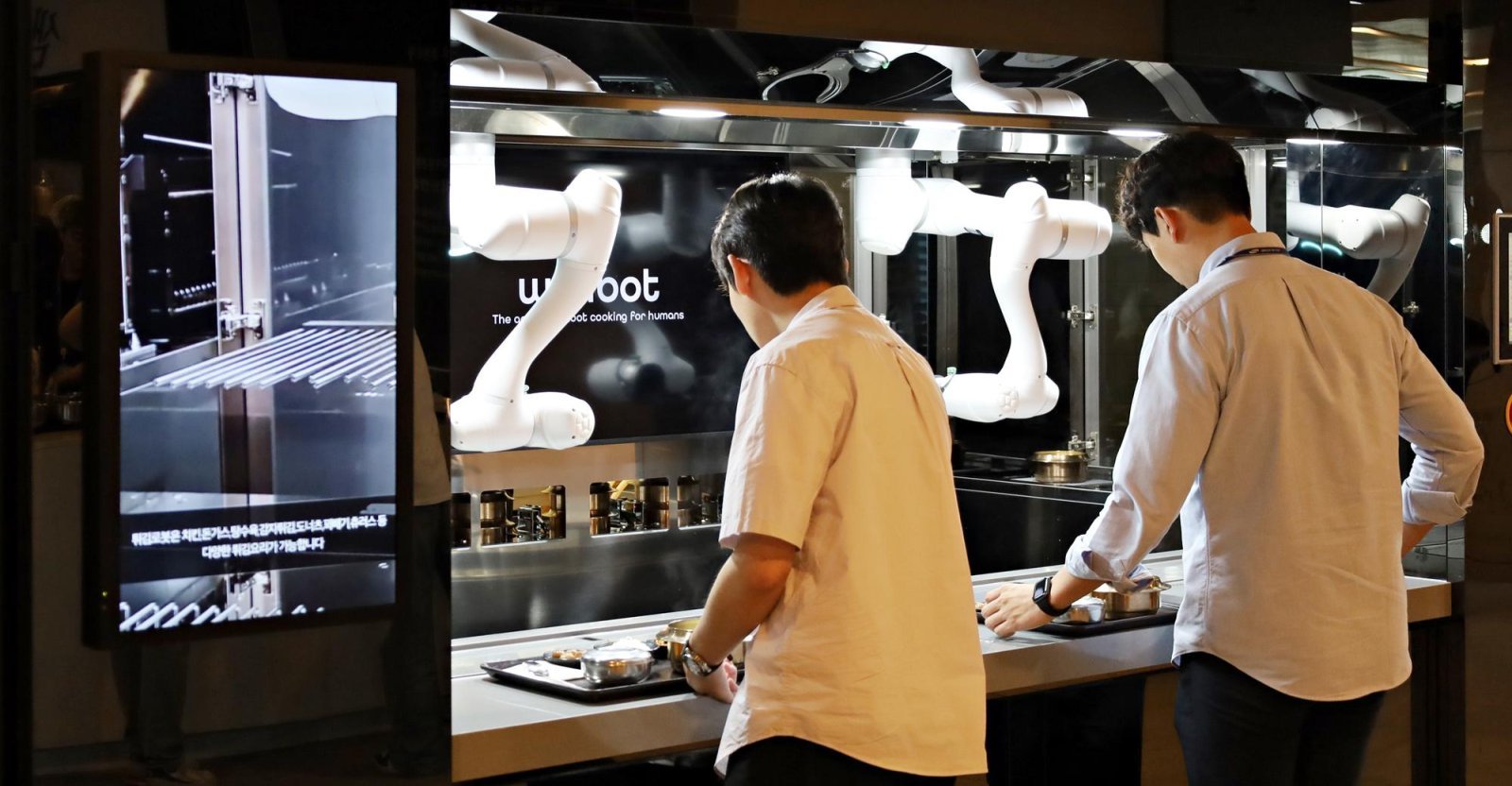
As the retail industry actively introduces artificial intelligence (AI) robots, Samsung Welstory’s “Welibot” is shown cooking soups and stews. Introduced in 2023, around 300 units of Welibot are currently in operation across 10 sites. Provided by Samsung Welstory
It checks customers’ order details, locates the items, and scans the barcodes. It places the located items in boxes, packages them, and loads them onto delivery vehicles. All data generated in the work process, from customer demand to product inventory status, is converted into information and used for management. All of this will be done by humanoid robots that are to be introduced in the retail sector.
● Retail industry accelerates adoption of humanoid robots
Recently, from logistics center operations to food preparation in cafeterias, the retail industry has been expanding the introduction of human-like robots across its operations.
A prime example is Lotte, which has embarked on developing humanoids for use in logistics centers. On the 7th, Lotte Hi-Mart and Lotte Global Logistics announced that they will participate in a national R&D project to develop domestically produced physical artificial intelligence (AI)-based humanoids. The project, overseen by the Korea Evaluation Institute of Industrial Technology (KEIT) under the Ministry of Trade, Industry and Energy, aims to develop industry-specialized humanoid robots domestically and reduce dependence on foreign-made robots and AI models. It is a long-term project to be pursued over five years from this year through 2031.
Benson, a premium ice cream brand operated by Veruscoop Creamery, a subsidiary of Hanwha Galleria, is also running its filling and packaging process at its Pocheon production center using Hanwha Robotics’ collaborative robots.
The introduction of robots in the retail sector is also accelerating data-driven management that utilizes AI for demand forecasting and inventory management. Lotte Mart has applied the “Ocado Smart Platform (OSP),” an integrated operation solution from the UK’s Ocado, to its “Zeta Smart Center Busan,” which began operation in August. This solution manages store inventory status using big data and AI, and can be linked to robot-based product picking and packing operations.
Shin Hyun-chae, Head of SCM at Lotte Hi-Mart, said, “If humanoid robots are deployed for repetitive and labor-intensive tasks, they can reduce employees’ workload and improve overall operational efficiency,” adding, “Errors that occur during work processes can also be minimized, which will further enhance the quality level of logistics operations.”
● Carrying goods, boiling soup… easing workload
In the retail sector, humanoid robots are already being actively utilized not only in logistics but also in cooking, a field that involves many hot and hazardous tasks.
Samsung Welstory introduced “Welibot,” the first dedicated cooking robot station in the contract foodservice industry, in 2023. Welibot is a cooking robot specialized in soups and stews and can automatically handle the entire process from cooking to serving in about five minutes. Each unit can automatically cook around 400 bowls per hour. To date, around 300 units have been deployed across approximately 10 sites. Ourhome is also reviewing ways to apply cooking automation robots and “Vinobot,” a wine service robot, to its foodservice business. Kim Jae-sung, Head of the Innovation Lab Group at Samsung Welstory, explained, “As labor shortages in the service industry intensify, the introduction of cooking robots is a solution that can address both manpower shortages and safety accident issues.”
ⓒ dongA.com. All rights reserved. Reproduction, redistribution, or use for AI training prohibited.
Popular News