A domestic research team has identified a mechanism by which hypertension can further accelerate the progression of already advanced osteoarthritis. Photo = Getty Images Bank.
Osteoarthritis is a representative joint disease that becomes more common with age. According to the World Health Organization (WHO), about 73% of osteoarthritis patients are 55 years of age or older. Until now, wear and tear and damage to the joints caused by aging or physical trauma have been regarded as the main causes.
However, a Korean research team has revealed that hypertension can accelerate the progression of osteoarthritis in joints already weakened by aging or injury, as well as the specific mechanism involved. This suggests that hypertension is not simply a problem of blood pressure and blood vessels, but can promote the destruction of cartilage in aged or injured joints.
This study, conducted by a joint research team led by Professor Ryu Jehwang of Chonnam National University and Distinguished Professor Jeon Jang-su of Inje University, was published on 1 October (local time) in the international journal
Science.
Osteoarthritis and hypertension may appear to be separate diseases. However, previous studies have reported an association in which people with hypertension have a higher risk of osteoarthritis or more severe disease. The biological mechanism linking the two conditions, however, has remained unclear.
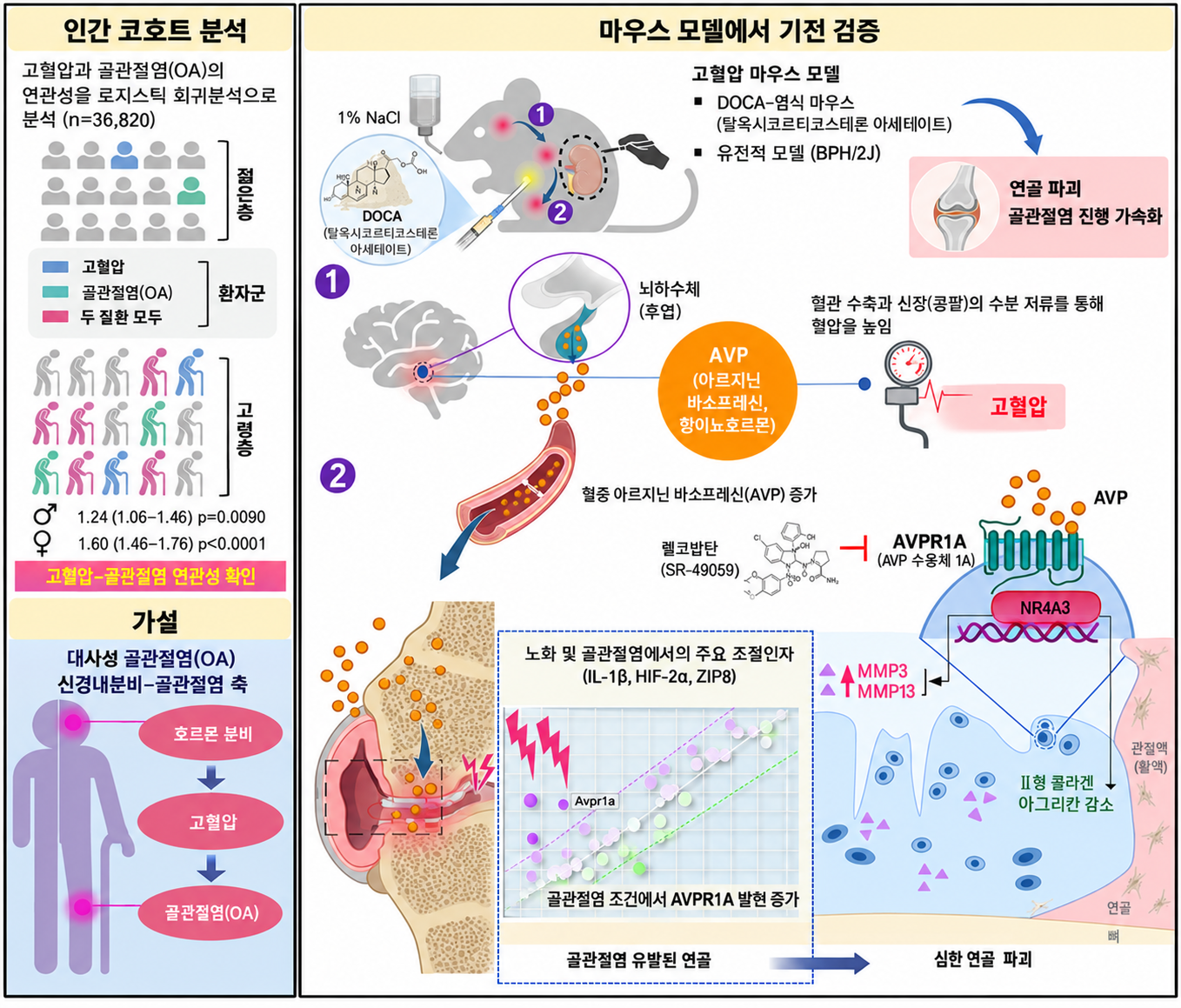
The research team analyzed data from the Korea National Health and Nutrition Examination Survey on 36,820 adults aged 45 or older and found that the prevalence of osteoarthritis was higher in people with hypertension, and that the association with hypertension became stronger as structural damage to the joints became more severe.
Subsequent experiments using two types of mouse models confirmed that hypertension in fact promotes the deterioration of aged or injured joints. Specifically, structural changes characteristic of osteoarthritis were more pronounced, including more severe damage to articular cartilage and abnormal thickening of the subchondral bone.
This damage process involved a hormone secreted in the brain and the receptor for this hormone present in the joint.
When these two factors interacted, the production of enzymes that break down cartilage increased. At the same time, the production of cartilage components such as collagen and aggrecan, which are necessary to form and maintain joints, was suppressed.
Gene expression analysis showed that in hypertensive mice, the blood concentration of arginine vasopressin (AVP), a hormone secreted in the brain, increased. AVP traveled through the bloodstream and entered the synovial fluid.
Graphic explanation of how hypertension aggravates osteoarthritis Hypertension → increase in blood AVP → increase in AVPR1A in damaged/aged cartilage → activation of NR4A3 → ↑ cartilage breakdown, ↓ cartilage formation → worsening of osteoarthritis.
In healthy, young articular cartilage, the receptor that binds this hormone was expressed at very low levels. However, the situation changed when mechanical damage or aging occurred.
In aged or damaged cartilage, expression of the receptor AVPR1A increased sharply. When AVP carried by the blood bound to this receptor, a gene regulator called NR4A3 was activated.
From that point, a chain reaction that damages cartilage began. Chondrocytes produced an excessive amount of enzymes that degrade cartilage, while reducing production of proteins needed to form and maintain cartilage.
The researchers also compared damaged knee cartilage, relatively healthy cartilage, and synovial fluid obtained from patients who underwent total knee arthroplasty. In the cartilage of patients with damage, levels of the AVPR1A receptor and vasopressin-related biomarkers were higher.
The team then removed the AVPR1A gene or directly injected relcovaptan, a vasopressin receptor antagonist (a substance that blocks the action of the hormone), into the knee joint. As a result, the phenomenon in which hypertension accelerated cartilage loss was suppressed.
In contrast, when ordinary antihypertensive drugs were administered to mice, the condition of the cartilage did not improve.
This indicates that simply lowering blood pressure was not sufficient to prevent the hypertension-related worsening of cartilage damage observed in this experiment, but directly blocking the AVPR1A receptor to which AVP binds could suppress the acceleration of cartilage damage.
The researchers stated that targeting the AVP–AVPR1A signaling pathway identified in this study could potentially be used as a new strategy to slow the progression of osteoarthritis caused by hypertension, and that they plan to conduct follow-up studies for therapeutic development.
Related paper link:
https://doi.org/10.1126/science.aed8207
ⓒ dongA.com. All rights reserved. Reproduction, redistribution, or use for AI training prohibited.
Popular News