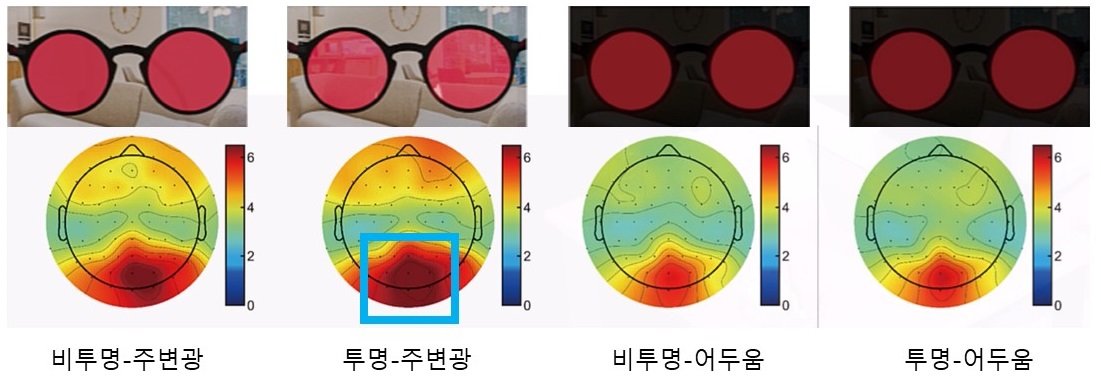
Results of gamma-frequency light stimulation under four conditions combining transparent/non-transparent OLED glasses and presence/absence of ambient light. Courtesy of Seoul National University Bundang Hospital
A “transparent OLED smart glasses” device has been developed that can stimulate the brain with light while allowing the wearer to see the surroundings. In a test involving 20 healthy adults, gamma-wave activity and signal transmission between brain regions were most active when ambient light was present.
A joint research team led by Professor Kim Ki Woong of the Department of Psychiatry at Seoul National University Bundang Hospital and Professor Yoo Seung Hyup of the School of Electrical Engineering at KAIST announced on the 6th that it had developed transparent OLED smart glasses and confirmed changes in brain activity through actual wear tests. The research findings were published in the international journal “Science Advances.”
As Alzheimer’s disease progresses, information transfer between multiple brain regions declines, and gamma-wave activity related to cognitive functions such as memory and attention is also known to change. Due to these characteristics, non-invasive methods using light or sound flickering at specific frequencies to stimulate gamma waves have been under investigation.
Previous attempts attached OLED panels to glasses to deliver light stimulation, but the panels were opaque and blocked the field of view. Because it was difficult to see the surroundings while wearing them, users had to receive stimulation only in dark environments, making it hard to combine use with daily activities.
● Light stimulation while seeing the surroundings… OLED glasses with 75% transmittanceThe research team applied transparent OLEDs so that the surrounding environment could be seen as usual. The light transmittance was designed at 75%, and screen brightness uniformity at 90% or higher. Because users can see their surroundings while wearing the glasses, the device is easier to apply in daily life than conventional opaque-panel systems.
The team provided light stimulation to 20 healthy adults under four conditions, combining transparent and opaque OLED glasses with the presence or absence of ambient light, and compared brain activity before and after stimulation.
Changes in gamma-wave activity were most pronounced when participants wore transparent OLED glasses in the presence of ambient light. Under this condition, signal transmission from the occipital lobe, which is responsible for vision, to the frontal lobe, which is associated with cognitive functions, was also the most active. Participants reported the least glare and eye fatigue under this condition.
● Gamma-wave changes confirmed… Verification in patients still neededHowever, these findings should not be directly interpreted as evidence of prevention or treatment benefits for Alzheimer’s disease. The trial subjects were 20 healthy adults, not patients with Alzheimer’s disease, and what was measured was not improvement in cognitive function but changes in brain waves and inter-regional brain signals after light stimulation. The research team plans to verify changes in cognitive function, safety, and real-world applicability in patients with mild cognitive impairment and early Alzheimer’s disease going forward.
The clinical efficacy of gamma-frequency stimulation itself also remains inconclusive. A 2025 meta-analysis of 11 studies involving patients with Alzheimer’s disease and mild cognitive impairment observed changes in brain structure, but did not confirm significant improvements in cognitive function or activities of daily living. The researchers concluded that larger-scale clinical trials are needed.
Professor Kim Ki Woong of the Department of Psychiatry at Seoul National University Bundang Hospital, Professor Yoo Seung Hyup of the School of Electrical Engineering at KAIST, Research Assistant Professor Park Ye Seung of Seoul National University, and Dr. Chae Hyeonuk of KAIST (from left)
Professor Kim Ki Woong said, “This study is encouraging in that it implemented gamma-wave stimulation in a form that can be combined with daily life and confirmed changes actually occurring in the brain,” adding, “We will further develop this into a method by which users can receive continuous brain stimulation simply by wearing the glasses, without the need to visit hospitals or use special equipment.”
Professor Yoo Seung Hyup said, “By using transparent OLED technology, we implemented a wearable device that secures the field of view while reliably delivering gamma waves,” and added, “We will continue research so that display technology can expand beyond simple information delivery into medical fields such as brain stimulation.”
ⓒ dongA.com. All rights reserved. Reproduction, redistribution, or use for AI training prohibited.
Popular News