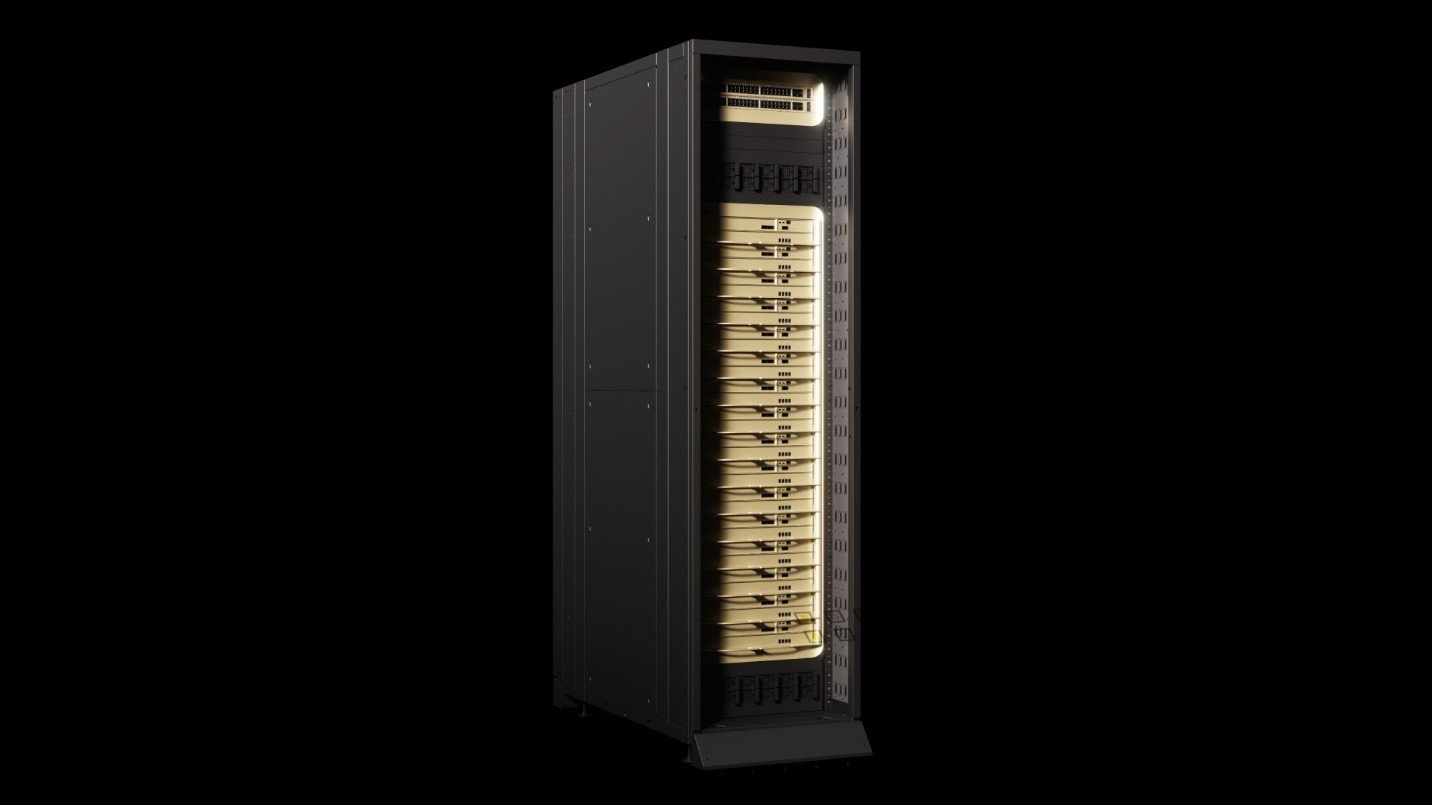
Nvidia, which is evolving into a “full-stack” company encompassing everything from chips required for artificial intelligence (AI) computation to systems and software, has begun mass production of its AI inference-specialized accelerator “Grok 3 LPX.” The company aims to offer a platform in which AI is trained using Nvidia’s graphics processing units (GPUs) and then extended through inference via Grok 3 LPX. As Grok 3 LPX will be manufactured entirely by Samsung Electronics’ foundry, expectations are rising for Samsung Electronics Foundry to return to profitability.
On the 24th (local time), Nvidia announced that it had started mass production of Grok 3 LPX, which improves inference speed to run AI agents. AI agents are AI systems that not only generate answers but also execute actions, and inference capability is essential for understanding conversational context.
Grok 3 LPX is an AI accelerator that bundles 256 language processing units (LPUs), which are inference-only chips, into a cabinet-sized rack. Nvidia stated that AI systems can be configured so that general-purpose tasks such as AI model training are handled by GPU accelerators, while Grok 3 LPX is responsible for the subsequent inference process in which the AI generates responses. Nvidia’s latest AI accelerator “Vera Rubin” can be connected with Grok 3 LPX to enhance inference performance.
Previously, in December last year, Nvidia effectively acquired the AI inference chip design startup Grok by securing licenses for its intellectual property (IP) and hiring key personnel. Grok is a startup founded by researchers who participated in designing Google’s proprietary inference chip, the Tensor Processing Unit (TPU). The acquisition price at the time was about USD 20 billion (approximately KRW 27.7 trillion), making it the largest acquisition in Nvidia’s history. The newly mass-produced Grok 3 LPX will be manufactured entirely by Samsung Electronics Foundry. As Grok 3 LPX mass production ramps up, some observers project that Samsung Electronics Foundry could turn profitable in the second half of this year (July–December).
On the 22nd of this month (local time), Nvidia also announced that it had partnered with AI startup Poolside to develop open-source AI models. Nvidia invested about USD 7 billion (approximately KRW 9.7 trillion) in Poolside to secure technology licenses and more than 100 of Poolside’s key personnel. These staff will move to Nvidia and join the development of its in-house AI model “Nemotron 4.” Nemotron 4 is a large-scale AI model with 1 trillion parameters and is scheduled to be unveiled this fall.
Nvidia’s recent moves are seen as a response to major big tech companies such as Google and Amazon—its largest customers—embarking on in-house AI chip development. Amazon is already using its self-developed AI semiconductor “Trainium” in its own cloud services and is considering selling it to other companies. Google has also announced plans to sell its inference-specialized TPU chips to external customers for the first time this year. In the face of efforts by big tech firms to reduce their dependence on Nvidia, the company is seeking to defend its ecosystem by spreading open AI models that run on Nvidia GPUs, among other strategies.
Choi Ji-won
AI-translated with ChatGPT. Provided as is; original Korean text prevails.
ⓒ dongA.com. All rights reserved. Reproduction, redistribution, or use for AI training prohibited.