Beyond traditional problem-solving benchmarks, debut of an open-science project proposing real-world molecular structures Analysis in malaria and tuberculosis reveals performance gaps depending on models and analytical strategies used Pooling global AI capabilities to develop treatments for neglected diseases long shunned due to low profitability
Provided by VIDRAFT
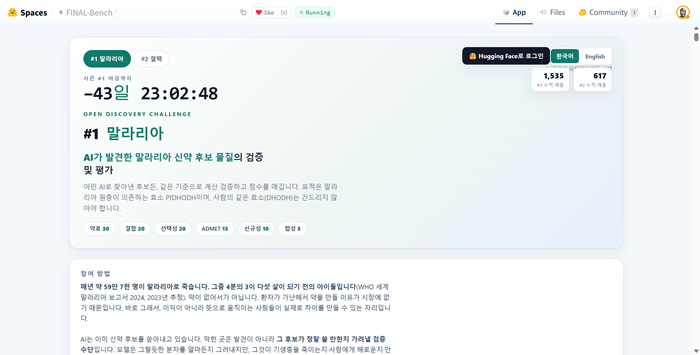
Artificial intelligence (AI)-based scientific research company VIDRAFT has launched an open new drug candidate discovery project, the “Open Discovery Challenge,” which has drawn attention by collecting more than 2,000 participation data entries within three days of being released on global AI platform Hugging Face.
This project differs from existing AI evaluation methods that focus on solving predefined test questions. It is a participatory task in which participants use their preferred AI models, such as OpenAI, Claude, and DeepSeek, to directly propose new molecular structures. The submitted data are evaluated with a score based on a comprehensive preclinical simulation across items including efficacy potential, toxicity, and absorption, distribution, metabolism, and excretion (ADME) indicators.
Analysis of the initial data showed notable differences depending on which AI model participants used. In the malaria research field, participants using Claude-based AI models recorded a median score of 43.7 points, higher than the 31.7 points for those using OpenAI-based models. A similar pattern was observed in the tuberculosis field, where Claude-based models (39.9 points) outperformed OpenAI-based models (30.9 points).
Submissions using open-source AI such as DeepSeek and Qwen also delivered results comparable to commercial AI models, with a median score of 37.7 points. However, it is still difficult to draw definitive conclusions about the performance of some models that had relatively few submissions, and results may change as more data accumulate.
The most notable finding is that even when the same AI model was used, scores for submitted entries ranged widely from the 1-point range to the 78-point range. This indicates that performance depends less on which AI model is selected and more on what prompts researchers give to the AI and what analytical tools they combine it with.
The ongoing Season 1 (malaria) and Season 2 (tuberculosis) address representative neglected diseases. The initiative aims to apply AI and open science to areas where research and development by private companies have been insufficient due to low profitability. It effectively opens a path for individual researchers without large research facilities or budgets to contribute to new drug discovery, provided they have access to AI.
Kim Min-sik, CEO of VIDRAFT, stated, “The real competition in AI lies not in solving problems but in discovering truly useful molecular structures and scientific answers,” adding, “VIDRAFT plans to develop the Open Discovery Challenge into a global open science platform where researchers worldwide can participate in discovering new drugs needed by humanity.”
Choi Yong-seok
AI-translated with ChatGPT. Provided as is; original Korean text prevails.
ⓒ dongA.com. All rights reserved. Reproduction, redistribution, or use for AI training prohibited.