World Robot Conference opens in Beijing Korean firms including ROBOTIS and Neubility join “China excels in physical prowess… but Korea leads in brainpower”
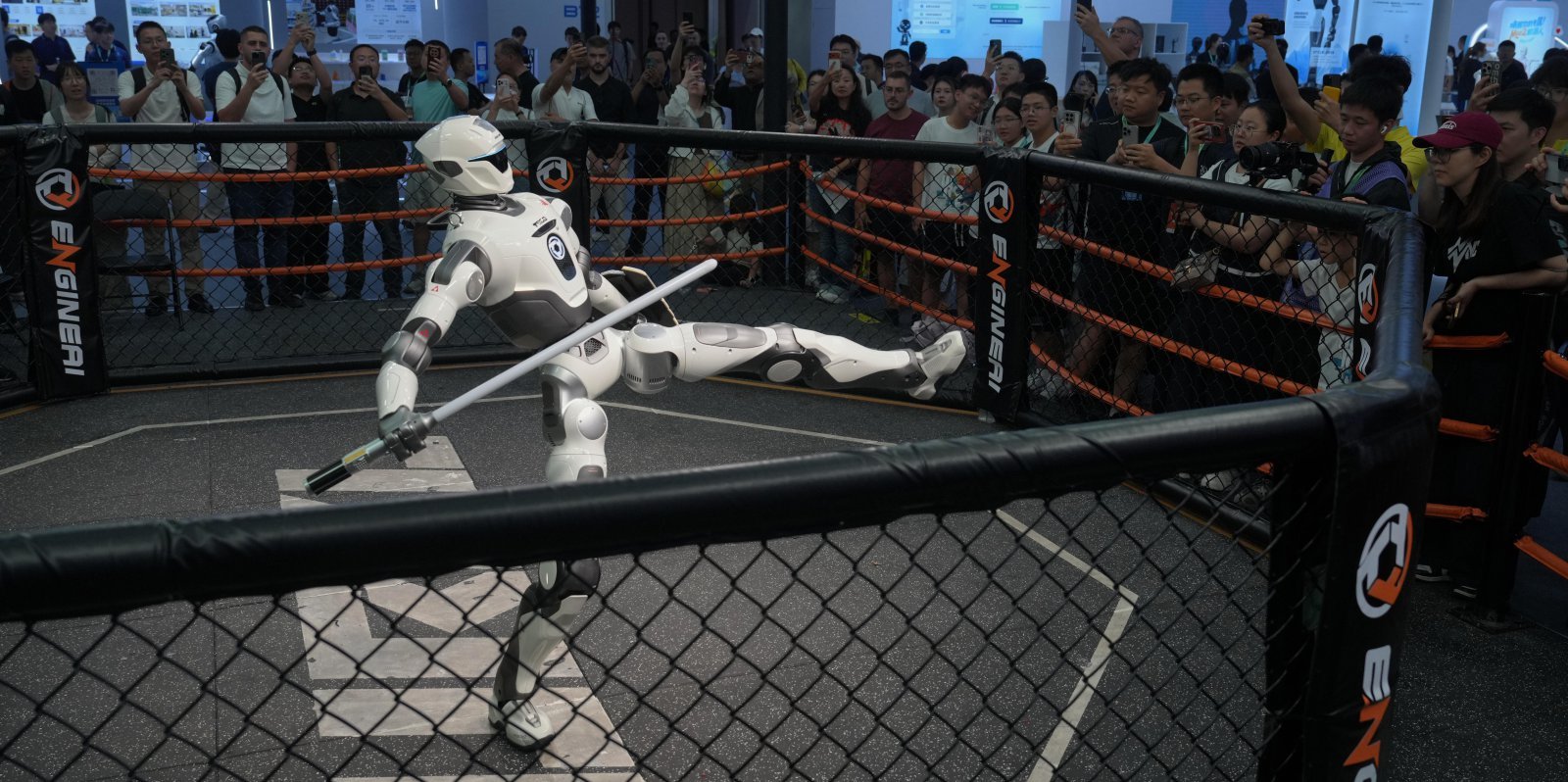
World’s largest robot event… 2,000 products from 300 companies participate The World Robot Conference (WRC), held at the Beijing Yizhuang International Conference and Exhibition Center in China from the 19th to the 23rd, is regarded as the world’s largest robot event. Now in its 8th year, this year’s conference features 2,000 products from 300 companies, including security guard robots and autonomous driving robots. Korea and Singapore are the only countries that have separate national pavilions. The photo shows a humanoid robot demonstration held at the WRC the previous day. Beijing = AP Newsis
“The growth of China’s robot industry should be viewed as an opportunity. If Chinese companies have strong hardware capabilities, such as the robot ‘body,’ Korean companies have competitiveness in technologies that serve as the robot’s ‘brain.’”
At the Korea-China Robot Innovation Cooperation Forum held in Beijing, China on the 20th, Ryu Joong-hee, CEO of physical artificial intelligence (AI) company Realworld, stated that China’s rise in the robot industry should not be feared, but leveraged as a partnership opportunity.
As Chinese robot companies such as Unitree (Yushu Technology·宇樹科技) attract attention at the WRC, the world’s largest robot event, Korean companies are also moving to enter the Chinese market.
At this year’s WRC, Korean robot specialist company Robotis set up an independent exhibition booth. Robotis showcased complete humanoid robots, including actuators that function as robot joints. In the Korea Pavilion next to Robotis, six Korean robot-related companies, including AI-based autonomous driving robot company Neubility, participated. Korea and Singapore are the only countries that set up separate national pavilions at this year’s WRC. Korean companies participating in the WRC expressed confidence despite China’s rapid rise in the robot sector. CEO Ryu said, “Chinese robots have strengths in hardware and mass production, but they are not significantly ahead in a robot’s ability to think for itself.” Biometric-mimicking AI company AIDOR also joined the event to seek collaboration with Chinese finished robot manufacturers. Kim Jae-pil, CEO of AIDOR, explained, “Korean companies are ahead of China in technologies that enable robots to quickly perceive and respond to events (movements) occurring right before their eyes.” Other participating companies, such as Wonik Robotics, which specializes in robot hands, focused on supply chain cooperation with Chinese companies that manufacture high cost-performance parts.
In the afternoon, many Chinese robot companies and investors, including humanoid robot company Noetics, took part in a business consultation session for 12 Korean robot companies organized by the Korea Trade-Investment Promotion Agency (KOTRA).
Kim Cheol-jung
AI-translated with ChatGPT. Provided as is; original Korean text prevails.
ⓒ dongA.com. All rights reserved. Reproduction, redistribution, or use for AI training prohibited.